Quad Muscles: Anatomy, Function & Care Guide
Complete guide to quadriceps muscles: anatomy, function, and keeping them healthy.
Understanding Quad Muscles: A Comprehensive Anatomy and Function Guide
The quadricep muscles, also known as the quadriceps femoris or simply quads, are among the most important muscle groups in the human body. Located at the front of your thighs, these powerful muscles are responsible for many of the movements we perform daily, from walking and running to sitting down and standing up. The name “quadricep” derives from Latin, meaning “four-headed,” though recent anatomical discoveries have revealed that these muscles are actually composed of five distinct parts working together as a unified system.
What Are the Quad Muscles?
The quad muscles are a group of large, powerful muscles that form the front portion of your thigh. They are joined together to form the patella tendon, which connects your kneecap (patella) to the femur, the strongest bone in your body. Your quadricep muscles work in coordination with your hamstring muscles, which are located at the back of your thigh, to create smooth, controlled leg movements.
When you move your leg, your quadriceps contract while your hamstrings relax, and this coordinated action prevents muscle strains and more serious injuries. This complementary relationship between opposing muscle groups is essential for maintaining proper biomechanics during physical activity and everyday movement. Beyond their role in basic locomotion, your quad muscles also enable you to perform more dynamic movements such as kicking and jumping.
Location and Anatomy of Quad Muscles
Quad muscles are located at the front of your thighs, positioned between your knees and hips. These muscles contain more mass than any other muscle group in your body, reflecting their importance and the significant workload they bear during daily activities. The quad tendons attach these muscles to several key skeletal structures, including your hip bones, pelvis, kneecap, and femur.
The muscle fibers that compose the quadriceps are tiny and elastic, allowing them to contract and tighten effectively. These fibers are both red and white in color, giving the quad muscles their characteristic striped appearance. This composition is what allows them to produce both powerful contractions for explosive movements and sustained contractions for endurance activities.
The Five Components of Quad Muscles
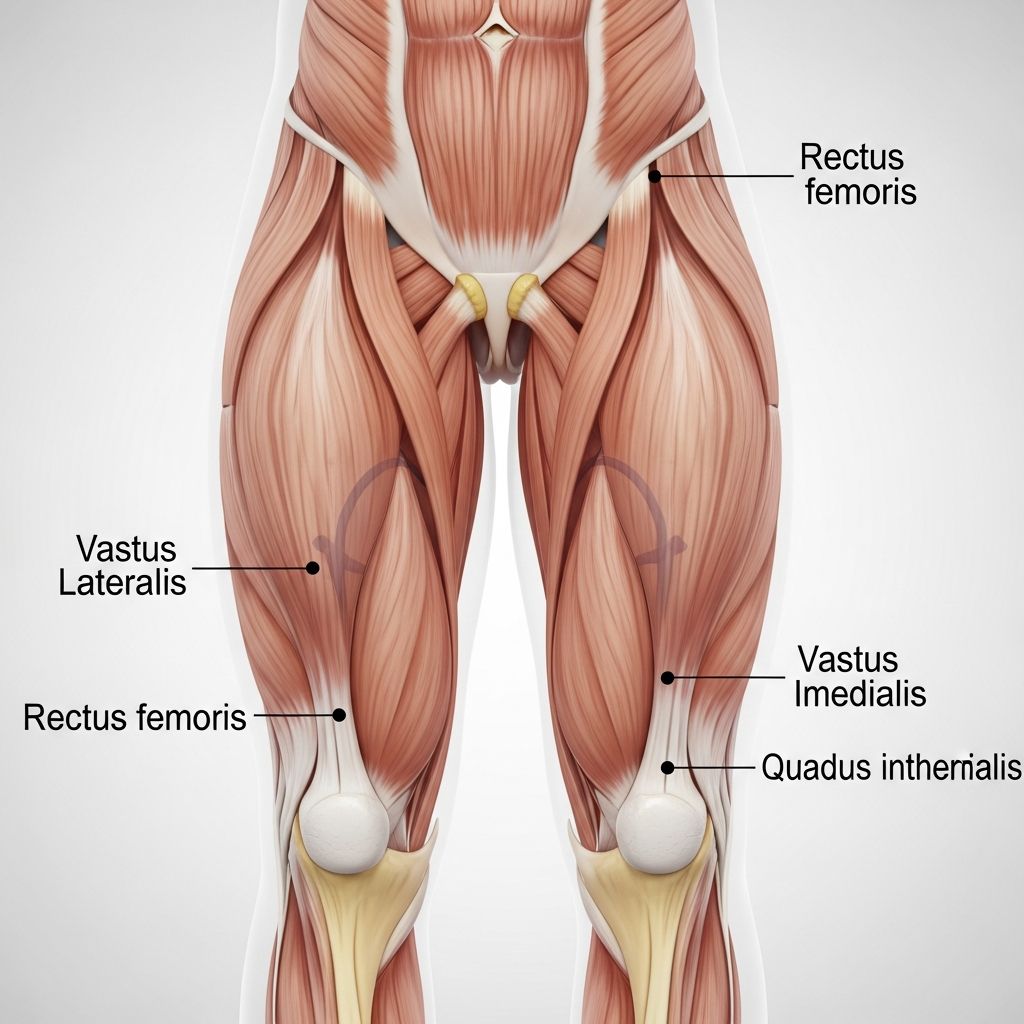
While traditionally described as having four heads, modern anatomical research has identified five distinct muscles within the quadriceps group. Each of these muscles has specific attachment points and functions, and all converge into a single tendon that attaches to the kneecap.
Rectus Femoris
The rectus femoris is the most superficial of the quad muscles, occupying the middle of the thigh and covering most of the other three quadriceps muscles. This muscle originates at your pelvis and stretches downward to your kneecap. It is unique among the quad muscles because it consists of two heads and is the only quad muscle that extends from both the hip joint and the knee joint. Because of this dual attachment, the rectus femoris not only extends the knee but also flexes the hip, making it essential for movements like lifting your knee toward your chest.
Related Stories



Vastus Lateralis
The vastus lateralis is located on the outer side of your thigh and connects the thigh bone to the kneecap. This muscle is recognized as the largest and strongest of all the quadricep muscles, and it extends along the lateral (outer) surface of the femur. The vastus lateralis is the most visible quad muscle and is often the focus of leg strength training exercises. Its substantial size reflects the significant workload it carries during weight-bearing activities and powerful leg movements.
Vastus Medialis
The vastus medialis is positioned on the inner side of your thigh and, like the vastus lateralis, connects the thigh bone to the kneecap. However, instead of running along the outside of your thigh, the vastus medialis extends along the medial (inner) surface of the femur. This muscle is the smallest of the quadricep muscles, yet it plays a crucial role in stabilizing the knee joint and patella, particularly during walking and other weight-bearing activities. The vastus medialis is especially important for maintaining proper knee alignment and preventing lateral tracking of the kneecap.
Vastus Intermedius
The vastus intermedius is located beneath the rectus femoris and lies in the middle portion of the thigh, between the vastus lateralis and vastus medialis. Because of its deep position beneath the rectus femoris, the vastus intermedius cannot be seen without careful dissection of the overlying muscle. Despite its hidden location, this muscle is primarily responsible for extending the knee and contributes significantly to the overall power and stability of the knee joint.
Tensor Vastus Intermedius
The tensor vastus intermedius (also called tensor of the vastus intermedius) is a recently discovered component of the quad muscle structure. This muscle is located between the vastus lateralis and the vastus intermedius and runs at a slanted angle through the thigh. While anatomical studies have confirmed its presence and noted that it has its own independent nerve supply, its specific role and functions are still being researched by anatomists and sports medicine professionals. Its variable presentation among individuals suggests that its functional significance may differ from person to person.
Primary Functions of Quad Muscles
The quadriceps femoris muscle group serves several essential functions that are critical to your overall mobility, stability, and quality of life. Understanding these functions helps illustrate why maintaining strong and flexible quad muscles is so important.
Knee Extension and Leg Lifting
The primary responsibility of your quadricep muscles is to extend your knee, allowing you to straighten your leg. This function is essential for fundamental activities such as walking, running, jumping, and climbing stairs. The quads are the only muscles capable of fully extending the knee joint, making them irreplaceable in lower body function.
Impact Absorption
When you walk, run, or jump, your heels strike the ground with considerable force. Your quad muscles work to absorb this impact through controlled lengthening (eccentric contraction), protecting your knees, hips, and spine from injury. This shock-absorbing function is particularly important during high-impact activities and becomes even more crucial as we age.
Balance and Posture Maintenance
Strong quadriceps are essential for maintaining proper balance and upright posture throughout the day. They help stabilize your entire lower body and work with other muscle groups to keep your body aligned and centered over your base of support. Weak quad muscles can lead to poor posture, increased fall risk, and compensatory strain on other joints.
Kneecap Stability and Movement
The quad muscles, particularly the vastus medialis, play a crucial role in moving and providing stability to the kneecap. Proper tracking of the kneecap within its groove on the femur is essential for painless knee function. When quad muscles are weak or imbalanced, the kneecap can track improperly, leading to patellofemoral pain and other knee problems.
Walking Pattern Regulation
Your quad muscles help regulate the way you walk, working in coordination with other lower body muscles to create smooth, efficient gait patterns. They control the speed and smoothness of leg movements, allowing you to walk with appropriate cadence and stride length.
Common Quad Muscle Injuries and Conditions
Because of their central role in movement and the significant forces they bear, quad muscles are susceptible to various injuries and conditions. Understanding these common problems can help you recognize warning signs and seek appropriate treatment.
Quad Muscle Strains
Muscle strains occur when muscle fibers are stretched beyond their normal range or partially torn. Quad strains are graded by severity:
Grade 1 Strain: This mild strain involves minimal fiber damage. You may experience slight pain and tenderness in your quad muscles, but your leg will generally retain normal strength and function.
Grade 2 Strain: This moderate strain involves partial tearing of muscle fibers. The pain is more significant than a grade 1 strain, and you may notice your muscles feel weaker than usual. Your leg may have difficulty supporting weight, and swelling may be present.
Grade 3 Strain: During a grade 3 strain, the quad tendon fully ruptures, causing the quadricep muscle to tear completely away from the kneecap or tendon. This severe injury prevents you from using your leg due to intense pain and significant swelling. Grade 3 strains require immediate medical attention and often necessitate surgical repair.
Other Quad-Related Injuries
Myositis Ossificans: This condition involves abnormal bone tissue forming inside a muscle, typically as a result of trauma or prolonged irritation. The quadriceps is the most common site where this condition develops.
Lacerations: These injuries often result from falls, vehicular accidents, or sports-related trauma. A laceration breaks the skin on your thigh, potentially damaging your quadricep muscles or tendons. These open wounds require immediate medical evaluation and treatment to prevent infection and ensure proper healing.
Tendonitis: This condition results when the tendons connecting your quad muscles to your kneecap become inflamed, causing thigh pain. Muscle irritation often occurs when additional pressure is placed on the tendons, and the condition can reduce the mobility of your thigh, knee, and hip joints.
Maintaining Healthy Quad Muscles
To maintain strong, healthy quad muscles and prevent injury, it is essential to provide them with sufficient stretching and exercise. Regular physical activity that targets the quad muscles helps maintain their strength, flexibility, and resilience.
Importance of Quad Strength
When you don’t have good strength in your quadricep muscles, the knee can become unstable, leading to serious injuries such as meniscus tears or ACL (anterior cruciate ligament) injuries. Strong quad muscles play a large role in preventing falls and maintaining balance and control throughout your daily activities. This is particularly important as you age, when falls become more common and more serious.
Exercise and Training
The best exercises for your quads include squats, forward lunges, and leg lifts. These exercises can be performed at home without equipment or at a gym with weights and machines. Leg press exercises and leg extensions are also effective for building quad strength. Incorporating quad exercises into your regular fitness routine helps build strength and stability while preventing injuries.
Frequently Asked Questions About Quad Muscles
Q: Why are the quad muscles so important?
A: The quad muscles are critical because they are the sole extensors of the knee joint, enabling all weight-bearing activities including walking, running, jumping, and standing. They also absorb impact, maintain balance, stabilize the kneecap, and regulate walking patterns. Strong quads prevent knee injuries and maintain overall mobility and quality of life.
Q: How many muscles are actually in the quadriceps?
A: While traditionally described as having four muscles, modern anatomy has identified five distinct muscles within the quadriceps group: the rectus femoris, vastus lateralis, vastus medialis, vastus intermedius, and the tensor vastus intermedius, which was recently recognized as a separate muscle with its own nerve supply.
Q: What is the relationship between the quadriceps and hamstrings?
A: The quadriceps and hamstrings work as opposing muscle groups. When the quadriceps contract to extend the leg, the hamstrings relax, and vice versa. This coordinated action prevents muscle strains and injuries, and is essential for smooth, controlled leg movements.
Q: How can I tell if my quad muscles are weak?
A: Signs of weak quad muscles include difficulty standing up from a chair, trouble climbing stairs, feeling unstable during walking, increased fall risk, and pain or instability in the knee. If you experience any of these symptoms, consider consulting with a healthcare provider or physical therapist.
Q: What exercises are best for strengthening my quad muscles?
A: The most effective quad exercises include squats, lunges, leg presses, leg extensions, and leg lifts. These exercises can be modified based on your fitness level and any existing injuries. Consistency is key—incorporating these exercises into your routine 2-3 times per week can significantly improve quad strength and function.
Q: How can I prevent quad muscle injuries?
A: To prevent quad injuries, maintain consistent strength and flexibility through regular exercise and stretching. Warm up properly before physical activity, gradually increase the intensity of your workouts, and use proper technique during exercise. Stay hydrated and allow adequate recovery time between intense workouts.
References
- Quad Muscles: What To Know — WebMD. 2024. https://www.webmd.com/fitness-exercise/quad-muscles-what-to-know
- Quadriceps Muscle: Anatomy and Function — Cleveland Clinic. 2024. https://my.clevelandclinic.org/health/body/22816-quad-muscles
- Thigh Muscles: What Are They, Anatomy & Function — Cleveland Clinic. 2024. https://my.clevelandclinic.org/health/body/21936-thigh-muscles
- 9 Quad Exercises to Amp Up Your Leg Day — Cleveland Clinic Health. 2024. https://health.clevelandclinic.org/quad-exercises
Similar Articles








Read full bio of Sneha Tete