Reactive Perforating Collagenosis: Causes, Symptoms, and Treatment
Understanding reactive perforating collagenosis: causes, clinical features, diagnosis, and effective management strategies.
Understanding Reactive Perforating Collagenosis
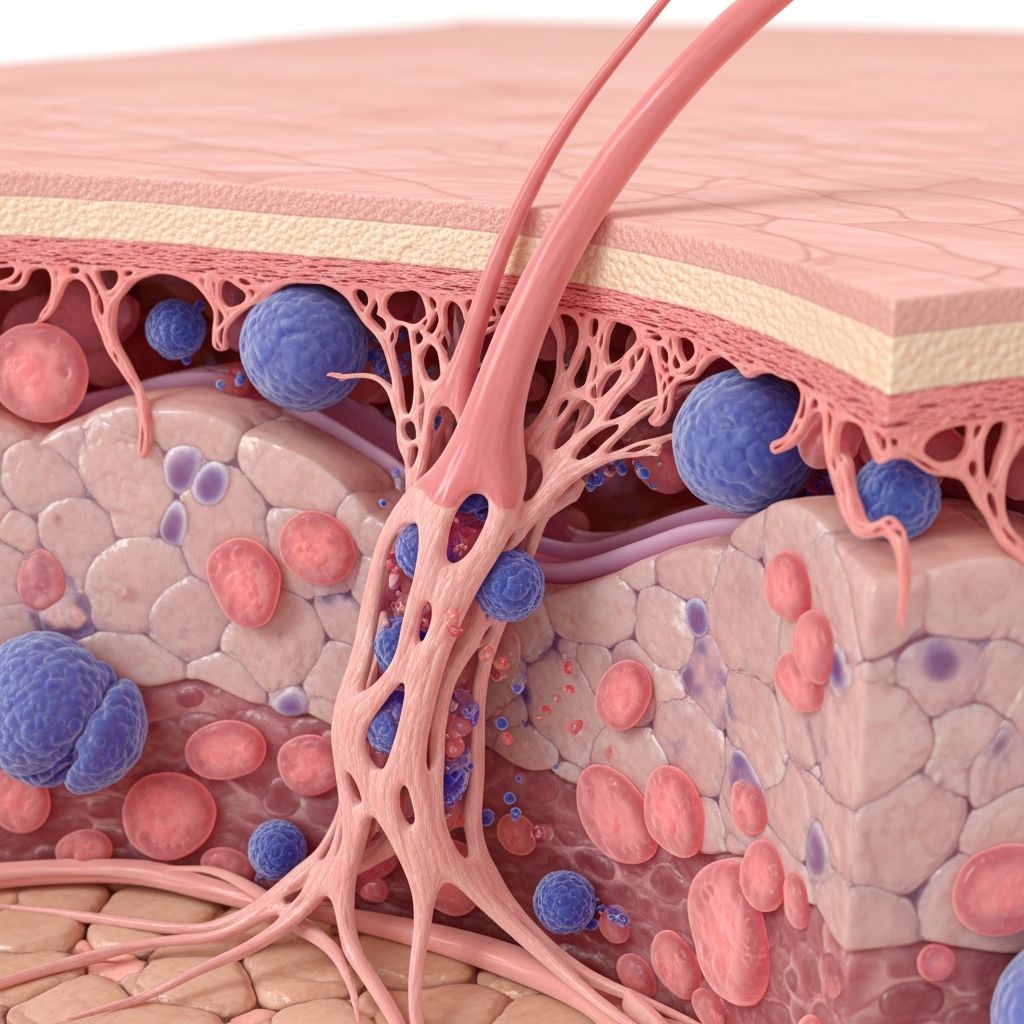
Reactive perforating collagenosis (RPC) is the most common type of primary perforating dermatosis, a rare skin condition characterized by the transepithelial elimination of collagen from the dermis through the epidermis to the skin surface. This chronic disorder presents as umbilicated papular lesions with adherent keratotic plugs and crusts that appear predominantly on the extensor surfaces of the extremities and trunk. Understanding this condition is essential for both healthcare providers and patients affected by this distressing dermatological disorder.
Demographics and Epidemiology
Reactive perforating collagenosis can be classified into two main forms: the familial (inherited) form and the acquired form. The condition appears in two distinct presentations based on genetic and environmental factors. The familial form typically affects younger individuals and tends to be lifelong, with lesions becoming larger and more numerous with age. The acquired form, also known as acquired perforating dermatosis (APD), predominantly affects patients in their 40s and 50s, with a strong association to underlying systemic diseases.
While epidemiologic studies remain limited, seven retrospective case series studies have summarized approximately 282 cases of acquired perforating dermatosis. The condition shows no significant gender predilection and can affect individuals across various ethnic backgrounds, though presentation may vary in skin of color, often with associated hyperpigmentation.
Pathogenesis and Causes
The exact pathogenesis of reactive perforating collagenosis remains unclear, though several theories have been proposed based on clinical observations and research findings.
Inherited Form
The familial form appears to result from a genetic abnormality in collagen that causes focal damage and subsequent extrusion through the epidermis. Cold weather and skin trauma typically trigger or aggravate the skin lesions in genetically predisposed individuals. The Koebner phenomenon—the development of new lesions at sites of skin trauma—is regularly observed in both familial and acquired forms of the disease.
Acquired Form
The acquired form of reactive perforating collagenosis is frequently associated with underlying systemic diseases. Diabetes mellitus and chronic kidney disease represent the most common comorbidities, though other conditions including cardiovascular disease, infection (HIV, hepatitis, tuberculosis), rheumatic disease, pulmonary disease, malignancy, and hypothyroidism may contribute to disease development.
Several mechanisms have been proposed for the acquired form. Microvascular insufficiency and elevated fibronectin levels in plasma, as seen with diabetes and renal failure, may play a significant role. Another theory suggests that microdeposition of substances and abnormal glycosylation of collagen I and III in diabetes alter collagen fibers, making them more susceptible to elimination. Diabetic microangiopathy may promote local hypoxia and necrosis, contributing to lesion formation.
Additional pathogenic factors include microtrauma caused by scratching prompted by pruritus, overloading of urinary metabolites due to renal insufficiency, and the presence of chronic pruritus associated with systemic diseases. Superficial trauma and cold exposure lead to necrobiosis and epidermal thinning in susceptible patients, creating conditions favorable for collagen extrusion.
Clinical Features and Presentation
Reactive perforating collagenosis presents with characteristic clinical features that aid in diagnosis. The condition manifests as multiple, nonfused, umbilicated hyperkeratotic papules and nodules with a central round crusted ulcer surrounded by a reddish-brown raised border. Individual lesions typically measure several millimeters in diameter and display a distinctive crater-like or cup-shaped appearance.
Related Stories



The primary symptom reported by patients is pruritus, which varies in intensity and may be accompanied by pain in some cases. The itching often triggers scratching behavior, perpetuating the cycle of lesion formation through the Koebner phenomenon. Lesions develop over weeks and typically involute spontaneously within six to eight weeks; however, new lesions frequently appear as older ones are healing.
Distribution patterns favor the extensor surfaces of the extremities, including the elbows, knees, hands, and lower legs, as well as the trunk. While the condition remains confined to the skin and does not affect internal organs, the chronic nature and recurrent lesions significantly impact patients’ quality of life.
Presentation in Different Skin Types
Reactive perforating collagenosis in individuals with skin of color is often associated with hyperpigmentation at lesion sites and surrounding areas. This post-inflammatory hyperpigmentation may persist longer than in lighter-skinned individuals and requires specific consideration during treatment planning.
Dermoscopy Features
Dermoscopic examination provides characteristic and consistent findings that support clinical diagnosis. The dermoscopy features include the distinctive crater-like or cup-shaped lesions with central necrotic debris, surrounded by erythema and a hyperkeratotic rim. These features are highly specific for reactive perforating collagenosis and can differentiate it from other papular dermatoses when clinical features alone are insufficient.
Complications
While reactive perforating collagenosis remains a dermatological condition confined to the skin, several complications may arise from the chronic pruritic nature and repeated lesion formation. Secondary bacterial infection is a potential risk, particularly when lesions are manipulated or scratched. Hyperpigmentation and hypopigmentation may persist at lesion sites, especially in individuals with darker skin tones. Chronic pruritus significantly impacts psychological well-being and quality of life, potentially leading to sleep disturbances and anxiety.
Diagnosis
Reactive perforating collagenosis can usually be diagnosed based on its distinct clinical features and associated systemic conditions. The characteristic presentation of umbilicated papulonodular lesions with central crusted ulcers, combined with a history of pruritus and trauma-induced lesion formation, strongly suggests the diagnosis.
Diagnostic Confirmation
Dermoscopy provides confirmatory evidence through characteristic features consistent with reactive perforating collagenosis. When clinical presentation is atypical or diagnosis remains uncertain, skin biopsy becomes essential. Multiple skin biopsies examined with multiple histological levels may be required to identify the diagnostic histopathology. The histologic pattern is distinct and characterized by cup-shaped invagination of the epidermis plugged with necrotic inflammatory debris and transepidermal elimination of dermal collagen.
Differential Diagnoses
Several other conditions must be excluded before confirming a diagnosis of reactive perforating collagenosis. The differential diagnosis includes insect bites, atopic dermatitis, lichen planus, and other papular dermatoses. Careful attention to the distinctive crater-like structure of RPC lesions helps differentiate this condition from these mimics. Histological evidence of transepidermal elimination confirms the diagnosis when clinical features are equivocal.
Treatment Approaches
The main objective of treatment for reactive perforating collagenosis is to reduce itch and minimize skin trauma, thereby interrupting the cycle of lesion formation and recurrence.
First-Line Therapies
Initial treatment approaches include:
- Antihistamines: Oral antihistamines such as loratadine effectively reduce pruritus and scratching behavior, addressing a primary symptom and pathogenic factor.
- Topical emollients: Regular use of moisturizing agents maintains skin barrier function and reduces irritation.
- Topical corticosteroids: Mid-to-high potency topical corticosteroids applied to affected areas reduce inflammation and pruritus.
- Keratolytics: Agents like salicylic acid or urea help soften hyperkeratotic material and may facilitate lesion resolution.
Second-Line Therapies
When first-line treatments prove inadequate, additional options include:
- Intralesional corticosteroid injections for localized lesions
- Topical tretinoin, tazarotene, and imiquimod for resistant lesions
- Narrow-band ultraviolet B light therapy and psoralen plus ultraviolet A (PUVA) light therapy
Systemic Therapies
For more severe or extensive disease, systemic medications may be considered:
- Systemic retinoids (acitretin, isotretinoin)
- Allopurinol, which may reduce lesion formation
- Doxycycline for its anti-inflammatory properties
- Systemic corticosteroids in severe cases
- Dupilumab and nemolizumab, newer biologic agents targeting specific inflammatory pathways
Management of Underlying Conditions
Treatment of underlying systemic diseases is crucial in the acquired form. Optimizing diabetes control and managing chronic kidney disease may significantly improve reactive perforating collagenosis. When the condition is associated with other comorbidities, comprehensive medical management addressing these underlying conditions often improves skin lesions.
Prognosis and Outcome
The long-term outlook for reactive perforating collagenosis differs between the familial and acquired forms. Familial reactive perforating collagenosis is a lifelong condition, with lesions typically becoming larger and more numerous with advancing age. However, individual lesions in both forms are self-healing, though they often recur at new sites or as previously healed lesions return.
In the acquired form, the prognosis may improve with effective management of underlying systemic diseases. Patients with well-controlled diabetes or renal function may experience fewer lesions and longer periods of remission. Consistent adherence to treatment protocols, skin care practices, and avoidance of trauma significantly influence disease course.
Prevention and Management Strategies
While reactive perforating collagenosis cannot be prevented entirely, especially in genetically predisposed individuals, several strategies minimize lesion formation:
- Avoid scratching through effective pruritus management with antihistamines
- Protect skin from trauma and cold exposure
- Maintain meticulous skin care with gentle cleansing and consistent moisturization
- Optimize control of underlying systemic diseases, particularly diabetes and chronic kidney disease
- Wear protective clothing over affected areas when possible
- Seek prompt dermatological evaluation for new or worsening lesions
Frequently Asked Questions
Q: Is reactive perforating collagenosis contagious?
A: No, reactive perforating collagenosis is not contagious. It is a non-infectious dermatological condition resulting from genetic factors or underlying systemic diseases.
Q: Can reactive perforating collagenosis affect internal organs?
A: No, reactive perforating collagenosis remains confined to the skin and does not affect internal organs, though associated systemic diseases may require separate medical management.
Q: How long do individual lesions last?
A: Individual lesions typically involute spontaneously within six to eight weeks; however, new lesions frequently develop as older ones heal, creating a chronic pattern of recurrence.
Q: Is reactive perforating collagenosis hereditary?
A: The familial form is genetic and can run in families, appearing in siblings. The acquired form is associated with underlying systemic diseases and is not directly inherited.
Q: What role does scratching play in disease progression?
A: Scratching perpetuates the Koebner phenomenon, triggering new lesion formation. Controlling pruritus through antihistamines and avoiding trauma are essential management components.
Q: Can reactive perforating collagenosis be cured?
A: While the condition cannot be cured, especially in the familial form, symptoms can be effectively managed through appropriate treatment strategies, and lesions may resolve with proper therapy.
References
- Reactive Perforating Collagenosis — DermNet NZ. 2021-09-01. https://dermnetnz.org/topics/reactive-perforating-collagenosis
- Reactive Perforating Collagenosis — JAMA Dermatology. 2025. https://jamanetwork.com/journals/jamadermatology/fullarticle/531869
- Acquired Reactive Perforating Collagenosis in a Patient with Diabetes — Cleveland Clinic Journal of Medicine. 2023. https://www.ccjm.org/content/91/4/213
- Familial Reactive Perforating Collagenosis — Genetic and Rare Diseases Information Center (GARD), National Institutes of Health. 2025. https://rarediseases.info.nih.gov/diseases/13331/familial-reactive-perforating-collagenosis
Similar Articles








Read full bio of medha deb