Reactive Perforating Collagenosis Pathology
Understanding the histopathological features and microscopic findings in reactive perforating collagenosis.
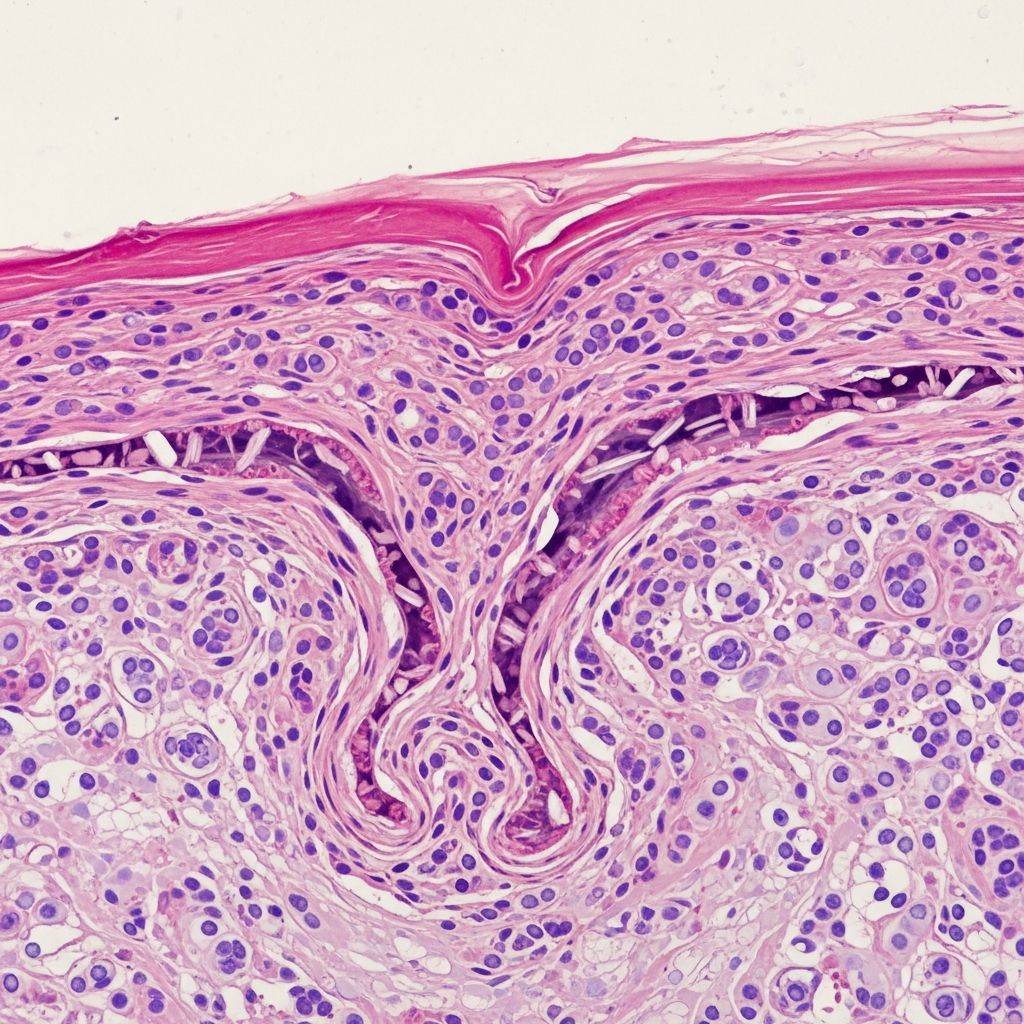
Understanding Reactive Perforating Collagenosis Pathology
Reactive perforating collagenosis (RPC) is a distinctive dermatological condition characterized by the transepithelial elimination of dermal collagen through the epidermis to the skin surface. The pathological examination of this condition reveals specific histological features that are essential for accurate diagnosis and understanding of the disease mechanism. This comprehensive guide explores the microscopic findings, histological characteristics, and diagnostic criteria necessary for identifying reactive perforating collagenosis in clinical practice.
Histological Features and Microscopic Findings
The histopathological examination of reactive perforating collagenosis reveals several distinctive features that differentiate it from other perforating dermatoses. The most characteristic finding is the presence of vertically oriented collagen fibers that traverse the epidermis in a perpendicular manner, creating a distinctive pattern visible under microscopy. These collagen fibers appear to be extruded through the epidermis toward the skin surface in a process known as transepidermal elimination.
One of the hallmark pathological features is the presence of keratotic plugs at the epidermis, which represent areas of concentrated keratin material mixed with fragmented collagen fibers. These plugs are often surrounded by inflammatory infiltrates, primarily composed of neutrophils and lymphocytes. The inflammatory response appears to be a reaction to the foreign material being eliminated through the epidermis.
The epidermis typically shows thinning and possible ulceration overlying the area of collagen extrusion. In many cases, there is a central depression or umbilication at the site of perforation, which corresponds to the clinical appearance of umbilicated papules. The dermal-epidermal junction often demonstrates focal disruption where the collagen fibers breach the basement membrane zone.
Collagen Degeneration and Morphological Changes
Examination of the dermal collagen in reactive perforating collagenosis reveals significant morphological alterations. The collagen fibers undergoing elimination often appear degenerated, basophilic, and fragmented rather than displaying the normal organized fibrillar structure. This degeneration suggests that the collagen has undergone pathological modification before being eliminated.
The involved collagen demonstrates several characteristic changes:
- Loss of normal collagen fiber organization and architecture
- Increased basophilia due to altered protein composition
- Fragmentation and breakdown of individual collagen bundles
- Abnormal tinctorial properties when stained with routine histological dyes
- Evidence of necrobiosis (tissue death) in surrounding dermal elements
Special stains such as Masson’s trichrome stain and Verhoeff-Van Gieson stain can highlight the abnormal collagen and elastic tissue distribution. Collagen appears concentrated in the vertical tracts, with a distinctive pattern that contrasts sharply with the surrounding dermis. Elastic fibers may also be involved in the elimination process, appearing fragmented and disorganized within the perforation tracts.
Inflammatory Infiltrate Characteristics
The inflammatory response in reactive perforating collagenosis pathology is a crucial diagnostic feature. The primary inflammatory component consists of neutrophilic infiltration around the areas of collagen extrusion. These neutrophils appear to be responding to the presence of altered collagen and other dermal elements being eliminated through the epidermis.
Beyond neutrophils, the inflammatory infiltrate includes:
- Lymphocytes (T cells and B cells) surrounding the perforation sites
- Histiocytes and macrophages phagocytosing collagen fragments
- Occasional eosinophils in some cases
- Endothelial changes with evidence of vasculitis in some specimens
In acquired forms of reactive perforating collagenosis, particularly those associated with systemic conditions, the inflammatory infiltrate may be more pronounced. Vasculitis affecting small and medium-sized vessels has been documented in some cases, suggesting that microvascular dysfunction plays a role in the pathogenesis.
Related Stories



Necrobiosis and Epidermal Changes
Necrobiosis, the death of tissue, represents a significant pathological feature of reactive perforating collagenosis. This process appears to be triggered by superficial trauma, such as scratching, particularly in susceptible individuals. The necrobiosis leads to epidermal thinning and eventual perforation through which the altered collagen can be eliminated.
The epidermal changes include:
- Focal areas of epidermal necrosis and apoptosis
- Thinning of the epidermis overlying the perforation
- Disruption of the basal layer and basement membrane zone
- Possible ulceration in more advanced lesions
- Regenerative changes at the margins of the perforation
In some cases, the epidermis may demonstrate hyperkeratosis surrounding the central perforation site. This pattern reflects the skin’s attempt to repair and contain the area of collagen elimination. The appearance of keratotic material within the perforation tract represents the body’s natural response to seal the defect.
Basement Membrane Zone Alterations
The basement membrane zone (BMZ), which normally serves as a barrier between the epidermis and dermis, shows characteristic alterations in reactive perforating collagenosis. At the site of perforation, the basement membrane demonstrates focal discontinuity, allowing passage of the vertically oriented collagen fibers. The integrity of the BMZ is compromised, but this disruption appears to be localized to the area directly overlying the collagen extrusion.
Immunofluorescence studies of the basement membrane zone may reveal:
- Normal linear deposition of basement membrane proteins along uninvolved areas
- Focal gaps or interruptions at perforation sites
- Possible alterations in type IV collagen distribution
- Changes in laminin and other BMZ-associated proteins
The preservation of relatively normal basement membrane structure in surrounding areas suggests that the pathological process is localized and not a generalized basement membrane disorder.
Diagnostic Biopsy Techniques and Multiple Levels
Due to the focal nature of the pathological changes in reactive perforating collagenosis, proper biopsy technique is crucial for establishing a diagnosis. Multiple skin biopsies examined at multiple levels may be required to demonstrate the diagnostic histology. The characteristic vertical orientation of collagen fibers may not be evident in all sections of a single biopsy specimen.
Recommended biopsy approaches include:
- Excisional biopsy of a representative lesion in early stages
- Punch biopsies from multiple lesions if available
- Serial sectioning of the specimen at multiple levels through the perforation
- Examination of both the center and margins of the lesion
- Consideration of special stains if diagnosis remains uncertain
The optimal tissue section typically captures the central perforation site showing the vertically oriented collagen fibers traversing the epidermis. Sections taken at different depths may reveal different aspects of the pathological process, from the dermal collagen degeneration to the epidermal changes and eventual surface elimination.
Variation in Pathological Features by Disease Form
Pathological findings may vary slightly between the familial inherited form and the acquired form of reactive perforating collagenosis. In the inherited form, the collagen changes may be more widespread throughout the dermis, reflecting a constitutional predisposition to abnormal collagen metabolism.
Key differences include:
- Inherited form: More extensive dermal involvement and larger areas of altered collagen
- Acquired form: More localized pathological changes concentrated at trauma sites
- Inherited form: Possible subtle abnormalities in collagen structure even in non-lesional skin
- Acquired form: Inflammation often more prominent due to associated systemic conditions
Associated Pathological Features in Systemic Disease
In acquired reactive perforating collagenosis associated with systemic conditions such as diabetes mellitus or chronic renal failure, additional pathological features may be observed. Microvascular changes, including endothelial damage and capillary abnormalities, have been documented in some specimens. These vascular alterations may impair tissue repair mechanisms and contribute to the development of reactive perforating collagenosis.
Pathological findings in acquired forms associated with systemic disease:
- Evidence of microangiopathy affecting dermal vessels
- Increased dermal mucin deposition in some cases
- Possible abnormal glycosylation patterns in collagen molecules
- Enhanced inflammatory response compared to inherited forms
- Greater degree of epidermal ulceration and tissue destruction
Differential Pathological Diagnosis
While reactive perforating collagenosis has distinctive pathological features, other perforating dermatoses must be considered in the differential diagnosis. The vertical orientation of collagen fibers is characteristic of RPC, but similar findings can be seen in other conditions. Careful examination of the clinical context, distribution of lesions, and associated features helps distinguish reactive perforating collagenosis from conditions such as perforating folliculitis, elastosis perforans serpiginosa, and other perforating dermatoses.
Distinguishing features include:
- RPC: Primarily collagen involvement with characteristic vertical orientation
- Perforating folliculitis: Follicular location with follicular contents
- Elastosis perforans serpiginosa: Elastic fiber predominance with serpiginous clinical pattern
- Kyrle disease: Keratin plug prominence without specific collagen changes
Immunohistochemical and Special Staining Studies
Special histological techniques can provide additional diagnostic information in cases of reactive perforating collagenosis. Immunohistochemical staining for collagen types I and III may reveal abnormal distribution patterns. Transforming growth factor beta (TGF-β) expression has been noted to be elevated in some cases, suggesting involvement of this important regulatory protein in the pathological process.
Useful special stains and techniques:
- Masson’s trichrome stain: Highlights collagen in blue-green color
- Verhoeff-Van Gieson stain: Demonstrates elastic fibers and collagen
- Collagen type-specific antibodies: Reveals distribution of types I and III collagen
- TGF-β immunostaining: Assesses growth factor involvement
- Electron microscopy: Reveals ultrastructural collagen abnormalities in selected cases
Clinical-Pathological Correlation
Effective diagnosis of reactive perforating collagenosis requires correlation between clinical presentation and pathological findings. The clinical appearance of umbilicated papules with keratotic plugs directly corresponds to the pathological findings of vertically oriented collagen fibers within keratotic material overlying areas of epidermal thinning.
The distribution of lesions in reactive perforating collagenosis typically affects extensor surfaces and areas prone to trauma, which aligns with the theory that superficial trauma triggers the perforation process. Lesions on the hands, elbows, knees, and shins reflect areas subject to repeated minor injury and friction.
Frequently Asked Questions
Q: What is the most characteristic histological finding in reactive perforating collagenosis?
A: The most characteristic finding is the presence of vertically oriented collagen fibers that traverse the epidermis in a perpendicular direction, appearing to be extruded from the dermis toward the skin surface.
Q: Why are multiple biopsies necessary to diagnose reactive perforating collagenosis?
A: The pathological changes are focal and localized to areas of active perforation. Multiple biopsies at different levels increase the likelihood of capturing a section showing the diagnostic vertical collagen orientation.
Q: How does the pathology differ between inherited and acquired forms?
A: The inherited form typically shows more extensive dermal collagen involvement, while the acquired form demonstrates more localized changes concentrated at trauma sites, often with more prominent inflammation.
Q: What role does necrobiosis play in reactive perforating collagenosis?
A: Necrobiosis represents tissue death triggered by superficial trauma, leading to epidermal thinning and perforation through which altered collagen can be eliminated to the skin surface.
Q: Can special stains help confirm the diagnosis of reactive perforating collagenosis?
A: Yes, special stains such as Masson’s trichrome and Verhoeff-Van Gieson stains can highlight the abnormal collagen and elastic fiber distribution, supporting the clinical diagnosis.
Q: What inflammatory cells are typically seen in reactive perforating collagenosis?
A: Neutrophils predominate in the inflammatory infiltrate, with supporting lymphocytes, histiocytes, and occasional eosinophils surrounding the areas of collagen extrusion.
References
- Reactive Perforating Collagenosis — DermNet New Zealand. 2021. https://dermnetnz.org/topics/reactive-perforating-collagenosis
- Acquired Reactive Perforating Collagenosis – A Rare Cutaneous Manifestation of Anti-MDA5 Dermatomyositis — Indian Journal of Dermatology. 2022. https://pmc.ncbi.nlm.nih.gov/articles/PMC9455137/
- Acquired Reactive Perforating Collagenosis: Current Status — Journal of Dermatology. 2010. https://onlinelibrary.wiley.com/doi/10.1111/j.1346-8138.2010.00918.x
- Reactive Perforating Collagenosis — British Journal of Dermatology. https://academic.oup.com/bjd/article-abstract/91/4/399/6663395
Similar Articles








Read full bio of Sneha Tete