Reed Naevus Dermoscopy: Clinical Features and Diagnosis
Understanding Reed naevus dermoscopic patterns for accurate clinical diagnosis and management.
Reed Naevus Dermoscopy: Understanding Clinical Features and Diagnostic Patterns
Reed naevus, also known as pigmented spindle cell naevus of Reed (PSCNOR), is a benign melanocytic skin lesion characterized by distinctive clinical and dermoscopic features. These lesions represent a type of Spitz naevus and are primarily found on the lower extremities in young adults, though they can appear in various body locations. Understanding the dermoscopic features of Reed naevi is essential for accurate diagnosis and differentiation from potentially malignant melanoma.
Clinical Presentation and Epidemiology
Reed naevi typically present as hyperpigmented, well-circumscribed dark brown or black patches or papules. These lesions most commonly appear during childhood and early adulthood as benign skin growths. The lesions are characterized by the presence of spindle-shaped melanocytes on histological examination, which distinguishes them from other melanocytic naevi. When Reed naevi develop in adulthood, further inquiry and possible excision biopsy may be warranted to exclude spindle cell melanoma.
The macroscopic appearance of a typical Reed naevus shows a single, well-circumscribed lesion with uniform dark brown coloration. These lesions are usually small to moderately sized, with some studies examining lesions smaller than 6 millimeters to better understand early growth phases.
Dermoscopic Patterns and Features
Dermoscopy has significantly increased diagnostic accuracy in identifying Reed naevi and understanding their evolving behavior. Reed naevi display several characteristic dermoscopic patterns that aid in clinical recognition and differentiation from melanoma.
The Three Primary Dermoscopic Patterns
Reed naevi are characterized by three main dermoscopic patterns, each with distinctive morphological features:
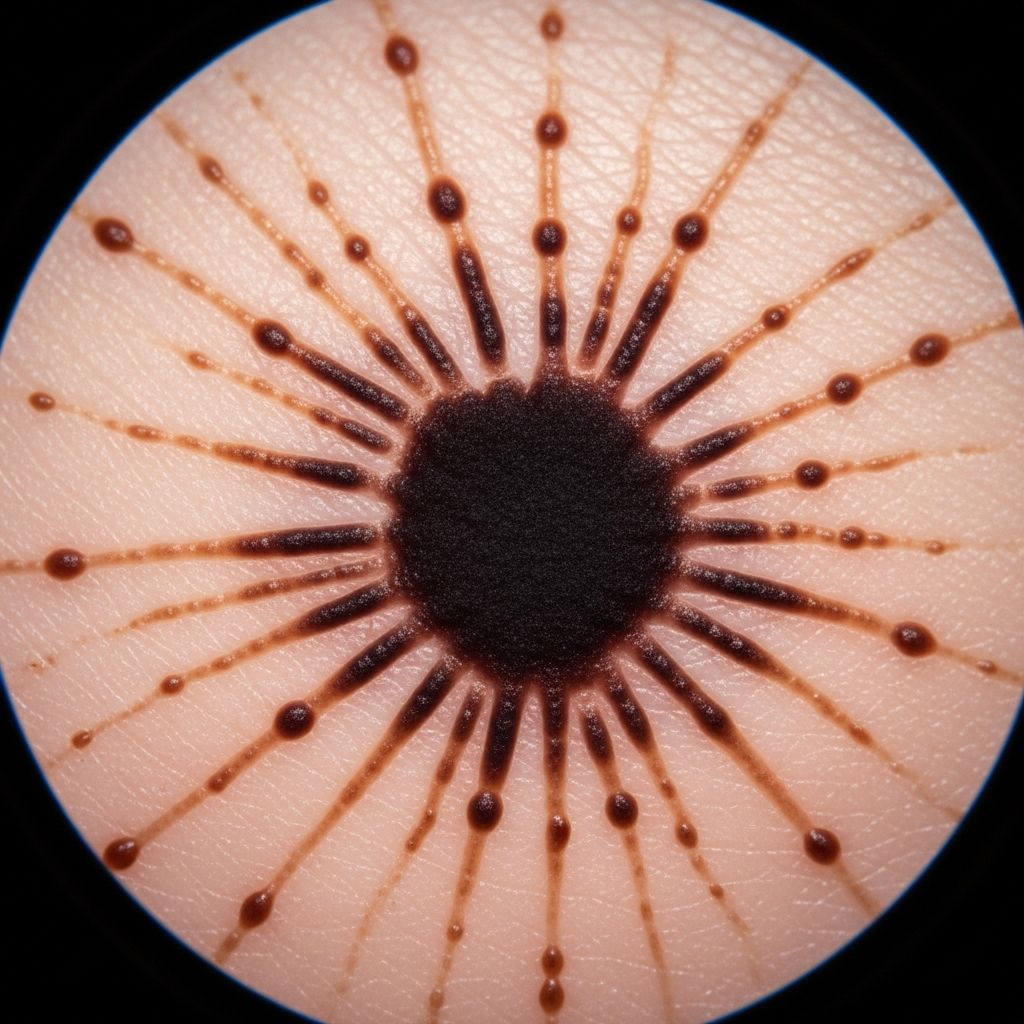
- Starburst Pattern: This pattern features prominent central pigmentation surrounded by symmetrical radial lines and streaks at the periphery. The radiations visible on dermoscopy correspond to areas of cell nest compression observed on histological examination. Lesions displaying a starburst pattern are expected to grow symmetrically in all directions, gradually acquiring a homogeneous blue-black color. This pattern represents the growth phase of Reed naevi.
- Globular Pattern: This pattern is characterized by hyperpigmented dots and globules distributed throughout the lesion, creating a distinctive “coffee-beans” appearance. Gray-brown to blue globules are generally distributed throughout the lesion or predominantly at the periphery. The globular pattern is frequently associated with reticular depigmentation, consisting of white intermingled lines surrounding the vessels.
- Reticular/Homogeneous Pattern: After the growth phase, Reed naevi may transition to a homogeneous pattern with central hyperpigmentation and uniform structureless brown-to-black coloration. In the involution phase, the lesion loses pigmentation and becomes less clinically apparent.
Additional Dermoscopic Features
Beyond the primary patterns, several additional features may be observed in Reed naevi:
- Reticular depigmentation or “inverse network” appearing in approximately 17.6% of cases
- Superficial black network in approximately 2.3% of cases
- Blue-white veil in approximately 1.6% of cases
- Regularly distributed dotted vessels in nonpigmented Spitz/Reed naevi
- Red globules, coiled or tortuous vessels in elevated nodular nonpigmented lesions
Atypical Patterns
While most Reed naevi display characteristic patterns, atypical presentations do occur. Atypical Reed naevi may present with uneven distribution of colors and structures, potentially resembling a blue-white veil appearance. These atypical lesions may present as hypo or amelanotic papules, creating diagnostic uncertainty. Dermoscopically asymmetric lesions with spitzoid features should be excised to rule out melanoma.
Related Stories



Dermoscopic Evolution and Growth Phases
Reed naevi demonstrate characteristic morphological evolution as they progress through different growth phases. Understanding this evolution is crucial for clinicians managing these lesions over time.
Growth Phase Evolution
In their growing phases, Spitz and Reed naevi evolve from a globular pattern to a starburst pattern with regular streaks at the periphery. The peripheral projections, which appear as finger-like or globule-like structures, gradually disappear over several months as the lesion stabilizes. During the growth phase, symmetric radial expansion is typically observed, with the lesion gradually acquiring uniform coloration.
Stabilization and Involution
As Reed naevi mature and stabilize, the dermoscopic appearance changes significantly. The characteristic radial projections diminish, and the lesion develops a homogeneous, structureless appearance with brown-to-black pigmentation. In the final involution phase, the lesion undergoes depigmentation and becomes less prominent clinically.
Pattern Distribution in Small Lesions
Research on small Reed naevi (less than 6 millimeters) has revealed different pattern distributions compared to larger, more mature lesions. Analysis of small lesions showed that 40% displayed a reticular pattern, 20% exhibited a starburst pattern, 6.5% showed a globular pattern, 6.5% had a homogeneous pattern, and 27% displayed an atypical pattern. These findings suggest that small, early-stage Reed naevi may not follow the classical evolution of growth patterns observed in larger lesions.
Histopathological Correlations
The distinctive dermoscopic features of Reed naevi correlate with specific histopathological findings. At histological examination, Reed naevi demonstrate melanocytic proliferation consisting of polygonal or cigar-shaped melanocytes with large nuclei, prominent nucleoli, and abundant ground-glass cytoplasm. The characteristic radial streaks visible on dermoscopy correspond to areas of cell nest compression on histology.
Additional histological features frequently observed in Reed naevi include large and coalescent eosinophilic bodies (Kamino bodies) at the dermoepidermal junction, edema, telangiectasias, and fibrosis of the papillary dermis. Melanin within spindle cells and dermal melanophages is also commonly present.
Differential Diagnosis: Distinguishing Reed Naevus from Melanoma
The critical challenge in managing Reed naevi is differentiating these benign lesions from melanoma, which can present with similar clinical and dermoscopic features. Several diagnostic criteria help distinguish Reed naevi from malignant lesions.
Diagnostic Certainty Factors
Research has demonstrated that flat or raised pigmented lesions dermoscopically characterized by a starburst or globular pattern were almost always benign naevi. In contrast, nodular nonpigmented lesions presenting with dotted vessels, with or without reticular depigmentation, may be clinically and dermoscopically indistinguishable from nonpigmented Spitz naevi and melanoma.
Features Suggesting Atypical Lesions or Melanoma
Certain features warrant greater clinical concern and may indicate atypical Spitz naevi or melanoma:
- Asymmetric distribution of spitzoid features
- Irregular color distribution
- Asymmetric growth patterns
- Acquisition of atypical patterns during monitoring
- Lesions developing in adulthood
- Lesions that appear clinically as an “ugly duckling” compared to the patient’s other naevi
Clinical Management and Monitoring Recommendations
Appropriate management of suspected Reed naevi requires systematic clinical evaluation and often specialist referral.
Initial Assessment
When assessing a suspected Reed naevus, clinicians should perform dermoscopic evaluation and compare the lesion to the patient’s other naevi. The appearance should be evaluated to determine if the lesion represents an “ugly duckling” significantly different from the patient’s typical naevi.
Referral Criteria
Suspected Spitz naevi, including Reed naevi with atypical features, should always be referred urgently to secondary care for specialist evaluation. This recommendation ensures that potential melanomas are not missed while avoiding unnecessary excision of benign lesions.
Excision and Histological Examination
Lesions with uncertain diagnosis are usually excised for histopathological evaluation. When excision is performed, histology forms should provide the pathologist with adequate clinical information and a clear differential diagnosis to guide accurate diagnosis. This is particularly important for atypical presentations and lesions developing in adulthood.
Monitoring Approach
For lesions diagnosed as Reed naevi, dermoscopic monitoring may be appropriate to document stability and characteristic evolution patterns. Serial dermoscopic documentation of lesions displaying a starburst pattern allows clinicians to observe the expected symmetric growth, stabilization, and gradual loss of peripheral pseudopods. However, any deviation from expected evolution, including asymmetric growth or acquisition of atypical features, warrants excision.
Special Considerations for Atypical and Amelanotic Lesions
Reed naevi may occasionally present in atypical forms that create diagnostic challenges. Atypical pigmented spindle cell naevi may present as hypo or amelanotic papules, lacking the characteristic dark brown or black coloration typical of standard Reed naevi. These presentations create greater diagnostic uncertainty and typically warrant excision biopsy to reliably exclude spindle cell melanoma.
The presence of blue-white veil or asymmetric features should raise concern and prompt consideration of excision, regardless of other reassuring features.
Frequently Asked Questions
Q: What is a Reed naevus?
A: A Reed naevus (pigmented spindle cell naevus of Reed) is a benign melanocytic skin lesion characterized by spindle-shaped melanocytes, typically presenting as a dark brown or black papule or patch, most commonly on the lower extremities in young adults.
Q: How is dermoscopy used to diagnose Reed naevi?
A: Dermoscopy allows visualization of characteristic patterns including starburst (radial streaks), globular (coffee-bean appearance), and reticular patterns that help differentiate Reed naevi from melanoma.
Q: Can Reed naevi be confused with melanoma?
A: Yes, Reed naevi can mimic melanoma at clinical, dermoscopic, and histological levels. This is why atypical presentations, especially those developing in adulthood, warrant specialist referral and possible excision.
Q: What is the typical evolution of a Reed naevus?
A: Reed naevi typically evolve from a globular pattern through a starburst pattern during growth, then stabilize with a homogeneous appearance, and finally involute with loss of pigmentation.
Q: Should all Reed naevi be excised?
A: Not necessarily. Lesions with typical dermoscopic features on flat or raised skin may be monitored clinically and dermoscopically. However, atypical lesions, nodular presentations, and lesions developing in adulthood should be excised to exclude melanoma.
Q: What features suggest a Reed naevus may be atypical or malignant?
A: Features of concern include asymmetric morphology, irregular color distribution, asymmetric growth, blue-white veil appearance, appearance as an “ugly duckling,” and development in adulthood.
References
- Pigmented Spindle Cell Naevus of Reed (PSCNOR) — Dermoscopea. 2024. https://www.dermoscopea.com/pigmented-spindle-cell-naevus-of-reed
- Update on dermoscopy of Spitz/Reed naevi and management guidelines by the International Society of Dermatopathology — British Journal of Dermatology, Lallas et al. 2017. https://onlinelibrary.wiley.com/doi/10.1111/bjd.15721
- Clinical and dermoscopic features of small Reed nevus (<6 mm) — Journal of the European Academy of Dermatology and Venereology. 2012. https://onlinelibrary.wiley.com/doi/10.1111/j.1468-3083.2012.04457.x
- Spitz/Reed nevi – Dermoscopic classification and characteristics — Dermoscopedia. 2024. https://dermoscopedia.org/Spitz_/_Reed_nevi
- Spitz naevi (including pigmented spindle cell naevus of Reed) — Primary Care Dermatology Society. 2024. https://www.pcds.org.uk/clinical-guidance/spitz-naevi-including-pigmented-spindle-cell-naevus-of-reed
- Spitz/Reed nevi: a review of clinical-dermatoscopic and histological features and management — Journal of the American Academy of Dermatology. 2015. https://pmc.ncbi.nlm.nih.gov/articles/PMC4866625/
Similar Articles








Read full bio of Sneha Tete