Renin-Angiotensin-Aldosterone System (RAAS)
Understanding RAAS: How Your Body Regulates Blood Pressure and Fluid Balance
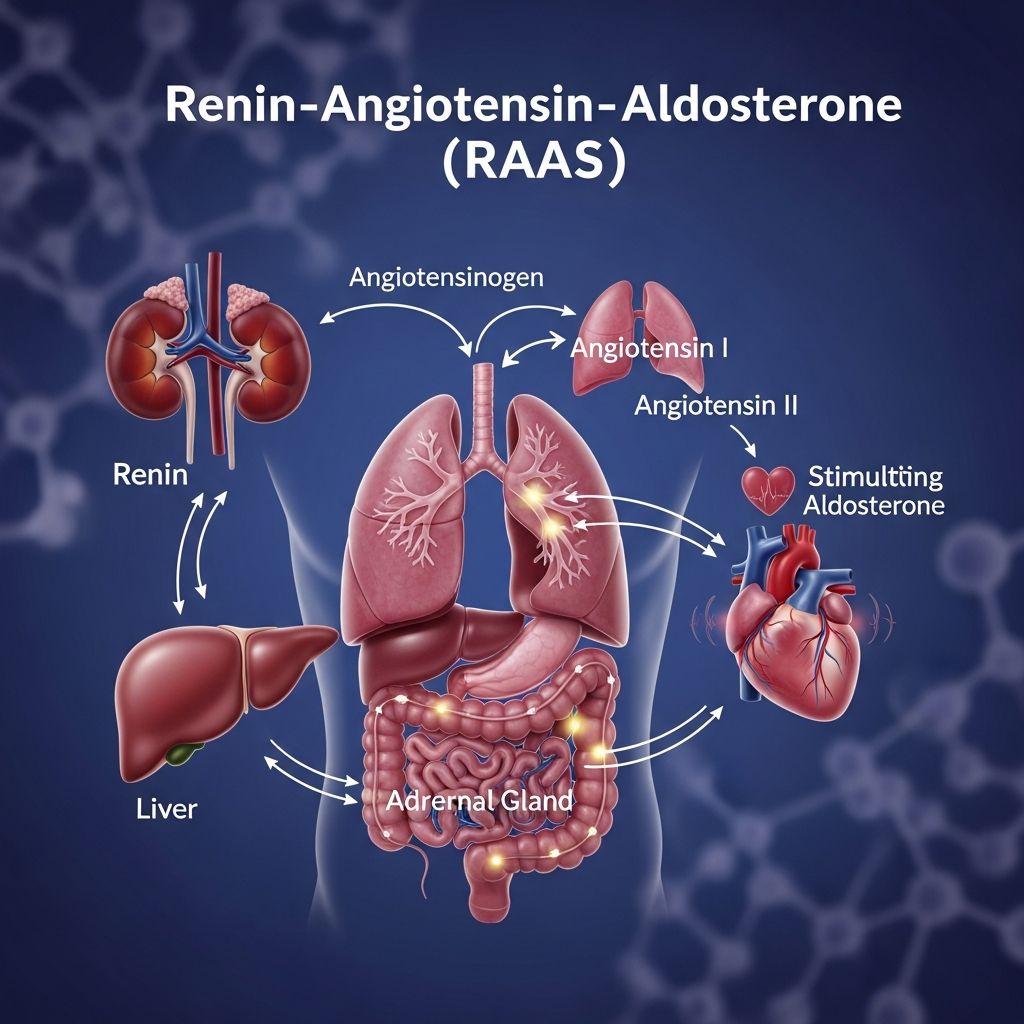
What Is the Renin-Angiotensin-Aldosterone System (RAAS)?
The renin-angiotensin-aldosterone system (RAAS) is a sophisticated network of hormones, proteins, enzymes, and biochemical reactions that work together to regulate your blood pressure and blood volume. This complex endocrine system plays a critical role in maintaining cardiovascular homeostasis by controlling how much fluid your body retains and how much force your blood vessels exert on circulating blood. Think of RAAS as your body’s internal blood pressure management system, constantly monitoring and adjusting to keep your cardiovascular system functioning optimally.
The RAAS operates through a cascade of chemical signals that begin in your kidneys and extend throughout your body, involving multiple organs including the liver, lungs, adrenal glands, and brain. Unlike the baroreflex, which provides immediate short-term responses to sudden blood pressure changes, the RAAS handles long-term regulation of blood volume and vascular resistance, making it essential for maintaining stable blood pressure over hours, days, and weeks.
The Three Major Substances of RAAS
The RAAS comprises three primary components that work in sequence to regulate blood pressure:
- Renin: An enzyme produced by specialized cells in the kidneys that initiates the cascade
- Angiotensin II: A powerful hormone that acts as the primary mediator of RAAS effects on the body
- Aldosterone: A steroid hormone that promotes sodium and water retention in the kidneys
These three substances work in a coordinated sequence, each activating the next step in a carefully controlled chain reaction that helps your body maintain blood pressure equilibrium.
How the RAAS Works: Step-by-Step Process
Understanding the RAAS requires following the cascade of events that occur when your body detects low blood pressure:
Step 1: Detection and Renin Release
When your blood pressure drops, specialized cells called juxtaglomerular cells located in the walls of the afferent arterioles of your kidneys detect this change. In response, these cells release renin into your bloodstream. Renin is produced from an inactive precursor called prorenin, which becomes activated when blood pressure falls or when the sympathetic nervous system is stimulated. This marks the beginning of the RAAS cascade.
Step 2: Angiotensinogen Conversion
Once renin enters circulation, it encounters angiotensinogen, a protein synthesized by your liver and constantly present in your bloodstream. Renin acts as an enzyme, cleaving angiotensinogen to produce angiotensin I, a peptide consisting of 10 amino acids. This conversion happens rapidly in the blood plasma, setting the stage for the next critical transformation.
Step 3: Angiotensin II Formation
Angiotensin I then encounters angiotensin-converting enzyme (ACE), which is predominantly found in your lungs and kidneys. ACE removes two amino acids from angiotensin I, creating angiotensin II, an 8-amino acid peptide. This is the crucial step that produces angiotensin II, the primary active hormone of the RAAS system. Angiotensin II is incredibly potent but short-lived, with a half-life of less than 60 seconds in circulation, meaning it is rapidly degraded into less active forms like angiotensin III and IV.
Step 4: Systemic Effects
Angiotensin II circulates throughout your body and binds to angiotensin II receptors on cells in various tissues. This binding triggers multiple coordinated effects that work together to increase blood pressure and blood volume, restoring normal blood flow and pressure.
Related Stories



The Effects of Angiotensin II
Angiotensin II is the workhorse of the RAAS, producing numerous physiological effects throughout your body:
Kidney Effects
Angiotensin II directly affects kidney function in several ways. It stimulates the proximal convoluted tubules of your kidneys to reabsorb sodium and water back into the bloodstream rather than excreting them in urine. This increases blood volume directly. Additionally, angiotensin II triggers the adrenal cortex to release aldosterone, which further enhances sodium and water reabsorption in the kidneys while promoting potassium excretion.
Vascular Effects
One of the most immediate effects of angiotensin II is vasoconstriction—the narrowing of blood vessels. Angiotensin II acts on smooth muscle cells in systemic arterioles throughout your body, causing them to contract and narrow. This reduces the diameter of blood vessels, increasing systemic vascular resistance and forcing blood pressure upward. This vasoconstrictor effect is one of the most powerful and rapid ways RAAS raises blood pressure.
Hormonal Effects
Angiotensin II stimulates the release of aldosterone from the adrenal cortex, a hormone that promotes sodium and water retention while increasing potassium excretion. It also triggers the posterior pituitary gland to release antidiuretic hormone (ADH), also known as vasopressin, which promotes water retention by the kidneys. Both hormones work synergistically to increase blood volume.
Central Nervous System Effects
In your brain, angiotensin II acts on the hypothalamus to stimulate thirst, encouraging you to drink more water. This increases your fluid intake and further expands blood volume. Angiotensin II also modulates baroreceptor sensitivity, reducing how effectively your baroreflex can counteract the pressure-raising effects of RAAS. This ensures that RAAS activation is not immediately opposed by short-term regulatory mechanisms.
RAAS Versus the Baroreflex: Different Timescales of Regulation
Your body uses two main systems to regulate blood pressure, each operating on different timescales. The baroreflex provides rapid, beat-to-beat adjustments to blood pressure changes, responding within seconds to small fluctuations detected by arterial baroreceptors. The RAAS, in contrast, works more slowly but provides sustained, long-term regulation over hours and days. When you experience a sudden drop in blood pressure, your baroreflex responds immediately. If blood pressure remains low for a longer period, your RAAS activates to provide sustained correction. Together, these systems ensure your blood pressure remains stable across all time scales.
RAAS and Cardiovascular Disease
When RAAS becomes overactive or inappropriately activated, it can contribute to serious health problems. Chronic overactivation of the RAAS is a major cause of hypertension (high blood pressure), which increases your risk of heart attack, stroke, and kidney disease. In heart failure, the body senses reduced cardiac output as low blood pressure, triggering excessive RAAS activation. This leads to increased angiotensin II production, which causes further vasoconstriction and fluid retention, paradoxically worsening heart function. The enlarged heart that often accompanies heart failure may be partially due to the chronic effects of excess angiotensin II on cardiac tissue.
RAAS Inhibition: Medications That Target the System
Because overactivity of the RAAS contributes to hypertension and heart disease, many of the most commonly prescribed medications target different points in the RAAS cascade. Healthcare providers use various strategies to inhibit excessive RAAS activity:
ACE Inhibitors
Angiotensin-converting enzyme inhibitors block the conversion of angiotensin I to angiotensin II, reducing the production of this powerful vasoconstrictor. By decreasing angiotensin II levels, ACE inhibitors lower blood pressure and reduce the workload on the heart. These are among the most frequently prescribed blood pressure medications.
Angiotensin Receptor Blockers (ARBs)
Rather than blocking enzyme activity, angiotensin receptor blockers prevent angiotensin II from binding to its receptors on target cells. This effectively blocks the effects of angiotensin II throughout the body, lowering blood pressure and reducing cardiac stress. ARBs are often used as alternatives to ACE inhibitors for patients who cannot tolerate these medications.
Aldosterone Antagonists
These medications block the effects of aldosterone, reducing sodium and water retention by the kidneys and thus decreasing blood volume and blood pressure.
Renin Inhibitors
These newer medications directly inhibit renin, preventing the initial activation of the RAAS cascade entirely.
Regulation of Blood Volume and Vascular Resistance
The RAAS maintains blood pressure through two complementary mechanisms: controlling blood volume and managing vascular resistance. Blood volume depends on how much fluid your body retains versus excretes, primarily regulated by your kidneys. The RAAS increases sodium and water reabsorption, expanding blood volume and increasing the amount of blood your heart must pump. Systemic vascular resistance refers to the resistance blood vessels offer to blood flow. The RAAS increases resistance through vasoconstriction, making it harder for blood to flow through narrowed vessels. These mechanisms are particularly important for maintaining mean arterial pressure, the average pressure in your arteries during the cardiac cycle.
Clinical Significance and Research
Understanding the RAAS has profoundly influenced clinical medicine. Medications that target the RAAS have become cornerstone therapies for hypertension, heart failure, chronic kidney disease, and diabetes. Research continues to reveal new aspects of RAAS physiology, including local tissue RAAS systems that operate independently of the systemic cascade. These tissue-specific systems may play important roles in organ-specific pathology and represent potential targets for future therapeutic interventions.
Frequently Asked Questions About RAAS
Q: What happens if my RAAS is overactive?
A: Overactive RAAS leads to excessive vasoconstriction, sodium and water retention, and elevated blood pressure. This can cause or worsen hypertension, increase risk of heart disease and stroke, and contribute to kidney damage over time.
Q: Why is ACE inhibitor prescribed for heart failure?
A: In heart failure, the body inappropriately activates RAAS in response to reduced cardiac output. Excess angiotensin II worsens heart function by increasing afterload and promoting fluid retention. ACE inhibitors reduce angiotensin II production, decreasing workload on the weakened heart and improving outcomes.
Q: How quickly does RAAS respond to blood pressure changes?
A: RAAS responds over minutes to hours, providing sustained regulation rather than immediate correction. This distinguishes it from the baroreflex, which responds within seconds to sudden pressure changes.
Q: Can RAAS be completely blocked?
A: While RAAS can be significantly inhibited by medications, complete blockade is generally not achieved or desired, as some RAAS activity is necessary for normal kidney function and electrolyte balance.
Q: Is RAAS the only system that controls blood pressure?
A: No. Blood pressure is controlled by multiple overlapping systems including the baroreflex, sympathetic and parasympathetic nervous systems, natriuretic peptides, endothelial factors, and local vascular mechanisms. RAAS is one critical component among several.
References
- Physiology, Renin Angiotensin System — National Center for Biotechnology Information (NCBI). 2024. https://www.ncbi.nlm.nih.gov/books/NBK470410/
- Renin-Angiotensin-Aldosterone System (RAAS) — Cleveland Clinic. 2024. https://my.clevelandclinic.org/health/articles/24175-renin-angiotensin-aldosterone-system-raas
- The Renin-Angiotensin-Aldosterone System — TeachMePhysiology. 2024. https://teachmephysiology.com/urinary-system/regulation/the-renin-angiotensin-aldosterone-system/
- What is the Renin Angiotensin Aldosterone System? — News Medical Life Sciences. 2024. https://www.news-medical.net/health/What-is-the-Renin-Angiotensin-Aldosterone-System.aspx
- The Renin–Angiotensin–Aldosterone System, RAAS, Animation — YouTube. 2024. https://www.youtube.com/watch?v=6EUSEa6Lw8g
Similar Articles








Read full bio of medha deb