Resistance Band Ab Workout: 10 Best Exercises For Defined Abs
Sculpt your core with this effective resistance band ab workout that targets all abdominal muscles at home.
This resistance band ab workout is designed to torch your core muscles using minimal equipment. Resistance bands add variable tension to traditional ab exercises, making them more challenging and effective for building strength, stability, and definition in your abs, obliques, and deeper core muscles. Whether you’re a beginner or advanced athlete, these moves can be scaled to your fitness level. You’ll need a set of mini loop bands (light to heavy resistance) and a longer therapy band for some variations. Perform this routine 3-4 times per week for optimal results, combining it with cardio and full-body strength training.
Benefits of Resistance Band Ab Workouts
Resistance bands provide constant tension throughout the range of motion, which engages your core more intensely than bodyweight exercises alone. This leads to greater muscle activation in the rectus abdominis, transverse abdominis, and obliques. Studies show that elastic resistance training improves core stability, which is crucial for posture, injury prevention, and athletic performance. Bands are portable, affordable, and joint-friendly, allowing workouts anywhere—from home to travel.
- Enhanced Muscle Engagement: Variable resistance recruits more muscle fibers.
- Improved Stability: Targets deep stabilizers for better balance and power transfer.
- Versatility: Suitable for all levels; adjust tension by stepping further from anchors.
- Low Impact: Reduces strain on spine and joints compared to weighted crunches.
How to Choose the Right Resistance Band
Select bands based on your strength: light for beginners (focus on form), medium for intermediates, and heavy for advanced users. Mini loop bands (6-12 inches) are ideal for lower body and glute activation in core moves. Longer bands (5-7 feet) work for pulls and anchors. Look for latex or fabric bands to avoid snapping. Test tension: it should challenge you by the last 3 reps without compromising form.
The 10 Best Resistance Band Ab Exercises
These 10 exercises cover anti-extension, anti-rotation, flexion, and stabilization patterns. Do 3 sets of 10-15 reps per exercise (or 30-45 seconds for timed moves). Rest 30-60 seconds between sets. Warm up with 5 minutes of light cardio and dynamic stretches.
1. Banded Bridge
Lie faceup with a mini band around your thighs, heels near hips, shoulder-width apart. Lift hips high, pressing knees outward against the band to activate hip abductors and glutes. Squeeze your core to maintain a straight line from shoulders to knees. Slowly lower with control. This move stabilizes the lower back and fires up the entire core.
- Reps: 12-15
- Tips: Keep shoulder blades grounded; avoid arching lower back.
2. Seated Mermaid Twist
Sit sideways on one hip, knees bent, mini band anchored in bottom hand. Hold band near chest with top hand, spine long. Rotate torso to stretch the band, focusing effort in obliques. This anti-rotation exercise builds rotational strength without spinal stress.
- Reps: 8-10 per side
- Tips: Keep shoulders relaxed; exhale on twist.
3. Banded Dead Bug
Loop mini band around one foot, hold in opposite hand. Stabilize shoulder on the floor, extend banded leg while pulling band taut. Engage core to prevent lower back arching. Switch sides. Excellent for transverse abdominis activation.
- Reps: 10-12 per side
- Tips: Press low back into floor; move slowly.
Related Stories



4. Bear Plank Walkouts
In plank position with mini band above knees, walk legs forward to bear plank (knees hovering), then back. Alternate lead leg. This dynamic move challenges core stability and hip control.
- Reps: 8 per side
- Tips: Keep hips level; breathe steadily.
5. Seated Roll-Up
Sit with band looped around feet, holding ends. Slowly roll spine down to supine, scooping abs inward, then roll up with control. Mimics Pilates roll-up with added resistance.
- Reps: 8-10
- Tips: Nod chin to chest; keep arms straight.
6. V-Sit Russian Twist
In V-sit (knees bent, heels down), loop band around feet, hold ends. Twist ribcage side-to-side, moving hands hip to hip. Progress by lifting feet.
- Reps: 15 per side
- Tips: Twist from core, not arms; maintain V shape.
7. Banded Bird Dog
On hands and knees, anchor band around one foot, hold in opposite hand. Extend arm and leg simultaneously, stabilizing spine. Smooth, controlled reps.
- Reps: 10 per side
- Tips: Squeeze glutes; avoid rotation.
8. Pallof Press
Anchor long band at shoulder height, stand perpendicular, arms extended. Press out, resisting rotation. Slowly return. Gold standard for anti-rotation.
- Reps: 10-12 per side
- Tips: Brace core like preparing for a punch.
9. Tabletop Leg Extension
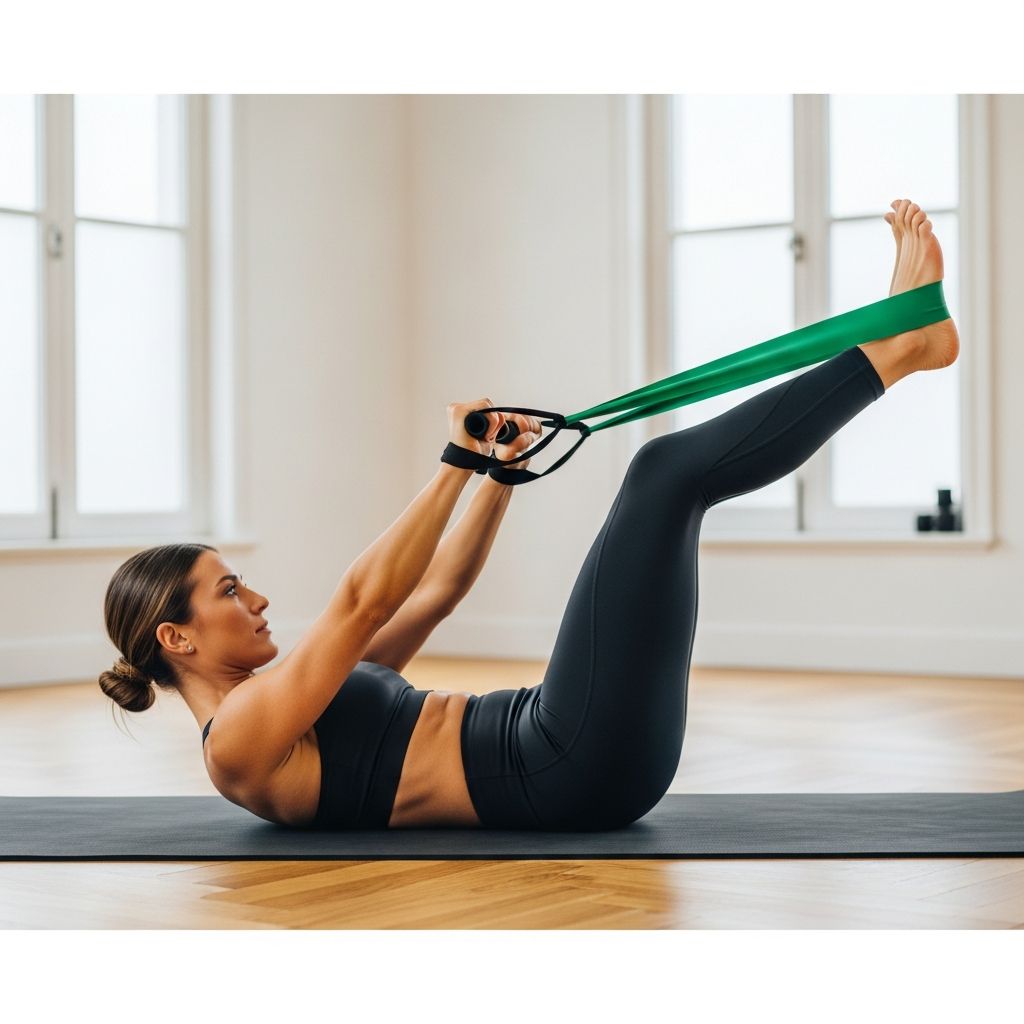
Lie back, legs in tabletop (90/90), band around feet, ends in hands. Extend legs out low, controlling return. Add shoulder lift for intensity.
- Reps: 12-15
- Tips: Draw abs toward spine; hover legs just above floor.
10. Standing Band March
Band around thumbs, arms extended forward. March knees high alternately, maintaining tension. Targets lower abs and balance.
- Reps: 20 total
- Tips: Keep core tight; shoulders down.
Sample Resistance Band Ab Workout Routine
Complete this circuit 3-4 rounds for a 20-30 minute session. Rest 15-30 seconds between exercises, 1 minute between rounds.
| Exercise | Sets x Reps/Time | Focus |
|---|---|---|
| Banded Bridge | 3 x 12 | Glutes/Core Stability |
| Seated Mermaid Twist | 3 x 10/side | Obliques |
| Banded Dead Bug | 3 x 12/side | Deep Core |
| Bear Plank Walkouts | 3 x 8/side | Dynamic Stability |
| V-Sit Russian Twist | 3 x 15/side | Rotational Strength |
Progress by increasing resistance, reps, or slowing tempo (3-second eccentrics).
Common Mistakes to Avoid
- Pulling with arms/shoulders instead of core—focus on midsection drive.
- Allowing lower back to arch—brace abs first.
- Using momentum—prioritize control for max activation.
- Skipping warm-up—leads to strains; always activate glutes/core first.
- Not progressing—change bands every 2-4 weeks as you strengthen.
Frequently Asked Questions (FAQs)
Can beginners do resistance band ab workouts?
Yes, start with light bands and fewer reps to master form. These exercises scale easily.
How often should I do this ab workout?
3-4 times weekly, with rest days for recovery. Combine with full-body routines.
Do resistance bands really build abs?
Yes, they increase time under tension for hypertrophy and strength, visible with low body fat.
What’s the difference between mini bands and long bands for abs?
Mini for lower body integration; long for pulls/presses targeting anti-rotation.
Can I do this workout every day?
No, core needs recovery like other muscles—aim for every other day max.
Nutrition and Recovery Tips for Core Gains
Fuel with protein (1.6-2.2g/kg bodyweight) post-workout for repair. Include anti-inflammatory foods like berries and omega-3s. Sleep 7-9 hours; foam roll tight hip flexors. Track progress with photos/measurements, not just scale.
References
- How to Use Resistance Bands in Your Workouts – 12 Band Exercises — Men’s Health. 2020-06-15. https://www.menshealth.com/fitness/a32093962/resistance-band-workouts/
- Resistance Band Workouts for Abs: 11 Exercises to Try — Healthline. 2023-05-10. https://www.healthline.com/health/fitness/resistance-band-workouts-abs
- 14 Resistance Band Abs Exercises That Will Light Up Your Core — Women’s Health. 2022-08-20. https://www.womenshealthmag.com/fitness/a38405057/resistance-band-ab-workout/
- Resistance Training and Core Stability — National Strength and Conditioning Association (NSCA). 2024-01-15. https://www.nsca.com/education/articles/kinetic-select/resistance-training-for-core-stability/
- Effects of Elastic Band Resistance Training on Core Muscle Activation — Journal of Strength and Conditioning Research (PubMed). 2022-11-05. https://pubmed.ncbi.nlm.nih.gov/34724689/
Similar Articles








Read full bio of Sneha Tete