Reticular Erythematous Mucinosis Pathology
Detailed pathology of reticular erythematous mucinosis, a rare cutaneous mucinosis with distinctive histological features.
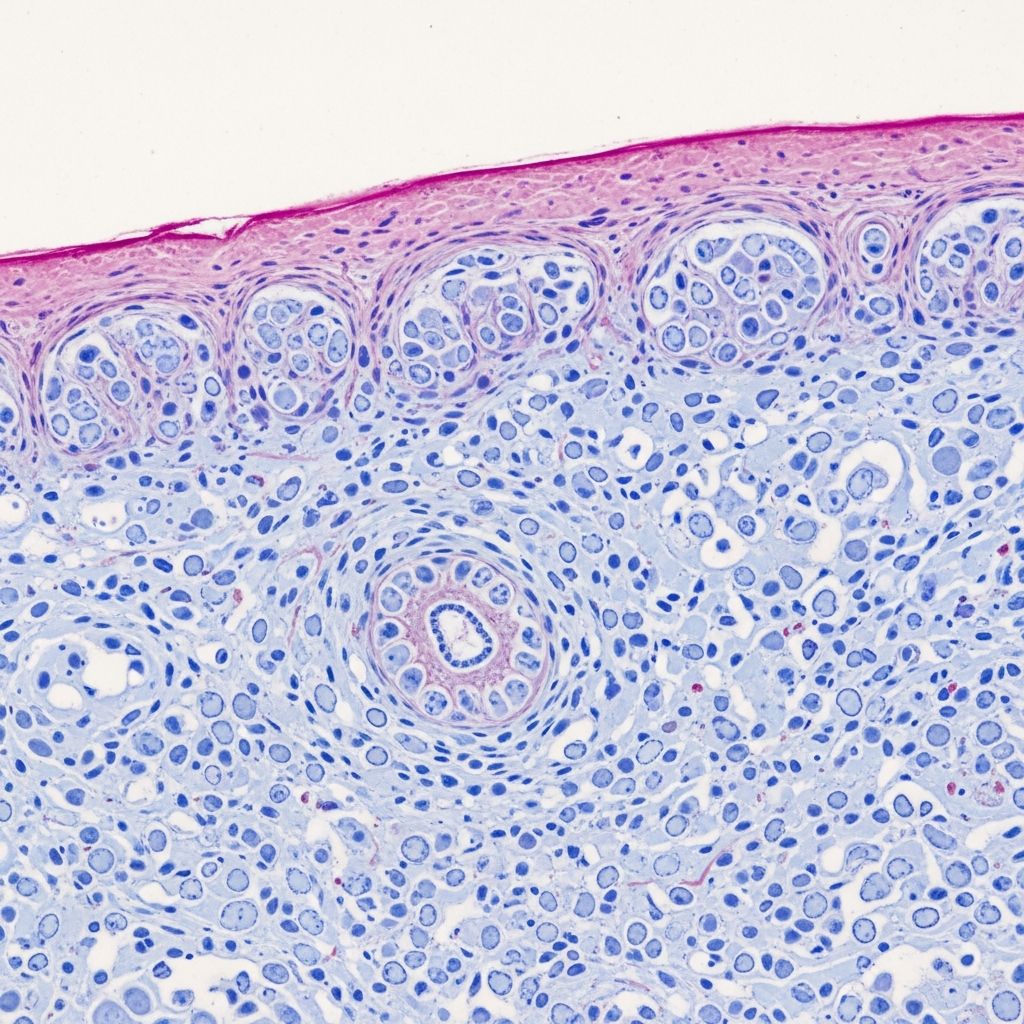
Reticular erythematous mucinosis (REM), also known as midline mucinosis, is a rare primary cutaneous mucinosis characterized by reticulated erythematous patches or plaques predominantly on the midline of the chest and upper back.
Introduction
Reticular erythematous mucinosis is a chronic dermatosis primarily affecting women in their third to fifth decades of life. It manifests as pink to red papules or macules that coalesce into a net-like (reticular) pattern, typically on the central chest or upper back. The condition is considered a plaque-like mucinosis due to excessive mucin deposition in the dermis, distinguishing it from more common rashes. Although benign and not associated with systemic involvement in most cases, REM can mimic other mucinoses or lupus erythematosus variants, necessitating precise histopathological evaluation.
The aetiology remains unknown, but triggers such as sun exposure, heat, and hormonal changes may exacerbate lesions. Fibroblasts produce abnormally large amounts of mucopolysaccharides, leading to dermal mucin accumulation. This article delves into the clinical features, pathology, diagnosis, and management of REM, providing a comprehensive resource for dermatologists and pathologists.
Clinical Features
REM typically presents with asymptomatic or mildly pruritic erythematous patches on the midline trunk. Key clinical characteristics include:
- Reticular pattern: Flat, irregularly configured pale erythema forming a net-like appearance on the central chest and upper back.
- Lesion morphology: Pink to red papules, macules, or plaques that merge into annular or reticulated plaques; satellite papules may be present.
- Symmetry: Often bilateral and symmetric, though unilateral cases occur.
- Symptoms: Usually asymptomatic; mild itching, burning, or tenderness reported in some patients.
- Triggers and course: Worsens with sun exposure (UVA/UVB), heat, or hormonal fluctuations; may improve spontaneously or persist chronically.
Lesions are persistent but non-scarring, with potential for remission and recurrence. Unusual sites like face, arms, legs, abdomen, or extremities are rare but documented.
Histopathology
The hallmark of REM pathology is dermal mucin deposition with a sparse inflammatory infiltrate. Low-power examination reveals superficial and deep perivascular and periadnexal mononuclear infiltrates without epidermal involvement.
Key microscopic features:
- Inflammatory infiltrate: Mild superficial, mid, and deep dermal perivascular lymphocytic infiltrate; periadnexal and perifollicular extension; occasional histiocytes, mast cells, and factor XIIIa-positive dendrocytes.
- Mucin deposits: Copious basophilic mucin separating collagen bundles in the upper and mid-dermis; most prominent around vessels, appendages, and infiltrate areas.
- Vascular changes: Dilated vessels with mild haemorrhage in papillary dermis; telangiectasias clinically correlate.
- Other findings: Focal elastic fiber fragmentation; active fibroblasts; electron microscopy shows tubular inclusions in keratinocytes, macrophages, pericytes, and endothelial cells.
On routine H&E staining, mucin may be subtle and overlooked. Special stains are essential:
| Stain | Purpose | Findings in REM |
|---|---|---|
| Colloidal iron | Detects mucin | Abundant blue mucin in dermis |
| Alcian blue (pH 2.5) | Confirms mucin | Excess mucin in upper dermis |
| Hyaluronidase-sensitive | Identifies hyaluronic acid | Mucin digestion confirms composition |
| Direct immunofluorescence | Immune deposits | IgM along basal layer (variable) |
These features overlap with lupus erythematosus tumidus, prompting debate on whether REM is a lupus erythematosus spectrum disorder.
Diagnosis
Diagnosis relies on clinicopathological correlation, as clinical features mimic plaque-like mucinosis, lupus mucinosis, or dermatomyositis. Essential steps include:
- Clinical evaluation: History of midline reticular erythema, phototriggers, exclusion of systemic disease.
- Skin biopsy: Confirms mucin deposits and mild infiltrate; rules out mimics.
- Dermoscopy: Emerging tool showing reticular vessels, structureless red areas (limited data).
- Laboratory tests: ANA, anti-dsDNA to exclude lupus; thyroid function, glucose for associations.
- Phototesting: UVA/UVB provocation reproduces lesions in some cases.
Related Stories



Differential diagnosis:
- Lupus erythematosus tumidus: More interstitial infiltrate, interface changes.
- Plaque mucinosis: Thicker plaques, less reticular.
- Lichen myxoedematosus: Smaller papules, monoclonal gammopathy.
- Dermatomyositis: Proximal muscle weakness, Gottron papules.
Associations and Pathogenesis
REM is usually isolated but linked to immune dysregulation: idiopathic thrombocytopenic purpura, diabetes, thyroid disease, neoplasia (breast, lung, colon), monoclonal gammopathy, HIV. Pathogenesis involves fibroblast hyperactivity producing glycosaminoglycans, possibly immune-mediated. Sunlight paradox: Exacerbates most cases but improves others.
Treatment
REM responds well to antimalarials; topical therapies for mild cases. Treatment ladder:
- First-line: Hydroxychloroquine 200-400 mg/day; resolution in 8-12 weeks.
- Topicals: High-potency corticosteroids, tacrolimus for limited disease.
- Alternatives: UVA1 phototherapy, methotrexate, cyclosporine for refractory cases.
- Supportive: Sun protection; avoid triggers.
Recurrence possible upon discontinuation; long-term low-dose maintenance may be needed.
Frequently Asked Questions (FAQs)
What is reticular erythematous mucinosis?
A rare skin condition with net-like red patches on the chest/back due to dermal mucin buildup, mainly in middle-aged women.
Is REM dangerous or linked to cancer?
Benign; rare associations with neoplasia or autoimmune diseases, but no direct causation.
How is REM diagnosed?
By skin biopsy showing dermal mucin and mild lymphocytic infiltrate; special stains confirm.
Does sun exposure worsen REM?
Usually yes, via UVA/UVB; photoprotection recommended, though paradoxical improvement occurs.
What is the best treatment for REM?
Hydroxychloroquine is highly effective, with good response rates and minimal side effects.
Prognosis
Excellent; chronic but controllable. Most achieve remission with therapy; no scarring or systemic progression.
References
- Reticular Erythematous Mucinosis | Dermatologist In Texas — Heights Skin. 2023. https://www.heightsskin.com/reticular-erythematous-mucinosis
- [Reticular erythematous mucinosis-A special subtype of cutaneous mucinosis] — PubMed. 2020-06-25. https://pubmed.ncbi.nlm.nih.gov/32588129/
- Reticular erythematous mucinosis – Wikipedia — Wikipedia. 2024. https://en.wikipedia.org/wiki/Reticular_erythematous_mucinosis
- Reticular erythematous mucinosis – DermNet — DermNet NZ. 2024. https://dermnetnz.org/topics/reticular-erythematous-mucinosis
- Advances in the Treatment of Reticular Erythematous Mucinosis — Practical Dermatology. 2023. https://practicaldermatology.com/youngmd-connect/resident-resource-center/advances-in-the-treatment-of-reticular-erythematous-mucinosis/23491/
- Think of Reticular Erythematous Mucinosis — International Journal of Clinical and Medical Case Reports. 2023. https://ijclinmedcasereports.com/pdf/IJCMCR-CR-00792.pdf
- [Translated article] Reticular Erythematous Mucinosis as Differential Diagnosis — Actas Dermo-Sifiliográficas. 2024. https://actasdermo.org/es-reticular-erythematous-mucinosis-as-articulo-S0001731024008573
- Reticular Erythematous Mucinosis (REM) pathology – DermNet — DermNet NZ. 2024. https://dermnetnz.org/topics/reticular-erythematous-mucinosis-pathology
Similar Articles








Read full bio of medha deb