Reticulohistiocytoma Pathology: Essential Diagnostic Guide
Comprehensive guide to the pathology, clinical features, and management of reticulohistiocytoma, a rare cutaneous histiocytic disorder.
Reticulohistiocytoma (RH), also known as solitary epithelioid histiocytoma, represents a rare benign proliferation of histiocytic cells within the dermis. This non-Langerhans cell histiocytosis typically manifests as a solitary, firm, skin-coloured or reddish-brown nodule less than 1 cm in diameter, most commonly affecting the head, neck, or upper trunk in young to middle-aged adults.
Clinical Features
Solitary reticulohistiocytoma presents as a well-circumscribed, asymptomatic dermal nodule, often with a smooth surface and occasional telangiectasia at the periphery. Lesions range from 0.5 to 2 cm but are usually under 1 cm, appearing reddish-yellow to brown. Common sites include the face, neck, and trunk, with a predilection for young adults, though cases in children as young as 2 years have been documented.
- Solitary form: Single painless nodule; spontaneous resolution possible over months to years.
- Diffuse cutaneous form: Multiple nodules without systemic involvement, primarily on head and neck.
- Multicentric reticulohistiocytosis (MRH): Severe variant with skin nodules (face, hands), erosive arthritis, and potential internal organ involvement; more common in middle-aged women.
In MRH, over 90% of cases show characteristic nodules on the face and dorsal hands, often pruritic and red to yellow-brown, ranging from 1 mm to several cm. Approximately 25-30% of patients may have associated xanthelasma, neoplasms, or vasculitis.
Histopathology
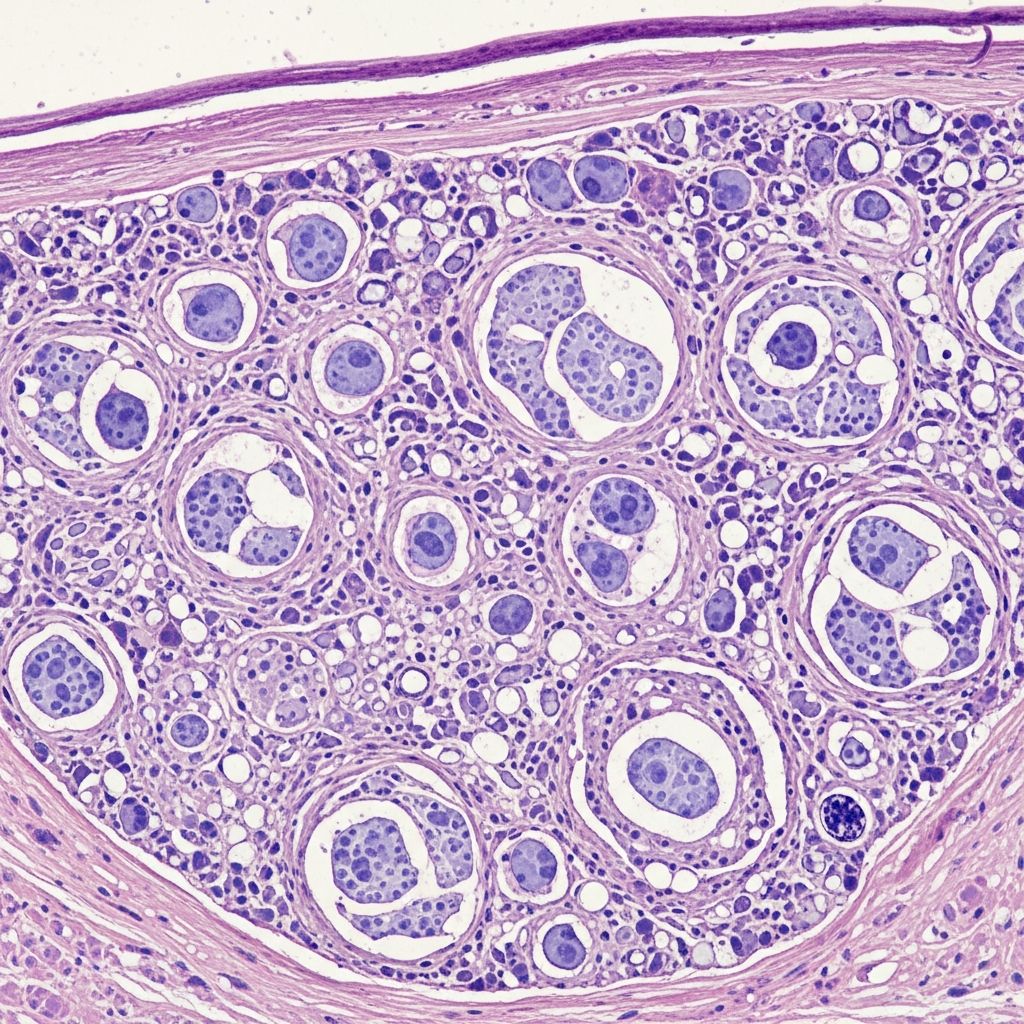
Microscopically, reticulohistiocytoma is confined to the dermis, occasionally extending into the subcutis, without epidermal involvement. The lesion features a nodular aggregate of large, plump histiocytes with abundant eosinophilic, glassy (homogeneous) cytoplasm that fills the entire cell volume.
- Histiocyte morphology: Abundant ground-glass cytoplasm due to intracytoplasmic lipid droplets and complex lysosomes; multinucleated giant cells common (up to 50 microns).
- Stroma: Delicate collagen bundles with scattered lymphocytes, neutrophils, or eosinophils; no Touton giant cells or foamy macrophages typical of xanthogranuloma.
- Low-power view: Well-circumscribed dermal nodule pushing into papillary dermis; higher power reveals vacuolated glassy cytoplasm with indented nuclei.
In multicentric forms, histology mirrors solitary RH but may show more diffuse infiltration. The process is non-neoplastic, representing a reactive macrophage response to unknown stimuli, possibly cytokines or trauma.
Cytoplasmic Inclusions
The hallmark glassy cytoplasm results from membrane-bound lipid droplets (0.5-3 microns) and lysosomal structures, periodic acid-Schiff (PAS) positive, diastase resistant. Electron microscopy reveals complex lysosomes with cholesterol clefts, distinguishing RH from other histiocytoses.
Histochemistry
Histochemical stains aid in confirming the lipid nature of cytoplasmic inclusions:
| Stain | Result | Significance |
|---|---|---|
| Periodic acid-Schiff (PAS) + diastase | Positive | Highlights lysosomal glycogen and lipids in glassy cytoplasm. |
| Oil Red O (frozen) | Positive | Demonstrates neutral lipids within vacuoles. |
| Sudan Black B | Positive | Stains phospholipids and neutral fats. |
| Fontana-Masson | Negative | Excludes melanin. |
| von Kossa | Negative | No calcium deposits. |
These stains differentiate RH from xanthomas (more foamy lipidization) and spindle cell tumours.
Related Stories



Immunohistochemistry
Immunoprofile confirms non-Langerhans histiocytic origin:
- Positive: CD68 (strong, diffuse), CD163, lysozyme; variable factor XIIIa.
- Negative: CD1a, langerin (excludes Langerhans cells), S100 (often negative or focal), SOX10.
- Proliferation: Low Ki67 index, supporting benign reactive process.
CD68 positivity highlights the macrophage lineage, while CD1a/S100 negativity rules out dendritic cell histiocytoses.
Differential Diagnosis
RH must be distinguished from other dermal nodules and histiocytoses:
| Entity | Key Distinguishing Features |
|---|---|
| Xanthogranuloma | Touton giant cells, foamy histiocytes, lipidized macrophages; S100-/CD1a-. |
| Langerhans cell histiocytosis | CD1a+, S100+, Langerin+; Birbeck granules on EM. |
| Spitz naevus | Melanocytic; SOX10+, HMB45+; junctional activity. |
| Epithelioid fibrous histiocytoma | CD34+, factor XIIIa+; more spindled cells. |
| Multicentric reticulohistiocytosis | Identical histology but multisystem involvement, arthritis. |
Careful assessment of glassy cytoplasm, IHC, and clinical context is essential.
Electron Microscopy
Ultrastructurally, histiocytes show abundant cytoplasm packed with secondary lysosomes containing laminated bodies, lipid vacuoles, and cholesterol clefts. No Birbeck granules, confirming non-Langerhans lineage. This supports the macrophage-derived reactive proliferation model.
Treatment
Solitary RH is managed conservatively or with simple excision, which is often curative with no recurrence. Observation suffices for spontaneous regression cases. MRH requires systemic therapy including methotrexate, TNF inhibitors, or cyclophosphamide for arthritis and internal disease control.
Frequently Asked Questions
What is reticulohistiocytoma?
A rare, benign dermal histiocytic nodule with glassy cytoplasm, usually solitary and self-limited.
Is reticulohistiocytoma cancerous?
No, it is a non-neoplastic reactive process; solitary forms do not metastasize or recur post-excision.
How is reticulohistiocytoma diagnosed?
By biopsy showing glassy histiocytes, confirmed with CD68+ IHC and exclusion of CD1a/S100.
Does reticulohistiocytoma resolve on its own?
Solitary lesions often regress spontaneously over months to years without treatment.
What is the prognosis for multicentric reticulohistiocytosis?
Guarded due to arthritis and potential malignancy association (25% develop internal cancer); requires aggressive management.
Related Topics
References
- Reticulohistiocytoma and Reticulohistiocytosis — Basic Medical Key. 2018. https://basicmedicalkey.com/reticulohistiocytoma-and-reticulohistiocytosis/
- Reticulohistiocytoma — Wikipedia. 2023-10-15. https://en.wikipedia.org/wiki/Reticulohistiocytoma
- Reticulohistiocytic Granuloma — MalaCards. 2024. https://www.malacards.org/card/reticulohistiocytic_granuloma
- A Plaque-Type Solitary Reticulohistiocytoma in a Two-Year-Old Boy — PMC (Ann Dermatol). 2015-02-26. https://pmc.ncbi.nlm.nih.gov/articles/PMC4327552/
- Uncommon Cutaneous Solitary Reticulohistiocytoma: A Case Report — Biomedical Journal of Scientific & Technical Research. 2018. https://biomedres.us/fulltexts/BJSTR.MS.ID.006046.php
- Reticulohistiocytosis — DermNet NZ. 2023. https://dermnetnz.org/topics/reticulohistiocytosis
Similar Articles








Read full bio of medha deb