Rib Cage: Anatomy, Function & Protection
Understanding your rib cage: Structure, function, and vital organ protection.
Understanding Your Rib Cage: Complete Anatomy and Function Guide
Your rib cage is a crucial skeletal structure that forms the framework of your chest and serves multiple essential functions for your body. This basketlike arrangement of bones, cartilage, and muscles protects your most vital organs while enabling the mechanics of breathing and movement. Understanding the anatomy and function of your rib cage can help you appreciate how your body maintains health and protects itself from injury.
What Is the Rib Cage?
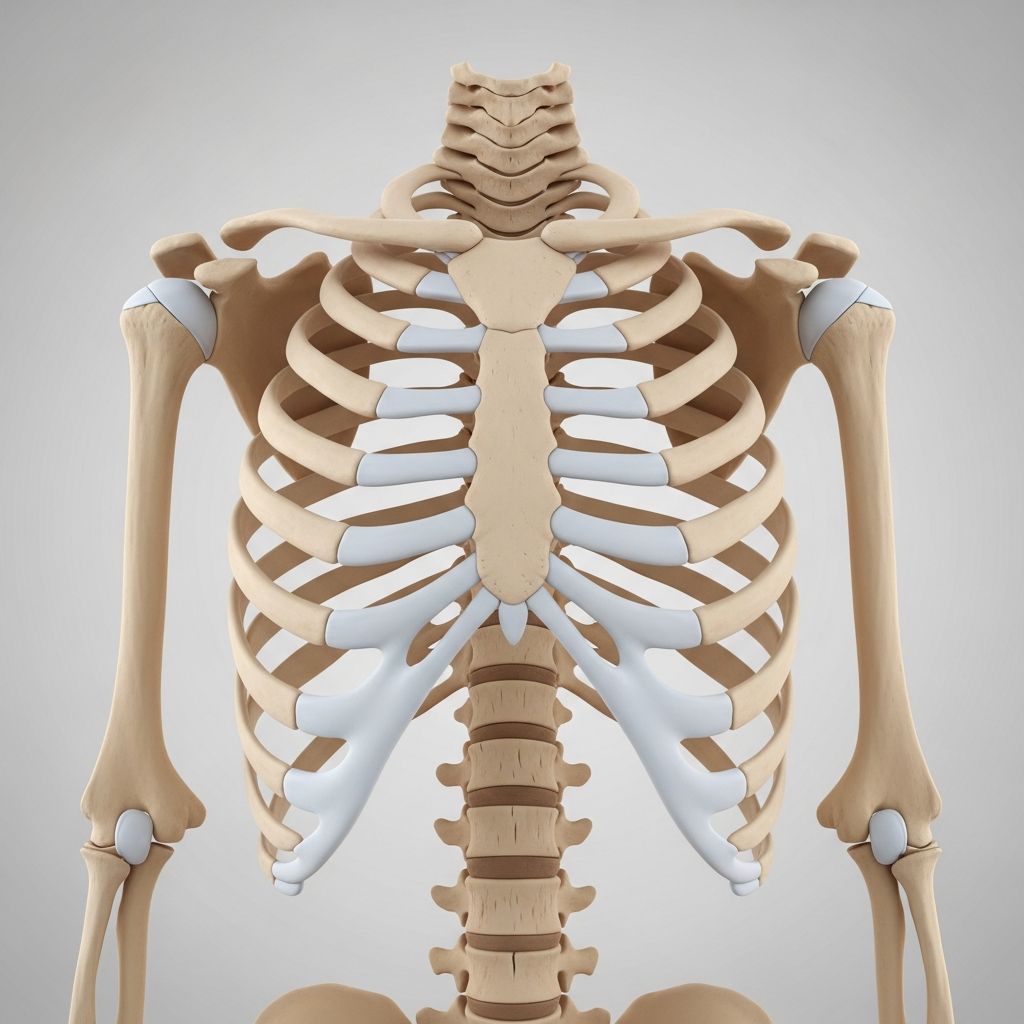
The rib cage, also known as the thoracic cage or thorax, is a semirigid skeletal structure that forms the chest cavity. It consists of 12 thoracic vertebrae, 24 ribs organized into 12 pairs, and the sternum (breastbone). This sophisticated arrangement creates a protective enclosure that surrounds and safeguards your heart, lungs, and other vital organs located within your thoracic cavity.
The rib cage is semirigid yet expansile, meaning it can increase and decrease in size while maintaining structural integrity. This flexibility is essential for allowing your lungs to expand during breathing while still providing robust protection for delicate internal organs. The ribs themselves are curved bones that wrap around your thorax, extending from your spine at the back to your sternum at the front.
Anatomy of the Rib Cage
Basic Structure and Components
Your complete rib cage consists of multiple interconnected components working together as an integrated system. The structure includes the 12 thoracic vertebrae of your spine, which form the posterior (back) attachment point for your ribs. The sternum, positioned at the center front of your chest, serves as the anterior (front) anchor point for most ribs. Small joints between your ribs and vertebrae permit gliding motion, allowing your ribs to move during breathing and other activities.
Each rib is a long, curved bone that extends from your thoracic spine toward the front of your chest. With each succeeding rib from the first (uppermost) to the twelfth (lowest), the curvature becomes progressively more open, creating a wider, more spacious lower chest cavity that accommodates the diaphragm and allows for greater expansion during breathing.
Classification of Ribs
Your 12 ribs are classified into three distinct categories based on how they attach to your sternum and other structures:
True Ribs (First Seven Ribs)
The first seven ribs are called true ribs because they attach directly to your sternum through flexible connective tissues called costal cartilages. These cartilages allow for slight movement while maintaining firm attachment. True ribs provide primary structural support and protection for your heart and upper lungs. Their direct attachment to the sternum makes them particularly stable and load-bearing.
False Ribs (Ribs Eight Through Ten)
The next three ribs, numbered eight through ten, are termed false ribs because they do not attach directly to your sternum. Instead, their costal cartilages connect to the cartilage of the rib above them, creating an indirect attachment system. This arrangement allows for more flexibility in the lower chest region while still providing structural support. These ribs are particularly involved in the bucket-handle breathing motion of your lower chest.
Floating Ribs (Ribs Eleven and Twelve)
Your bottom two ribs are called floating ribs because they have the most limited attachments of all ribs. These ribs attach only to your thoracic spine at the back and do not connect to your sternum or to the ribs above them at the front. Instead, their costal cartilages end in the muscles of your abdominal wall. This unique arrangement provides maximum flexibility for abdominal movement and diaphragmatic function while still offering some structural support and protection to lower organs.
Related Stories



Connecting Tissues and Attachments
Your ribs connect to your vertebrae and sternum through several types of tissues. Costal cartilages are pliable connective tissues that attach ribs to the sternum, allowing for flexibility and cushioning. Ligamentous attachments between your ribs and vertebrae limit excessive motion, preventing injury while permitting the controlled gliding movements necessary for breathing. The small joints between your ribs and thoracic vertebrae allow specialized sliding motion that enables your rib cage to expand and contract efficiently.
Functions of Your Rib Cage
Protection of Vital Organs
The primary function of your rib cage is to protect your most vital organs from injury. Your heart, lungs, and other thoracic organs are surrounded and shielded by this bony framework. The curved design of the ribs creates a dome-shaped protective enclosure that absorbs impact and prevents penetrating injuries from reaching these sensitive structures. Without this protective cage, even minor trauma to your chest could result in life-threatening damage to your heart or lungs.
Breathing and Respiratory Function
Your rib cage plays an essential role in the mechanics of respiration. When you inhale, your diaphragm (the primary breathing muscle) contracts and moves downward, while your external intercostal muscles contract to pull your ribs upward and outward. This coordinated action expands your rib cage, increasing the volume of your thoracic cavity and creating negative pressure that draws air into your lungs. When you exhale, your internal intercostal muscles contract, pulling your ribs downward and inward, which decreases the volume of your thoracic cavity and pushes air out of your lungs.
Your rib cage motion occurs in two distinct patterns: your upper chest primarily lifts front-to-back in what’s called pump-handle motion, while your lower ribs widen side-to-side in bucket-handle motion. Together, these movements create the volume and pressure changes necessary for efficient breathing.
Support and Structural Integrity
Beyond protection and breathing, your rib cage provides crucial structural support for your entire upper body. The sternum connects to your clavicles (collarbones) and forms the foundation for your shoulder girdle attachment. Various chest and abdominal muscles connect to your sternum and ribs, using these structures as anchor points for movement and stability. This interconnected system of bones, cartilage, and muscles creates a stable yet flexible framework that supports your posture and enables upper body movement.
Intercostal Muscles: The Active Component
Structure and Organization
The intercostal muscles are the muscular tissues that link each rib to its neighboring ribs, spanning the intercostal spaces (gaps between your rib bones). These muscles are part of your thoracic wall and work in coordinated sets to control rib movement. The intercostal spaces also house important nerves and blood vessels that the intercostal muscles rely upon for their function.
Three Types of Intercostal Muscles
Your intercostal muscles consist of three distinct layers, each with specific functions in respiration:
External Intercostal Muscles
The external intercostal muscles are located on the outer surface of your rib cage. During inhalation, these muscles contract and pull your ribs together and upward, expanding your rib cage and drawing air into your lungs. They work like rowing teams pulling in sync, creating the coordinated lifting motion necessary for breathing in.
Internal Intercostal Muscles
The internal intercostal muscles lie beneath the external intercostal muscles. During exhalation, these muscles contract and pull your ribs downward and inward, decreasing the volume of your rib cage and pushing air out of your lungs. Their action is complementary to the external intercostals, working in an opposing yet coordinated manner.
Innermost Intercostal Muscles
The innermost intercostal muscles are the deepest layer and provide additional support and fine-tuning to the breathing process. They work in conjunction with the internal intercostals during expiration, particularly during forced or rapid breathing.
Common Rib Cage Conditions
Costochondritis
Costochondritis is a condition that causes inflammation in the cartilage connecting your ribs to your sternum. An infection, injury, or arthritis can trigger this condition. Costochondritis typically causes sharp, stabbing rib pain and tenderness, usually felt in the sternal area and the first three sets of ribs, though pain can spread to your arms and shoulders. You may also notice warmth and tenderness in the affected area.
Slipping Rib Syndrome
Slipping rib syndrome occurs when one of your lower ribs partially dislocates, slipping in and out of place and sometimes trapping the nerve beneath it. This happens when the cartilage attaching two lower ribs together loosens or becomes unstable, causing one rib to slip in and out of place and irritating your intercostal nerve. The condition typically affects ribs eight through ten (false ribs), which don’t attach directly to your breastbone.
This syndrome is known by many names including displaced rib, clicking rib syndrome, and Cyriax syndrome. A slipping rib can cause sharp, localized pain that may eventually develop into a more diffuse pain that radiates to your upper back or flanks, making it harder to locate the source.
Rib Fractures
Broken ribs are among the most common chest injuries, typically resulting from trauma, falls, or direct impact. While rib fractures are rarely severe enough to require surgery, they do require careful management to prevent complications such as pneumothorax (collapsed lung) or injury to internal organs.
The Thoracic Spine Connection
Your thoracic spine plays a vital role in rib cage anatomy and function. Consisting of 12 vertebrae labeled T1 through T12, your thoracic spine is the middle section of your spinal column, starting at the base of your neck and ending at the bottom of your ribs. The thoracic spine is especially rigid and stable, making it the least common area of injury along your spine. Each thoracic vertebra articulates with a pair of ribs, creating the posterior anchor points for your rib cage. The intervertebral disks between thoracic vertebrae provide cushioning and allow for the controlled gliding motions necessary for breathing and upper body movement.
The Sternum: Your Rib Cage Anchor
Your sternum, or breastbone, is a flat, T-shaped bone at the center and front of your chest that serves as the primary anterior attachment point for your rib cage. The sternum protects the organs and muscles inside your chest from injury and provides essential support by connecting to your clavicles (collarbones) and the first six sets of ribs. While the sternum itself doesn’t directly assist with chest movement, the cartilage connecting your sternum to your ribs enables the minor motions that occur with each breath.
Breathing Mechanics and Rib Cage Motion
The rib cage plays a central role in the mechanics of breathing through two distinct types of motion. During quiet breathing, your upper chest primarily lifts front-to-back in pump-handle motion, while your lower ribs widen side-to-side in bucket-handle motion. During deep or forced breathing, abdominal muscles contract to help push air out more forcefully, while neck and chest muscles can help lift and lower your ribs more dramatically. Together, these coordinated motions create the volume and pressure changes that move air in and out of your lungs, enabling efficient gas exchange and oxygen delivery throughout your body.
Frequently Asked Questions
Q: How many ribs do humans have?
A: Adult humans have 12 pairs of ribs, for a total of 24 ribs, organized into true ribs, false ribs, and floating ribs based on their attachment points.
Q: Can the rib cage expand and contract?
A: Yes, the rib cage is semirigid yet expansile, able to increase and decrease in size during breathing. Small joints between ribs and vertebrae permit gliding motion essential for this movement.
Q: What organs does the rib cage protect?
A: The rib cage primarily protects your heart, lungs, and other vital thoracic organs from injury, trauma, and external impact.
Q: How do intercostal muscles help with breathing?
A: External intercostal muscles expand the rib cage during inhalation, while internal intercostal muscles contract it during exhalation, controlling the volume changes necessary for breathing.
Q: What connects the ribs to the sternum?
A: Costal cartilages, which are pliable connective tissues, attach the ribs to the sternum, allowing for flexibility and movement while maintaining structural integrity.
Q: Are floating ribs less important than other ribs?
A: While floating ribs have more limited attachments than other ribs, they still provide important structural support and protection to lower organs while allowing maximum flexibility for abdominal and diaphragmatic movement.
References
- Rib Cage | Anatomy & Function — Britannica. Accessed December 2025. https://www.britannica.com/science/rib-cage
- Sternum (Breastbone): What It Is, Where It Is & Anatomy — Cleveland Clinic. https://my.clevelandclinic.org/health/body/sternum-breastbone
- Intercostal Muscle Function & Anatomy — Cleveland Clinic. https://my.clevelandclinic.org/health/body/intercostal-muscles
- Slipping Rib Syndrome: Symptoms & Treatment Options — Cleveland Clinic. https://my.clevelandclinic.org/health/diseases/slipping-rib-syndrome
- Thoracic Spine: What It Is, Function & Anatomy — Cleveland Clinic. https://my.clevelandclinic.org/health/body/22460-thoracic-spine
- Chest (Thorax) Anatomy & Function — Cleveland Clinic. https://my.clevelandclinic.org/health/body/chest-thorax
Similar Articles








Read full bio of Sneha Tete