Right Brain vs Left Brain: Separating Myth from Science
Discover the truth behind left-brain and right-brain dominance theories in modern neuroscience.
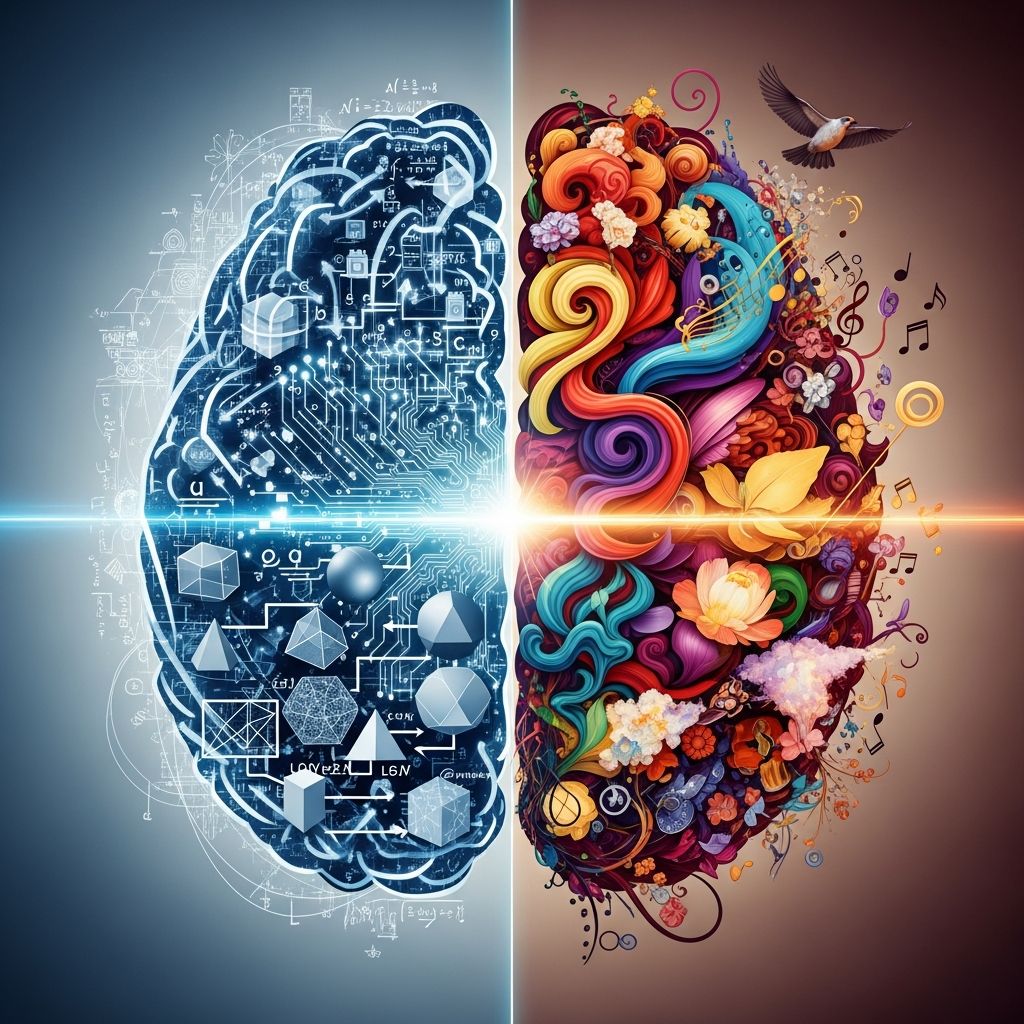
For decades, popular culture has perpetuated the idea that people are either “left-brained” or “right-brained.” According to this theory, left-brained individuals are analytical, logical, and methodical, while right-brained people are creative, intuitive, and emotional. Many of us have even taken online quizzes to determine which category we fall into, using the results to explain our personalities, career choices, and learning styles. However, modern neuroscience research has substantially challenged this widely accepted belief, revealing that the reality of how our brains function is far more complex and integrated than this simple dichotomy suggests.
The Origin of the Left-Brain, Right-Brain Theory
The left-brain versus right-brain dominance theory emerged from groundbreaking neuroscience research conducted in the 1960s. Psychobiologist Roger W. Sperry and psychology professor Michael Gazzaniga were among the first scientists to systematically investigate hemispheric lateralization—the concept that each side of the brain specializes in different functions. Their research focused on split-brain patients, individuals who had undergone surgery to sever the corpus callosum, the bundle of nerves connecting the two hemispheres. This procedure was performed to treat severe epilepsy by preventing seizures from spreading between hemispheres.
Through their innovative split-brain experiments, Sperry and Gazzaniga made several important discoveries about brain function. They found that the left hemisphere controls speech, language comprehension, and the ability to recognize words, letters, and numbers. Additionally, the left hemisphere handles analysis and mathematical calculations. In contrast, the right hemisphere appeared to control creativity, spatial perception, and the recognition of faces, places, and objects. These findings were revolutionary at the time, and Sperry’s work was so significant that he won the Nobel Prize for his contributions to neuroscience.
How the Myth Developed and Spread
Based on Sperry and Gazzaniga’s research, a compelling narrative developed: people who excelled in mathematics and logical reasoning were “left-brained,” while artists, musicians, and creative thinkers were “right-brained.” This framework provided an intuitive way to categorize personality types and cognitive styles. The simplicity and appeal of this theory made it perfect for popular consumption. It spread rapidly through self-help books, educational materials, workplace seminars, and social media quizzes. The concept resonated with people because it offered a straightforward explanation for individual differences in thinking styles and abilities.
Furthermore, the left-brain, right-brain framework became so embedded in popular culture that it seemed to explain nearly everything about human behavior and cognition. People began using brain dominance to justify career choices, learning preferences, and even relationship compatibility. Terms like “golden brain” emerged to describe people who supposedly utilized both sides of their brain equally, similar to how some people are ambidextrous in their handedness.
The Scientific Evidence Against Brain Dominance
While Sperry and Gazzaniga’s original findings about hemispheric specialization contained kernels of truth, subsequent research has thoroughly debunked the idea of brain dominance. In 2013, a landmark study conducted by researchers at the University of Utah analyzed brain imaging scans of over 1,000 individuals ranging in age from seven to 29 years old. The researchers divided the brain into 7,000 distinct regions and examined activity patterns across these regions.
The results were clear and definitive: there was no evidence that any individual showed greater brain activity on one side compared to the other. The study found that brain activity was remarkably similar across both hemispheres, contradicting the fundamental premise of the dominance theory. Additionally, analyses of brain scans revealed no correlation between brain structure and thinking style. As Dr. Robert Shmerling, a faculty editor at Harvard Health Publishing, noted, if you performed a CT scan, MRI scan, or even an autopsy on the brain of a mathematician and compared it to the brain of an artist, you would find little structural difference between them.
Related Stories



This finding was particularly striking because it suggested that the differences in cognitive abilities and creative talents among individuals cannot be attributed to the dominance of one brain hemisphere over another. Instead, these differences arise from variations in neural connections, experiences, practice, and other complex factors.
Key Misconceptions and What Research Actually Shows
The 2013 University of Utah study and subsequent research have identified several key misconceptions about brain function:
Misconception 1: One Side of the Brain Dominates
Research clearly demonstrates that the human brain does not favor one side over the other in healthy individuals. While certain areas of the brain may have stronger neural connections for specific functions, this does not mean that one hemisphere is more dominant or that we use one side primarily during most activities. Both hemispheres contribute to virtually all cognitive tasks, working in concert to process information and generate responses.
Misconception 2: We Use Only One Brain Side at a Time
Perhaps one of the most damaging misconceptions is the idea that people use only one side of their brain at any given time. In reality, both sides of the brain work together simultaneously during virtually all activities. For example, while the left hemisphere may handle the computational aspects of mathematical problem-solving, the right hemisphere contributes by helping with estimates and numerical comparisons. Similarly, while reading involves language processing typically associated with the left hemisphere, the right hemisphere helps interpret context, emotion, and spatial layout of text.
Misconception 3: Brain Structure Determines Cognitive Ability
Another widespread misconception holds that brain size or the relative size of each hemisphere correlates with intelligence or cognitive ability. Research has consistently shown that this is not the case. Intelligence and cognitive abilities depend far more on the strength and efficiency of neural connections, which can be developed and strengthened through practice and experience, rather than on brain size or hemisphere dominance.
The Actual Specialization of Brain Hemispheres
While the dominance theory has been debunked, it remains true that different parts of the brain are indeed specialized for different functions. This specialization, however, does not translate into one hemisphere being more important or more used than the other.
The left hemisphere does show specialization for language production and comprehension, as well as for detailed analytical and mathematical processing. The right hemisphere shows specialization for spatial reasoning, visual-spatial processing, and certain aspects of emotional processing. Importantly, research has also revealed that the right hemisphere plays a crucial role in creativity, particularly in the ability to combine remote concepts into novel and useful ideas through associative processing.
However, these specializations represent divisions of labor rather than evidence of dominance. Both hemispheres communicate constantly through the corpus callosum, sharing information and working together to create our unified experience of the world. When you engage in any complex task—whether solving a mathematical equation, creating a work of art, or having a conversation—both sides of your brain are actively involved.
Evidence from Brain Imaging and Neuroscience
Modern neuroimaging technology has provided unprecedented insights into how the brain actually functions. Functional MRI scans, PET scans, and other advanced imaging techniques allow researchers to observe brain activity in real-time as people engage in various cognitive tasks. These studies consistently show that both hemispheres light up during complex cognitive activities, not just one side.
Research has also examined individuals who have suffered damage to one hemisphere or the other. Surprisingly, people who have lost significant portions of one hemisphere due to injury or surgical removal often retain the cognitive abilities associated with that hemisphere. For instance, some individuals with extensive damage to the left hemisphere can still develop language abilities, or those with right hemisphere damage retain spatial reasoning skills. This neuroplasticity demonstrates that brain function is not rigidly localized to one hemisphere and that the brain possesses remarkable flexibility.
Implications for Education and Personal Development
The debunking of the left-brain, right-brain myth has important implications for education and personal development. If people are not inherently “left-brained” or “right-brained,” then traditional educational approaches that cater to supposed brain dominance types may not be scientifically justified.
Instead of categorizing students as left-brained or right-brained and tailoring education accordingly, educators should recognize that all students benefit from approaches that engage both analytical and creative thinking. A student learning mathematics benefits not only from logical problem-solving strategies but also from visual and spatial approaches to understanding mathematical concepts. Similarly, an art student benefits from understanding the technical and analytical principles underlying their creative work.
The research suggests that individuals should work to develop skills across multiple domains rather than limiting themselves based on assumed brain dominance. Since both sides of the brain work together, and since neural connections strengthen with practice, people can become more skilled in both analytical and creative pursuits through deliberate effort and practice.
How the Brain Actually Works: An Integrated System
Modern neuroscience reveals that the brain is best understood as an integrated system rather than as two separate entities competing for dominance. The brain contains approximately 100 billion neurons connected by roughly 100 trillion connections, forming what might be described as an information superhighway. This extraordinary complexity cannot be reduced to a simple left-brain versus right-brain dichotomy.
Every task you perform, from the most routine to the most complex, involves extensive communication between brain regions across both hemispheres. When you learn something new, both sides of your brain work together to help you acquire and integrate that knowledge. The corpus callosum, containing approximately 200 million nerve fibers, facilitates this constant communication, allowing information processed in one hemisphere to be instantly shared with the other.
This integrated approach explains why people are rarely naturally good at only analytical tasks or only creative tasks. Most successful professionals and creative individuals demonstrate competence in both domains. A great engineer needs both strong analytical skills and creative problem-solving abilities. A successful artist must understand both the creative vision and the technical execution required to bring that vision to life.
Frequently Asked Questions
Q: If the left-brain, right-brain theory is a myth, why is it still so popular?
A: The theory persists because it offers a simple, intuitive framework for understanding individual differences in cognition and personality. People find it satisfying to have a straightforward explanation for why they might prefer certain types of activities or careers. Additionally, the theory entered popular culture so thoroughly that it has become self-perpetuating, widely taught in schools and featured in popular media despite lacking scientific support.
Q: Are there any real differences between the left and right hemispheres?
A: Yes, there are genuine differences in specialization. The left hemisphere specializes in language and detailed analysis, while the right hemisphere excels at spatial processing and certain aspects of emotional recognition. However, these specializations do not mean one hemisphere is more important or that people use one side more than the other.
Q: Can I develop skills in both analytical and creative thinking?
A: Absolutely. Since both hemispheres work together and neural connections strengthen through practice, you can develop competence in both analytical and creative pursuits. The brain’s neuroplasticity means you’re not limited by any supposed brain dominance.
Q: Does brain size correlate with intelligence?
A: No. Research has consistently shown that brain size does not correlate with intelligence or cognitive ability. Intelligence depends more on the efficiency and strength of neural connections, which can be developed through practice and experience.
Q: How should this information change education approaches?
A: Educators should avoid categorizing students as “left-brained” or “right-brained” and instead provide balanced instruction that engages both analytical and creative thinking across all subjects and student populations.
References
- Left brain vs. right brain: fact or fiction? — Atlassian. 2024. https://www.atlassian.com/blog/productivity/left-brain-vs-right-brain
- Neuromyths Part 3: Right Brain/Left Brain — Flexible Teaching Toolkit. https://flexibleteachingtoolkit.com/?p=171
- The Science Behind the Left and Right Brain — University of Toronto, Student Centre for Community Engagement. https://scc.sa.utoronto.ca/content/the-science-behind-the-left-and-right-brain/
- Debunking the Left vs. Right Brain Myth — Invent.org. https://www.invent.org/blog/trends-stem/left-right-brain-functions-myth
- The Myth of the Left-Brained Versus Right-Brained Person — Mathnasium. https://www.mathnasium.com/math-centers/needham/news/the-myth-of-the-left-brained-versus-right-brained-person
- Debunking the Left-Brain, Right-Brain Myth — Harvard Health Publishing. 2017. https://www.health.harvard.edu/blog/right-brainleft-brain-right-2017082512222
Similar Articles








Read full bio of medha deb