Risk Factors for Melanoma and Keratinocytic Cancers
Understand key risk factors for melanoma, BCC, and SCC to enable early detection and prevention through informed skin surveillance.
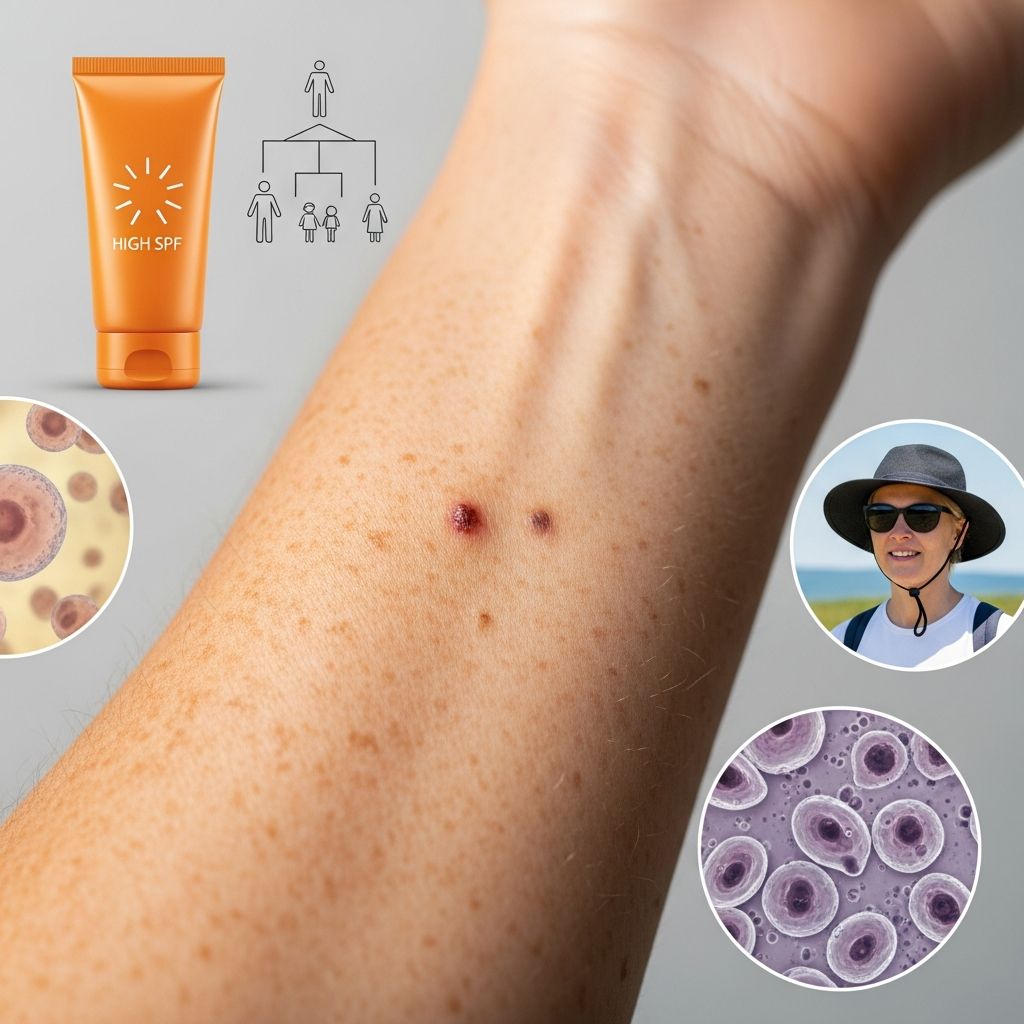
High-risk individuals exhibit specific characteristics that warrant regular skin examinations due to elevated susceptibility to melanoma and keratinocytic cancers such as basal cell carcinoma (BCC) and squamous cell carcinoma (SCC). Over 95% of melanomas are linked to ultraviolet (UV) radiation exposure from the sun, though the association is multifaceted. This article delineates risk factors for these cancers, aiding in risk profiling for proactive surveillance, particularly in teledermatology contexts where early detection via remote imaging can expedite diagnosis.
Risk Factors for Melanoma
Melanoma risk factors are well-characterized, primarily revolving around UV exposure patterns, phenotypic traits, and genetic predispositions. Intermittent intense sunburns, especially in youth, combined with numerous melanocytic naevi (moles), significantly elevate risk in younger adults. Conversely, older men with sun-damaged skin and slowly enlarging atypical lentigines represent another high-risk cohort.
UV Exposure and Sunburn History
More than 95% of melanomas correlate with UV radiation, particularly episodic intense exposures leading to sunburns rather than chronic low-level damage. Childhood and adolescent sunburns multiply lifetime risk, as UV-induced DNA damage in melanocytes promotes malignant transformation. Teledermatology studies underscore the urgency of early detection in sunburn-prone individuals, showing high diagnostic concordance when dermoscopic images are used.
Skin Phenotype and Phototype
Fair skin that burns easily (Fitzpatrick skin phototypes I-II), light hair, green or blue eyes, and freckling predispose individuals to melanoma. These traits impair melanin-mediated UV protection, increasing susceptibility. Genetic studies confirm heritability in fair-skinned populations.
Number of Moles (Melanocytic Naevi)
Individuals with over 100 common acquired moles or multiple atypical naevi face substantially higher melanoma risk. Younger adults with dysplastic naevus syndrome exemplify this profile. Total body photography in teledermatology enhances monitoring of high-nevi patients.
Family and Personal History
Family history of melanoma, especially in first-degree relatives, signals genetic risk via mutations like CDKN2A. Personal history of prior melanoma or non-melanoma skin cancers further amplifies odds.
Other Factors
Immunosuppression from organ transplants or drugs heightens risk across skin cancers, including rare melanomas like acrolentiginous or mucosal types, which occur equally across skin types. Online risk calculators exist but often rely on non-local data, limiting precision.
Risk Factors for Basal Cell Carcinoma (BCC)
BCC risk mirrors melanoma in many ways but lacks strong ties to mole count. Cumulative and intermittent UV exposure drives most cases, with fair skin and male sex predominant.
UV Exposure Patterns
Both chronic occupational sun exposure and recreational sunburns contribute, though data on precise patterns is sparser than for melanoma.
Phenotypic Risks
Light skin phototypes, prior sunburns, and male gender (due to historical outdoor work) are key. Family history may play a larger role than in melanoma.
Genetic Syndromes
Rare syndromes like basal cell naevus (Gorlin) syndrome predispose to multiple BCCs via PTCH1 mutations.
Related Stories



Risk Factors for Actinic Keratosis and Squamous Cell Carcinoma (SCC)
Unlike melanoma and BCC, actinic keratosis (AK) and SCC stem predominantly from cumulative lifetime UV damage, not intermittent sunburns.
Cumulative Sun Exposure
Outdoor occupations or recreations accumulate damage, manifesting as AK precursors to SCC. Fair, burn-prone skin heightens vulnerability.
Immunosuppression
Immunosuppressive therapies, especially post-transplant, dramatically increase AK and SCC incidence—up to 100-fold—necessitating vigilant surveillance.
Syndromes and Other Risks
Genodermatoses like xeroderma pigmentosum impair DNA repair, skyrocketing SCC risk from minimal UV. Chronic wounds or arsenic exposure also contribute.
High-Risk Profiles and Surveillance
High-risk profiles justify regular full-skin exams:
- Older sun-damaged men with atypical lentigines.
- Young adults with many moles and sunburn history.
- Fair-skinned individuals with family history or prior skin cancers.
- Immunosuppressed patients, e.g., transplant recipients.
Teledermatology facilitates this via store-and-forward imaging, reducing unnecessary biopsies and expediting malignant referrals. One study of 402 lesions found dermatologists deemed 63.7% benign, confirming 13.9% malignant, including 4.7% melanomas, via teledermatology. Diagnostic concordance improves with dermoscopy.
Teledermatology in Skin Cancer Risk Stratification
Teledermatology enhances risk factor-guided care by triaging high-risk lesions remotely. Referrers overdiagnose melanoma (20.8% true positives) and keratinocytic cancers, but teledermatology refines accuracy, cutting excisions of benign lesions. It shortens diagnosis-to-treatment time, vital for prognostication. Barriers like poor image quality affect 13.5% of referrals but are mitigable.
| Suspected Diagnosis | Referrals | Dermatologist: Benign (%) | Dermatologist: Malignant (%) | Histology-Confirmed Malignant |
|---|---|---|---|---|
| Melanoma | 77 | 59 (76.6%) | 18 (23.4%) | 19 |
| BCC | 82 | 23 (28.0%) | 59 (72.0%) | 26 |
| SCC | 62 | 18 (29.0%) | 44 (71.0%) | 11 |
Table adapted from teledermatology referral outcomes.
Syndromes Increasing Skin Cancer Risk
- Melanoma: Familial atypical multiple mole melanoma (FAMMM) syndrome, BAP1 syndrome.
- BCC: Gorlin syndrome, Rombo syndrome.
- SCC: Xeroderma pigmentosum, dystrophic epidermolysis bullosa.
These mandate specialized surveillance.
Frequently Asked Questions (FAQs)
What are the main risk factors for melanoma?
Key factors include UV exposure/sunburns, fair skin, many moles, family history, and immunosuppression.
How does UV exposure differ for melanoma vs. SCC?
Melanoma links to intermittent intense exposure; SCC to cumulative chronic damage.
Who needs regular skin checks?
High-risk groups: fair-skinned with sunburn history, many moles, family history, or immunosuppressed individuals.
Can teledermatology accurately diagnose skin cancer risks?
Yes, with dermoscopy, it matches in-person accuracy, reducing unnecessary procedures.
Are online melanoma risk tools reliable?
They help but often use non-local data; consult dermatologists for personalized assessment.
References
- Risk factors for melanoma and keratinocytic cancers — DermNet NZ. 2017 (updated). https://dermnetnz.org/cme/teledermatology-skin-cancer/risk-factors-for-melanoma-and-keratinocytic-cancers
- Teledermatology for Enhancing Skin Cancer Diagnosis — JMIR Dermatology. 2023-04-18. https://derma.jmir.org/2023/1/e45430/
- Teledermatology: idea, benefits and risks — PMC. 2020-05-29. https://pmc.ncbi.nlm.nih.gov/articles/PMC7262815/
- A review of telemedicine’s role in skin cancer care — PMC. 2024. https://pmc.ncbi.nlm.nih.gov/articles/PMC11065900/
- Barriers to Skin Cancer Diagnosis and Treatment — Wiley Online Library. 2024. https://onlinelibrary.wiley.com/doi/10.1002/puh2.70042
Similar Articles








Read full bio of medha deb