Rosettes In Dermoscopy: What You Need To Know
Understanding rosettes: Key dermoscopic patterns in actinic keratosis, squamous cell carcinoma, and beyond.
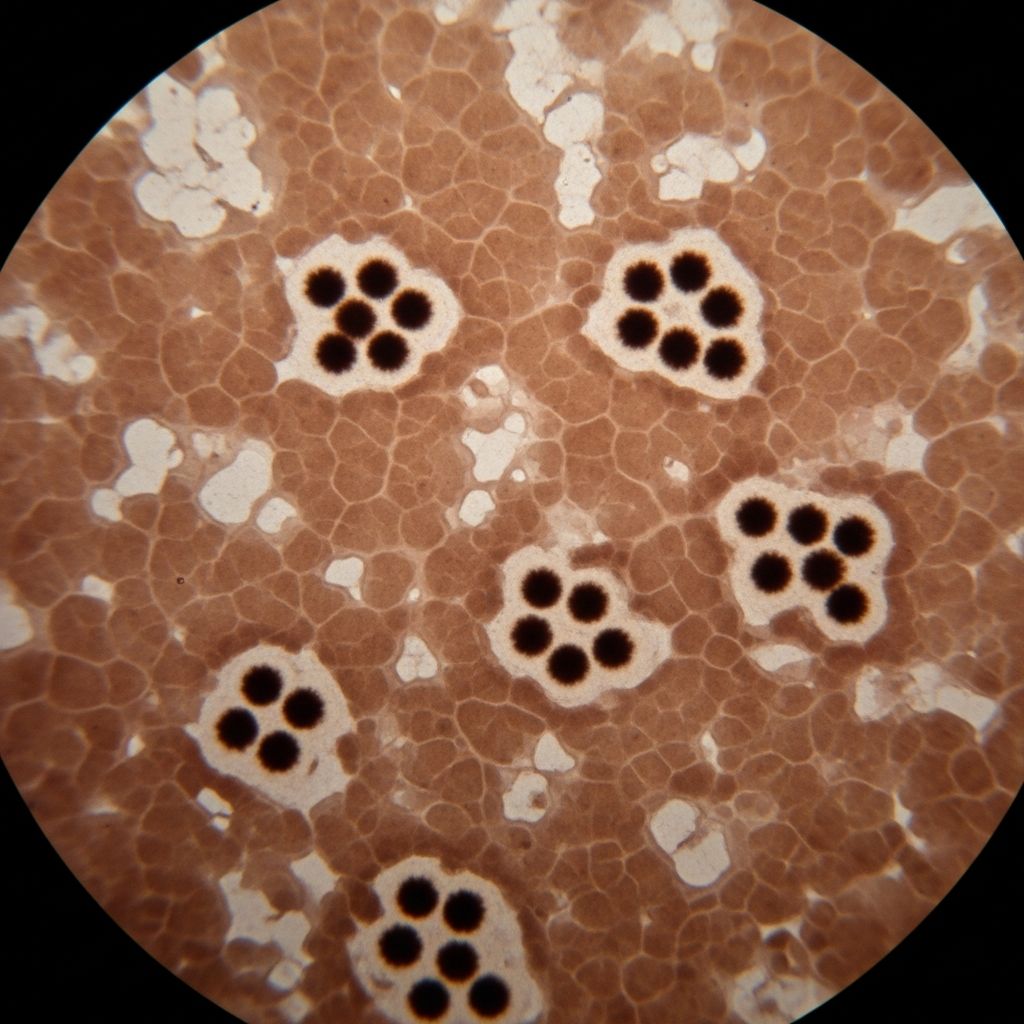
Rosettes represent a distinctive dermoscopic feature visible exclusively under polarised light, characterised by four white dots or globules arranged in a square formation resembling a four-leaf clover. Initially regarded as highly specific for actinic keratosis (AK) and squamous cell carcinoma (SCC), rosettes have since been identified across a broader spectrum of skin lesions, underscoring their non-specific nature in modern dermatoscopy.
What are rosettes?
Rosettes, also termed four-dot clods, emerge as a specialised manifestation of shiny white structures observable only through polarised dermoscopy. This technique filters light to highlight subsurface skin features invisible under non-polarised illumination. The classic rosette comprises four bright white dots, typically measuring 0.1–0.5 mm in diameter, uniformly oriented at the same angle, evoking the shape of a four-leaf clover. Smaller rosettes (0.1–0.2 mm) contrast with larger variants (0.3–0.5 mm), each potentially correlating to distinct histological elements.
These structures arise from the interplay between polarised light and keratin-filled or fibrotic adnexal openings, such as follicular infundibula or eccrine ducts. The optical anisotropy of compacted keratin or peri-follicular fibrosis refracts light, producing the characteristic four-point pattern. While not tied to a single histopathological entity, rosettes reliably indicate keratin accumulation or fibrotic changes around adnexal structures.
Appearance on dermoscopy
Under polarised dermoscopy, rosettes appear as crisp, white, quadrilateral dot clusters, invariably aligned parallel to one another across the lesion. Their visibility demands polarised mode; non-polarised dermoscopy fails to reveal them. Rosettes may cluster focally or distribute diffusely, with counts exceeding three per field suggesting a generalised pattern, as noted in plaque psoriasis cases.
Size differentiation aids interpretation: diminutive rosettes align with infundibular keratin plugs, whereas larger forms suggest concentric peri-follicular fibrosis. In high-magnification views (×10–×70), rosettes stand out against variably coloured backgrounds—orange-yellow in keratinising lesions or pink in inflammatory contexts. Accompanying features include white scales, dotted vessels, or structureless zones, contextualising the rosette within the lesion’s dermoscopic landscape.
- Key visual traits: Four equidistant white dots in square array.
- Size range: 0.1–0.5 mm.
- Orientation: Uniform angular alignment.
- Exclusivity: Polarised light only.
Lesions with rosettes
Though rosettes were first championed as pathognomonic for AK and SCC, subsequent observations expanded their diagnostic scope. They appear in neoplastic, inflammatory, infectious, and even normal skin, diminishing their specificity while enhancing utility as a non-specific keratinopathy marker.
Actinic keratosis and squamous cell carcinoma
Rosettes achieve highest prevalence in AK (pre-malignant keratinocyte proliferations) and SCC (invasive malignancies), often numbering prominently amid orange pseudopigment, white scales, and hairpin vessels. In AK, rosettes pepper the surface, reflecting infundibular hyperkeratosis; in SCC, they signal advanced keratinisation and fibrosis. Their density correlates with lesion severity, aiding triage for biopsy.
Other skin lesions
Beyond actinic tumours, rosettes manifest in diverse pathologies:
- Lichen planus: Hyperkeratosis forms ‘keratin-filled craters’ yielding rosettes amid Wickham striae.
- Perniosis (chilblains): Peri-eccrine inflammation and wavy hyperkeratosis produce rosettes on oedematous toes.
- Lichen sclerosus et atrophicus: Follicular plugging in atrophic plaques generates rosettes.
- Plaque psoriasis: Diffusely scattered rosettes (often generalised >3 per field) accompany dotted vessels and white networks, linked to peri-follicular hyperkeratosis.
- Apocrine hidrocystoma: Cystic structures with keratin debris evoke rosettes.
- Photo contact dermatitis: Inflammatory keratin changes mimic rosettes.
- Additional reports: Melanoma (incipient pigmented forms), basal cell carcinoma, dermatofibroma, molluscum contagiosum, lichen planus-like keratosis, discoid lupus erythematosus, pigmented purpuric dermatoses.
Related Stories



This heterogeneity positions rosettes as a versatile indicator of adnexal keratin-fibrosis interplay, transcending disease categories.
Normal skin
Rosettes occasionally pepper clinically unremarkable skin, particularly in sun-exposed areas, attributable to physiologic follicular keratin. Their presence alone neither mandates biopsy nor dismisses pathology; integration with global dermoscopic context remains paramount.
Histological explanation
The precise histogenesis of rosettes eludes consensus, but predominant theories invoke optical phenomena over true structural patterns. Polarised light interacts with birefringent materials—compacted keratin or collagen—yielding artefactual four-dot arrays.
Haspeslagh et al. elucidated correlations: small rosettes (0.1–0.2 mm) match concentric horny plugs in follicular/eccrine infundibula; larger rosettes (0.3–0.5 mm) correspond to peri-follicular fibrosis. In psoriasis, compact hyperkeratosis with parakeratosis and elongated rete ridges underpins rosettes, with peri-eccrine involvement in chilblains.
| Case | Diagnosis | Histological Correlate for Rosettes |
|---|---|---|
| Lichen sclerosus | Follicular plugging | |
| Lichen planus | Hyperkeratosis with sharp depressions (keratin craters) | |
| Perniosis | Hyperkeratosis with wavy margins, peri-eccrine inflammation | |
| Apocrine hidrocystoma | Keratin debris in cystic spaces | |
| Photo contact dermatitis | Epidermal hyperplasia with parakeratosis |
Alternative postulates include lamellar hyperkeratosis exhibiting optical anisotropy or dilated keratin-filled ostia. Irrespective, rosettes flag keratin-centric histopathology, guiding targeted biopsies.
Frequently Asked Questions
What causes rosettes in dermoscopy?
Rosettes result from polarised light refracting off keratin-filled adnexal openings or fibrotic peri-follicular sheaths, creating a four-dot optical effect.
Are rosettes specific to actinic keratosis?
No, while common in AK and SCC, rosettes appear in inflammatory (psoriasis, lichen planus), infectious, and normal skin, rendering them non-specific.
Can rosettes appear in normal skin?
Yes, particularly sun-exposed areas, due to physiologic keratin in follicles; context determines clinical relevance.
How do small vs. large rosettes differ histologically?
Small (0.1–0.2 mm): infundibular keratin plugs; large (0.3–0.5 mm): concentric peri-follicular fibrosis.
Is polarised light required to see rosettes?
Exclusively; non-polarised dermoscopy conceals them.
Clinical implications
Rosettes enhance dermoscopic repertoire, prompting consideration of keratinising pathologies. In suspicious lesions, abundant rosettes bolster AK/SCC suspicion, yet their ubiquity necessitates holistic pattern analysis. Emerging data from psoriasis and inflammatory cohorts suggest prognostic or monitoring roles, warranting prospective studies.
Dermoscopists should document rosette density, size, and distribution, correlating with vascular/architectural features for refined diagnostics. Training emphasises polarised mode proficiency to avoid missing this versatile sign.
References
- Rosette or Four Dot Signs in Dermoscopy: a Non-specific Observation — PMC. 2022-05-01. https://pmc.ncbi.nlm.nih.gov/articles/PMC9116560/
- Rosettes in dermoscopy – DermNet — DermNet New Zealand. 2019-02-01. https://dermnetnz.org/topics/rosettes
- Rosettes in plaque psoriasis — Cosmoderma. 2024-01-01. https://cosmoderma.org/rosettes-in-plaque-psoriasis/
Similar Articles








Read full bio of medha deb