Salivary Gland Cancer: Causes, Symptoms, and Treatment
Comprehensive guide to understanding salivary gland cancer, its types, symptoms, diagnosis, and treatment options.
Understanding Salivary Gland Cancer
Salivary gland cancer is a rare type of malignancy that originates in one of the salivary glands located inside and around the mouth. While most salivary gland tumors are benign and non-threatening, malignant cancers can develop and require prompt medical attention. Understanding the nature of this disease, its symptoms, and available treatment options is essential for patients and their families facing this diagnosis.
The Salivary Gland System
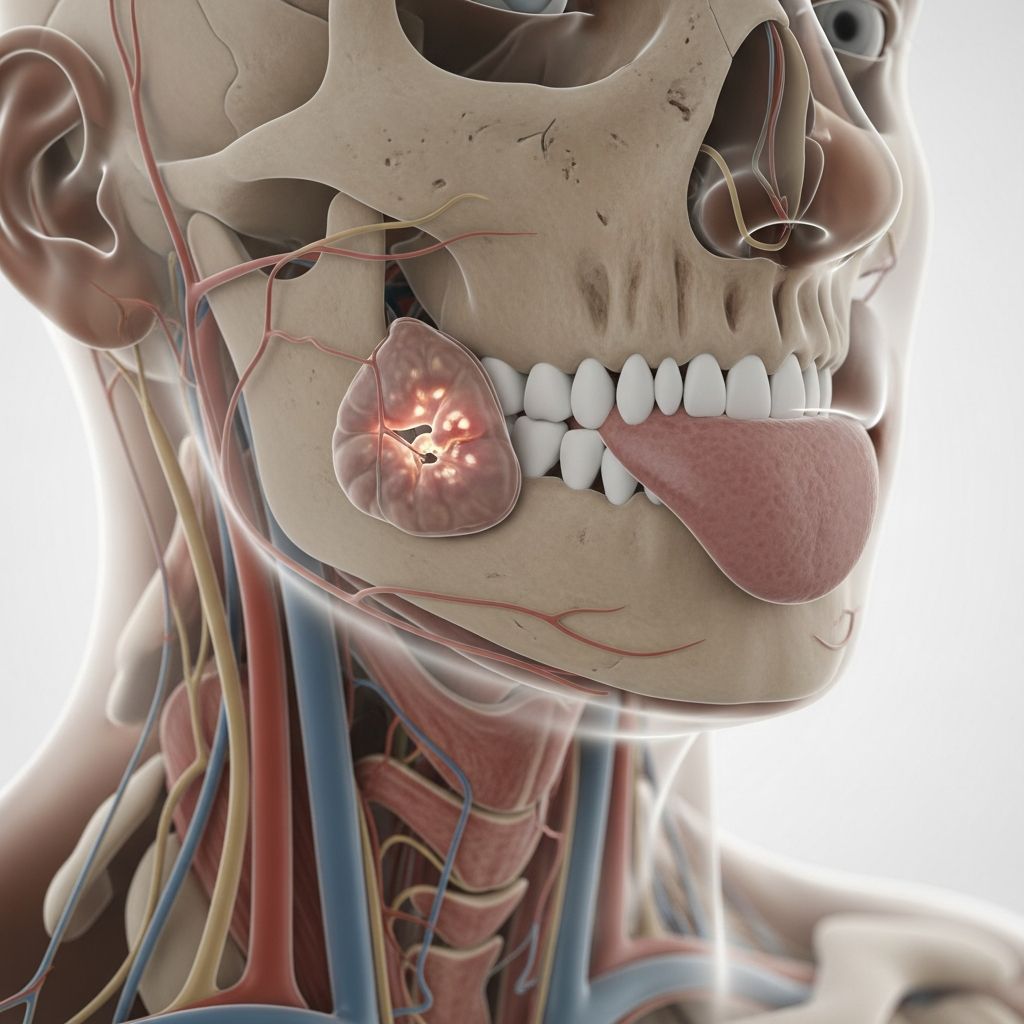
The salivary gland system consists of major and minor glands responsible for producing and releasing saliva, a crucial fluid that aids in digestion, oral lubrication, and maintaining overall oral health. Understanding the anatomy of these glands helps clarify where cancers are most likely to develop.
Major Salivary Glands
There are three pairs of major salivary glands:
Parotid Glands
The parotid glands are the largest salivary glands and are located just in front of the ears. Most salivary gland tumors originate in the parotid glands, making them the most common site for cancer development. While most parotid tumors are benign, the majority of malignant salivary gland cancers also begin in these glands.
Submandibular Glands
Located under the jawbone, the submandibular glands are the second-largest salivary glands. These glands play an important role in providing movement, feeling, and taste to the tongue and assist in moving the lower lip.
Sublingual Glands
The sublingual glands are the smallest of the major salivary glands and are situated under the tongue. They rarely develop tumors, but when cancers do occur in these glands, they are often malignant in nature.
Minor Salivary Glands
In addition to the three major gland pairs, there are hundreds of much smaller minor salivary glands scattered throughout the lining of the mouth and throat. These minor glands can also develop cancers, though less frequently than the major glands.
Types of Salivary Gland Cancer
Salivary gland cancers are an incredibly heterogeneous group of tumors, comprising 24 histologically distinct tumor types. The most common types include:
Mucoepidermoid Carcinoma
Mucoepidermoid carcinoma is one of the most frequently occurring types of salivary gland cancer. This cancer type exhibits variable behavior depending on its grade, ranging from slow-growing low-grade tumors to aggressive high-grade malignancies.
Adenoid Cystic Carcinoma
Adenoid cystic carcinoma is the second most common type of salivary gland cancer and is usually slow-growing with a low-grade appearance under laboratory examination. However, despite its seemingly indolent nature, this cancer is very difficult to eliminate completely because it tends to spread along nerves. These tumors frequently recur after treatment, sometimes many years after the initial diagnosis. The outlook is generally better when the tumor is smaller at the time of detection.
Related Stories



Salivary Duct Carcinoma
Salivary duct carcinoma (SDC) is a rare but highly aggressive salivary malignancy that is often diagnosed at an advanced stage. Recent studies of genomic alterations have significantly improved understanding of the biology and pathogenesis of this aggressive disease, opening new avenues for targeted therapy and treatment approaches.
Secretory Carcinoma
Secretory carcinoma, also known as mammary analogue secretory carcinoma, is more commonly found in minor salivary glands. These cancers tend to be low grade and grow slowly, and they occur equally in men and women.
Hyalinizing Clear Cell Carcinoma
This is another histologically distinct type of salivary gland cancer with specific genetic and molecular characteristics that distinguish it from other cancer subtypes.
Acinic Cell Carcinoma
Acinic cell carcinoma represents another distinct type of salivary gland malignancy with its own molecular profile and clinical behavior patterns.
Carcinoma Ex Pleomorphic Adenoma
These malignant mixed tumors develop from benign mixed tumors, also known as pleomorphic adenomas. Nearly all malignant mixed tumors are carcinoma ex pleomorphic adenomas, and they are found mainly in the major salivary glands. Both the grade and stage of these cancers are important in predicting outcomes.
Undifferentiated Carcinomas
This group includes small-cell undifferentiated carcinoma, large-cell undifferentiated carcinoma, and lymphoepithelial carcinoma. These are high-grade cancers that often spread, and the overall survival outlook tends to be poor.
Cancer Grading System
Salivary gland cancers are graded on a scale from 1 to 3 (or from low to high), with the grade providing important information about how quickly the cancer is likely to grow and spread. People with low-grade cancers typically have better outcomes than those with high-grade cancers.
| Grade Level | Classification | Cell Appearance | Growth Pattern | Prognosis |
|---|---|---|---|---|
| Grade 1 | Low Grade / Well Differentiated | Look very much like normal salivary gland cells | Grow slowly | Good outcome |
| Grade 2 | Intermediate Grade / Moderately Differentiated | Between Grade 1 and Grade 3 appearance | Moderate growth | Between Grade 1 and Grade 3 outcomes |
| Grade 3 | High Grade / Poorly Differentiated | Look very different from normal cells | Grow and spread quickly | Usually not as good as lower grades |
Symptoms and Warning Signs
If cancer develops in a salivary gland, it can cause various symptoms depending on the size and location of the tumor. Common warning signs include:
Local Symptoms
Patients may experience a lump or mass in front of the ears, under the jaw bone, inside the mouth, or in the neck region. These lumps may be painless initially but can grow over time.
Nerve-Related Symptoms
Salivary gland cancers can affect nearby nerves, causing facial weakness, numbness, or pain. Some patients may also experience difficulty opening the mouth fully.
Other Manifestations
Additional symptoms may include persistent swelling, difficulty swallowing, or changes in the appearance of the affected area.
Important Note: Most of these symptoms are not caused by salivary gland cancer. However, if you experience any of these symptoms for more than a few weeks, it is crucial to consult with your doctor so that problems can be diagnosed and treated as early as possible.
Risk Factors and Causes
While the exact causes of salivary gland cancer are not completely understood, certain factors may increase the risk of developing this disease. Understanding these risk factors can help individuals take preventive measures and seek appropriate medical evaluation when necessary.
Diagnosis and Evaluation
Accurate diagnosis of salivary gland cancer involves a combination of clinical evaluation, imaging studies, and tissue analysis. Healthcare providers use various diagnostic tools to confirm the presence of cancer and determine its type and stage.
Physical Examination
Your doctor will perform a thorough physical examination of the salivary glands and surrounding tissues, looking for lumps, swelling, or other abnormalities.
Imaging Studies
Imaging techniques such as ultrasound, CT scans, or MRI may be used to visualize the tumor, assess its size, and determine whether it has spread to nearby tissues or lymph nodes.
Biopsy
A tissue biopsy is often necessary to confirm the diagnosis and determine the specific type of cancer. This may involve fine-needle aspiration or core needle biopsy to obtain tissue samples for laboratory analysis.
Treatment Options
Salivary gland cancers are generally treated with surgery, and many patients receive a combination of treatments including radiation therapy depending on the size and location of the cancer. Your specialist will suggest treatment options that are suitable for your specific situation.
Surgical Treatment
Surgery is the primary treatment for most salivary gland cancers. The specific surgical approach depends on the tumor’s size, location, and stage. Surgeons may perform partial or complete removal of the affected gland.
Radiation Therapy
Radiation therapy may be used as an adjunct to surgery, particularly for larger tumors, high-grade cancers, or when the cancer has spread to lymph nodes. This treatment uses high-energy beams to target and destroy cancer cells.
Targeted Therapy
Recent advances in understanding the molecular and genetic basis of salivary gland cancers have opened new possibilities for targeted therapy approaches. For instance, research has identified specific genetic alterations in certain cancer subtypes that may be amenable to targeted treatment strategies.
Chemotherapy
In some cases, chemotherapy may be recommended, particularly for advanced or aggressive cancers that are unlikely to respond to surgery and radiation alone.
Prognosis and Outcomes
The prognosis for salivary gland cancer depends on several factors, including the cancer type, grade, stage at diagnosis, and how well the cancer responds to treatment. Low-grade tumors typically have better long-term outcomes, while high-grade and advanced-stage cancers may have less favorable prognoses. The specific genetic characteristics of the tumor, as identified through molecular analysis, may also influence treatment response and patient outcomes.
Distinguishing Benign from Malignant Tumors
Most salivary gland tumors are benign, meaning they are not cancer and will not spread to other parts of the body. These benign tumors are almost never life-threatening. There are many types of benign salivary gland tumors, with names such as pleomorphic adenoma, oncocytomas, and Warthin tumors. Benign tumors are almost always cured by surgery. Very rarely, they may become cancer if left untreated for a long time or if they are not completely removed and grow back.
Cancers That Spread to the Salivary Glands
Some cancers, like squamous cell skin cancer or melanoma, might start elsewhere but spread to the salivary glands. These cancers are treated based on where the cancer started, rather than as primary salivary gland cancers.
Frequently Asked Questions (FAQs)
Q: Is salivary gland cancer common?
A: No, salivary gland cancer is rare compared to other types of head and neck cancers. Most salivary gland tumors are benign and non-cancerous.
Q: What is the most common location for salivary gland cancer?
A: The parotid glands, which are located just in front of the ears, are the most common site for both benign and malignant salivary gland tumors.
Q: Can salivary gland cancer be cured?
A: The potential for cure depends on the cancer type, grade, stage at diagnosis, and response to treatment. Many early-stage salivary gland cancers can be successfully treated with surgery and radiation therapy.
Q: What should I do if I notice a persistent lump in my salivary glands?
A: Contact your doctor for evaluation if you notice any persistent lumps, swelling, or other symptoms lasting more than a few weeks. Early diagnosis and treatment can significantly improve outcomes.
Q: Are there new treatment options for salivary gland cancer?
A: Yes, advances in understanding the molecular and genetic basis of salivary gland cancers have led to new targeted therapy approaches and improved treatment strategies for specific cancer subtypes.
Q: How long is the recovery after salivary gland surgery?
A: Recovery time varies depending on the extent of surgery and individual factors. Most patients can resume normal activities within a few weeks, though complete healing may take several weeks to months.
References
- Salivary duct carcinoma: An aggressive salivary gland malignancy with high mortality — Johns Hopkins University, Oral Oncology Journal. 2017-11. https://pure.johnshopkins.edu/en/publications/salivary-duct-carcinoma-an-aggressive-salivary-gland-malignancy-w
- Genetic alterations in salivary gland cancers — National Institutes of Health, National Cancer Institute. 2016. https://pubmed.ncbi.nlm.nih.gov/26928905/
- Salivary Gland Cancer – What Is It? What are the Symptoms and Treatment Options — Head and Neck Cancer Australia. https://www.headandneckcancer.org.au
- What Is Salivary Gland Cancer? — American Cancer Society. 2024. https://www.cancer.org/cancer/types/salivary-gland-cancer/about/what-is-salivary-gland-cancer.html
Similar Articles








Read full bio of Sneha Tete