Salivary Glands: Location, Function & Health
Learn about your salivary glands: anatomy, functions, and how to maintain optimal oral health.
Understanding Your Salivary Glands
Your salivary glands are remarkable organs that play a crucial role in maintaining your oral health and supporting digestive processes. These glands produce saliva, a clear fluid that keeps your mouth moist and enables essential functions like swallowing, digestion, and tooth protection. Understanding the anatomy and function of your salivary glands can help you recognize potential problems early and take steps to maintain optimal oral health.
Anatomy of the Salivary Glands
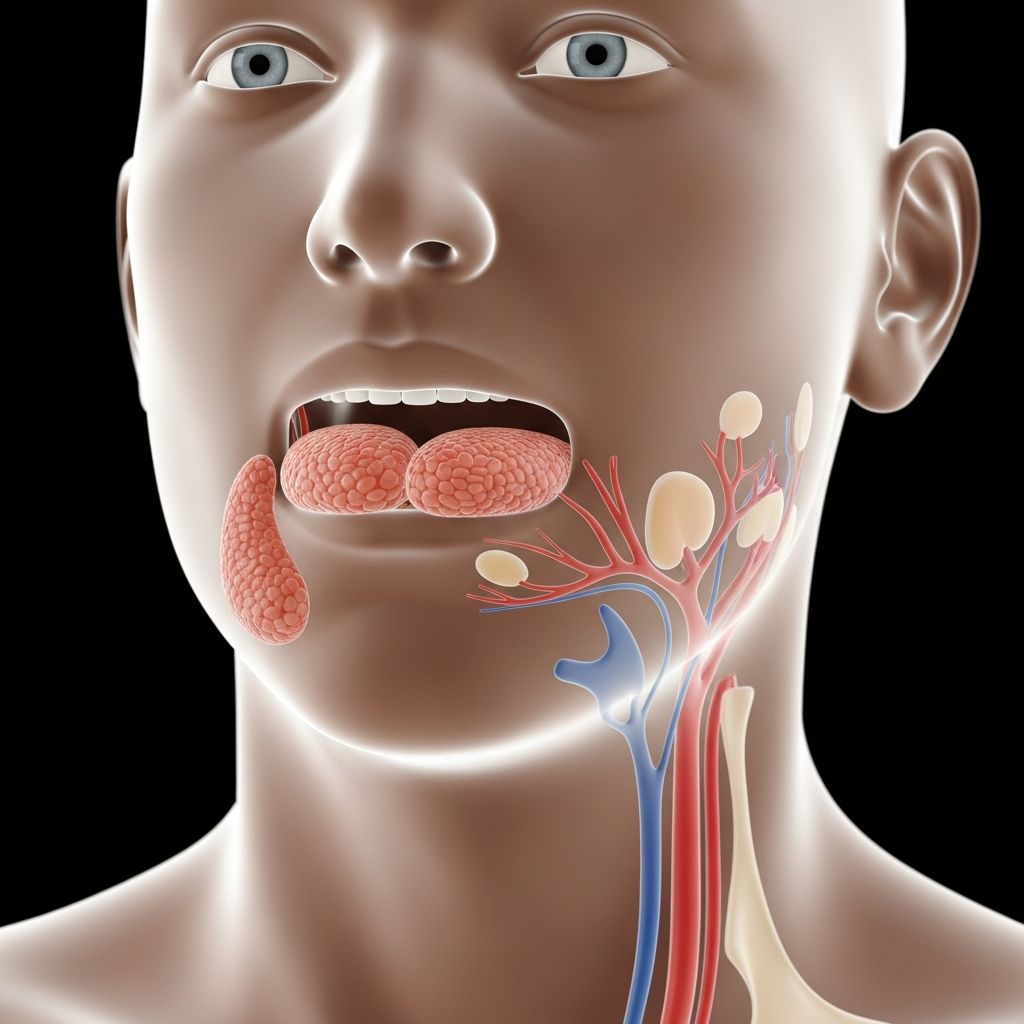
Your body contains two types of salivary glands: major salivary glands and minor salivary glands. The major glands are larger and more prominent, while the minor glands are distributed throughout your mouth and throat in smaller numbers.
Major Salivary Glands
You have three pairs of major salivary glands that contribute approximately 90% of your total saliva secretions: These glands work together to maintain adequate moisture in your mouth and support critical oral functions.
Parotid Glands
The parotid glands are the largest of your three major salivary glands. Located in front of and below each ear, these superficial glands are enclosed by the superficial layer of the deep cervical fascia in what is known as the parotid space. The saliva produced by your parotid glands enters your mouth through small ducts positioned near your upper molars. These glands are easily identified on routine imaging and contribute significantly to your overall saliva production.
Submandibular Glands
The submandibular glands are the second largest of your three major salivary glands. Positioned deep to the angle of your mandible, these glands straddle both the submandibular and sublingual spaces. The submandibular space is enveloped in the superficial layer of the deep cervical fascia and is bounded by specific anatomical landmarks including the mandible anteriorly, the anterior belly of the digastric muscle posteromedially, the mylohyoid muscle anterosuperiorly, and the hyoid bone inferiorly.
Sublingual Glands
The sublingual glands are the smallest of your three pairs of major salivary glands. Located beneath your tongue, these glands contribute to saliva production and work in conjunction with the submandibular glands to maintain oral moisture.
Minor Salivary Glands
In addition to your major salivary glands, you have hundreds of minor salivary glands distributed throughout your mouth, throat, and aerodigestive tract. These smaller glands contribute approximately 10% of your total saliva secretions but are poorly visualized on routine imaging. Despite their smaller size, these glands can still develop pathology that requires medical attention.
How Much Saliva Do You Produce?
Salivary glands make about 0.5 to 1.5 liters (2 to 6.3 cups) of saliva a day in most adults. This substantial volume of fluid is essential for maintaining oral health and supporting digestion. The production of saliva is continuous but increases in response to stimuli such as eating, tasting, or even thinking about food.
Related Stories



Functions of Saliva
Saliva performs multiple critical functions that extend beyond simply keeping your mouth moist. Understanding these functions helps illustrate why healthy salivary glands are essential for overall well-being.
Lubrication and Swallowing
One of saliva’s primary functions is to lubricate your mouth and throat, making it easier to swallow food and liquids. This lubrication is essential for comfortable eating and drinking throughout the day.
Digestion Support
Saliva contains enzymes that initiate the digestive process. These enzymes begin breaking down food particles in your mouth, preparing them for further digestion in your stomach and intestines. This initial enzymatic action is crucial for efficient nutrient absorption.
Tooth Protection
Saliva helps protect your teeth from bacteria and decay by creating an environment that inhibits bacterial growth. The antimicrobial properties of saliva help maintain a healthy oral microbiome and reduce the risk of cavities and gum disease.
Buffering Acids
Saliva neutralizes acids in your mouth that can damage tooth enamel. This buffering action is particularly important after consuming acidic foods or beverages and helps prevent erosion of your teeth.
Common Salivary Gland Conditions
Despite their resilience, salivary glands can develop various conditions that affect their function and your overall health. Recognizing symptoms of these conditions can help you seek appropriate treatment promptly.
Sialolithiasis (Salivary Stones)
Sialolithiasis, or calculus disease, is the most common benign process to affect the salivary glands, with a reported prevalence of 1.2%. This condition involves the formation of hardened mineral deposits, commonly called salivary stones, within your salivary glands.
Risk Factors and Causes
The pathogenesis of sialolithiasis is thought to be due to stagnation of saliva that is high in calcium. Risk factors include dehydration, smoking, and various medications, most commonly anticholinergics and diuretics. Understanding these risk factors can help you take preventive measures to reduce your likelihood of developing salivary stones.
Location of Salivary Stones
The majority of calculi (80-92%) are found within the submandibular gland, likely because the submandibular gland produces highly viscous saliva that must travel upward against gravity as it traverses Wharton’s duct. The remaining calculi are found in the parotid gland (6-20%) and sublingual or minor salivary glands (1-2%).
Symptoms and Diagnosis
Patients with sialolithiasis typically present with painful salivary glands, with discomfort that is often exacerbated by eating foods that precipitate saliva production. Unenhanced CT has replaced radiography as the first-line imaging test to workup sialolithiasis, primarily due to its improved sensitivity for detecting calcifications, intraglandular masses, and adjacent inflammatory changes.
Sialadenitis (Salivary Gland Infection)
Sialadenitis refers to inflammation of one or more of your salivary glands and can be caused by infections, autoimmune diseases, and salivary gland stones. When a salivary gland becomes inflamed, it can stop functioning properly, leading to discomfort and reduced saliva production.
Recovery Timeline
Sialadenitis usually goes away in about a week with conservative treatment, though if you had surgery, it could take about two weeks to fully recover. Infected or swollen salivary glands often resolve on their own or with conservative care, but if you have lingering symptoms such as swelling, pain, fever, or difficulty swallowing, you should seek medical attention.
Emergency Warning Signs
If you develop severe symptoms such as difficulty breathing or swallowing, call 911 immediately. These symptoms may indicate a serious infection requiring emergency intervention.
Sjögren’s Syndrome
Sjögren’s syndrome is an autoimmune condition that affects the salivary and lacrimal glands, causing inflammation and reduced saliva and tear production. The condition has been classified into two types, with Sjögren’s type 2 referring to autoimmune inflammation of the salivary glands associated with a systemic autoimmune process such as rheumatoid arthritis, systemic lupus erythematosus, or scleroderma.
Imaging Findings
Early changes of Sjögren’s sialadenitis on imaging include enlarged parotid glands, small cysts, and mild fatty replacement. As the disease process becomes chronic, imaging findings shift toward parotid atrophy, larger areas of fatty replacement, parenchymal calcifications, solid masses of lymph node aggregates, and either large areas of cystic destruction or multiple lymphoepithelial cysts.
Chronic Sclerosing Sialadenitis
Chronic sclerosing sialadenitis is a condition characterized by progressive inflammation and scarring of the salivary glands. The overwhelming majority of cases involve the submandibular glands, and recent literature has demonstrated a strong association with IgG4-related disease. In fact, a recent case series demonstrated IgG4 plasma cell infiltrates in 92% of patients with chronic sclerosing sialadenitis.
Diagnostic Tests for Salivary Gland Conditions
Various diagnostic tests can help healthcare providers identify salivary gland conditions and determine appropriate treatment plans.
Salivary Gland Scan
A salivary gland scan, also called parotid scintigraphy, is a noninvasive test that takes detailed pictures of your salivary glands. This test uses a camera and a radioactive substance called a tracer to identify salivary gland blockages or conditions like Sjögren’s syndrome.
How the Test Works
During a salivary gland scan, healthcare providers inject a radioactive tracer into a vein in your arm and position you in front of a special device called a gamma scintillation camera, which detects radiation and captures images. About 45 minutes into the test, your provider will give you a lemon drop or other sour substance to stimulate saliva production. As your salivary glands release saliva, your provider takes more pictures to see how much saliva remains in your ducts.
Test Results
A normal result means the tracer moves through your salivary glands without any blockage or slowdown. An abnormal result may mean that the tracer moves slowly through your glands, remains concentrated in one area, or fails to enter your mouth, all of which could indicate various conditions.
Aftercare and Recovery
A salivary gland scan is a noninvasive test that is usually painless and requires no special prep or aftercare. You can typically resume normal activities afterward.
When to Seek Medical Attention
You should contact your healthcare provider if you experience symptoms suggesting a salivary gland problem. These may include persistent swelling of salivary glands, pain when eating or drinking, difficulty swallowing, recurrent infections, or unusual changes in saliva production.
Maintaining Healthy Salivary Glands
Taking steps to maintain healthy salivary gland function can help prevent many common conditions. Stay hydrated by drinking plenty of water throughout the day, practice good oral hygiene including regular brushing and flossing, avoid smoking and excessive alcohol consumption, and maintain a balanced diet. If you take medications that may affect saliva production, discuss this with your healthcare provider to explore possible alternatives or management strategies.
Frequently Asked Questions
Q: What is the primary function of salivary glands?
A: Salivary glands produce saliva that lubricates your mouth, helps you swallow, aids in digestion, and protects your teeth from bacteria and decay.
Q: How many salivary glands do you have?
A: You have three pairs of major salivary glands (parotid, submandibular, and sublingual) and hundreds of minor salivary glands distributed throughout your mouth and throat.
Q: Why are salivary stones more common in the submandibular gland?
A: Salivary stones are more common in the submandibular gland because it produces highly viscous saliva that must travel upward against gravity through Wharton’s duct, making it prone to stagnation.
Q: How long does it take for sialadenitis to resolve?
A: Sialadenitis usually resolves in about one week with conservative treatment, though surgical cases may require up to two weeks for full recovery.
Q: Is a salivary gland scan painful?
A: No, a salivary gland scan is typically a painless, noninvasive test that requires no special preparation or recovery time.
Q: What is Sjögren’s syndrome?
A: Sjögren’s syndrome is an autoimmune condition affecting the salivary and lacrimal glands, causing reduced saliva and tear production.
Q: How much saliva does the average person produce daily?
A: Most adults produce about 0.5 to 1.5 liters (2 to 6.3 cups) of saliva per day.
References
- Review of the Major and Minor Salivary Glands, Part 1 — National Institutes of Health, National Center for Biotechnology Information. 2018. https://pmc.ncbi.nlm.nih.gov/articles/PMC6251248/
- Salivary Stones: Causes, Symptoms & Treatment — Cleveland Clinic. 2024. https://my.clevelandclinic.org/health/diseases/24344-sialolithiasis
- Salivary Gland Scan (Parotid Scintigraphy) — Cleveland Clinic. 2024. https://my.clevelandclinic.org/health/diagnostics/salivary-gland-scan
- Sialadenitis (Salivary Gland Infection): Symptoms & Treatment — Cleveland Clinic. 2024. https://my.clevelandclinic.org/health/diseases/15749-sialadenitis-swollen-salivary-gland
- Saliva (Spit): What To Know — Cleveland Clinic. 2024. https://my.clevelandclinic.org/health/body/saliva
- Salivary Gland Cancer: Symptoms, Causes & Treatment — Cleveland Clinic. 2024. https://my.clevelandclinic.org/health/diseases/17965-salivary-gland-cancer
Similar Articles








Read full bio of medha deb