Saturated vs Unsaturated Fat: 4 Differences for Heart Health
Understand the differences between saturated and unsaturated fats, their health impacts, and how to incorporate healthier options into your diet for better heart health.
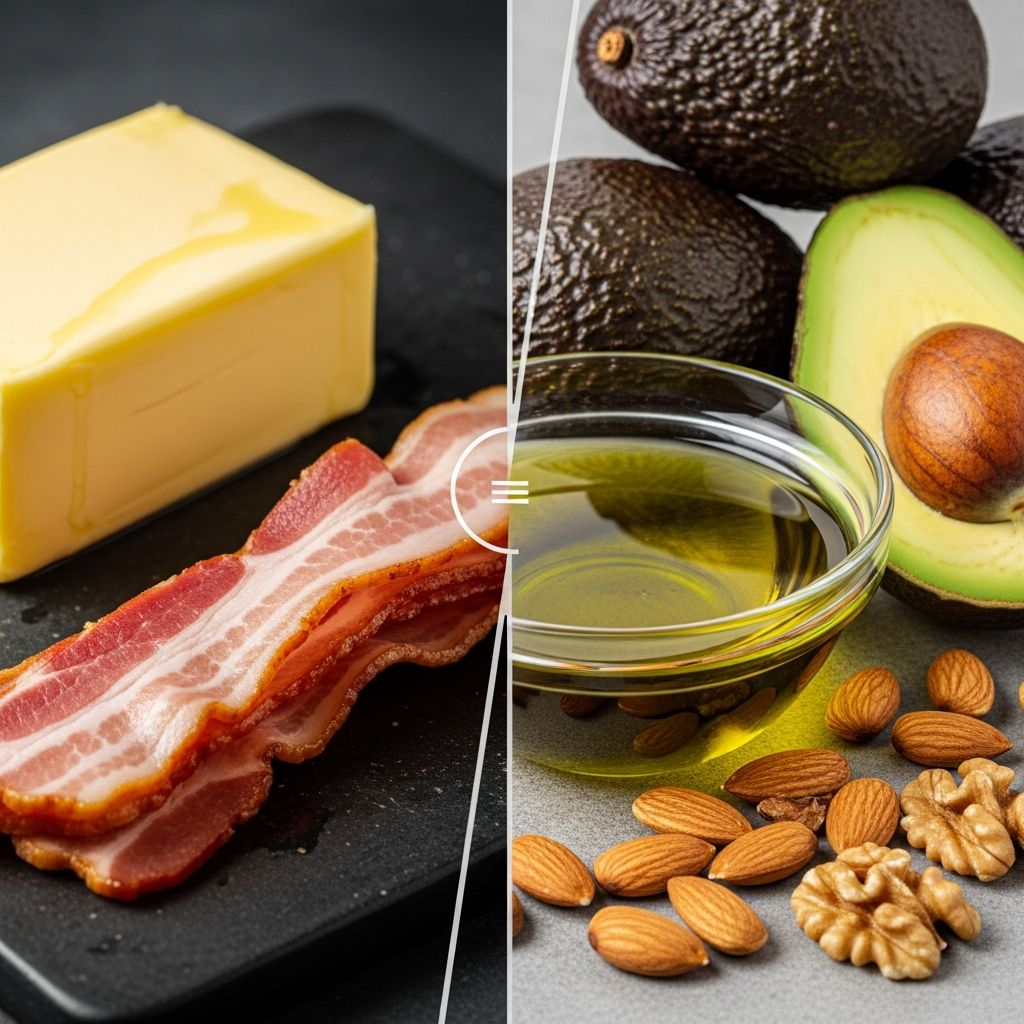
Fats are essential macronutrients that provide energy, aid in vitamin absorption, and support cell function, but not all fats impact health equally. Saturated fats, found mainly in animal products and tropical oils, tend to raise LDL cholesterol levels, increasing heart disease risk, while unsaturated fats from plants and fish promote heart health by improving cholesterol profiles.
Understanding these differences helps in making informed dietary choices. The American Heart Association (AHA) recommends limiting saturated fats to less than 6% of daily calories and prioritizing unsaturated fats for optimal cardiovascular health.
What Are Dietary Fats?
Dietary fats are a vital part of a balanced diet, supplying about 9 calories per gram—more than double that of carbohydrates or proteins. They help absorb fat-soluble vitamins (A, D, E, K), insulate organs, regulate body temperature, and form cell membranes. However, excessive intake, particularly of unhealthy types, can lead to weight gain and elevated risks of cardiovascular disease (CVD).
There are four primary types of dietary fats: saturated, unsaturated (including monounsaturated and polyunsaturated), and trans fats. Most foods contain a mix, but their proportions vary significantly. Saturated and trans fats are typically solid at room temperature, while unsaturated fats remain liquid, reflecting their chemical structures.
- Saturated fats: No double bonds between carbon atoms; fully ‘saturated’ with hydrogen.
- Monounsaturated fats (MUFAs): One double bond.
- Polyunsaturated fats (PUFAs): Multiple double bonds, including essential omega-3 and omega-6 fatty acids.
- Trans fats: Unsaturated fats artificially hardened through hydrogenation.
Health authorities like the Mayo Clinic emphasize choosing unsaturated fats over saturated ones to support heart health and reduce inflammation.
Saturated vs. Unsaturated Fats: Key Differences
The core distinction lies in molecular structure and physical properties. Saturated fats have straight chains with single bonds, allowing tight packing that makes them solid (e.g., butter). Unsaturated fats have kinked chains from double bonds, keeping them liquid (e.g., olive oil).
| Aspect | Saturated Fats | Unsaturated Fats |
|---|---|---|
| Structure | Single bonds; solid at room temp | Double bonds; liquid at room temp |
| Main Sources | Animal products, tropical oils | Plants, nuts, fish |
| Health Impact | Raise LDL cholesterol; limit intake | Lower LDL, raise HDL; heart-protective |
| Daily Limit | <6-10% calories (AHA/DGA) | Prioritize in diet |
Saturated fats raise both LDL (‘bad’) and HDL (‘good’) cholesterol but predominantly increase the harmful small, dense LDL particles linked to artery plaque buildup. Unsaturated fats, conversely, lower LDL and support HDL function.
Health Effects of Saturated Fats
Decades of research link high saturated fat intake to elevated CVD risk. They increase LDL cholesterol, promoting atherosclerosis—plaque buildup in arteries that can lead to heart attacks and strokes. The AHA notes that for a 2,000-calorie diet, saturated fat should not exceed 13 grams daily (about 120 calories).
Recent studies, including a 2021 review, confirm that replacing saturated fats with PUFAs reduces atherosclerotic CVD (ASCVD) risk. Beyond cholesterol, saturated fats may influence inflammation, blood clotting, and heart rhythm. Emerging evidence suggests links to dementia, though more research is needed.
Related Stories



Not all saturated fats are identical; lauric acid in coconut oil may aid metabolism, but evidence is insufficient to favor it over others. Overall, experts urge moderation.
Health Benefits of Unsaturated Fats
Unsaturated fats are cardioprotective. The Mediterranean diet, rich in MUFAs and PUFAs from olive oil, nuts, and fish, exemplifies this, showing lower heart disease rates despite higher fat content. Extra virgin olive oil’s antioxidants reduce blood pressure, LDL, and improve blood sugar control.
MUFAs (e.g., avocados, olives) lower LDL without affecting HDL. PUFAs, especially omega-3s from fatty fish, reduce triglycerides, inflammation, and arrhythmia risk. Harvard experts affirm replacing saturated fats with unsaturated ones cuts heart disease risk significantly.
Food Sources of Saturated Fats
- High-fat dairy: Butter, cheese, whole milk, ice cream, cream.
- Meats: Fatty cuts of beef, pork, lamb; poultry skin.
- Tropical oils: Coconut oil, palm oil, palm kernel oil.
- Processed: Baked goods, fried foods using lard or butter.
These foods are nutrient-dense but calorie-heavy; opt for leaner versions.
Food Sources of Unsaturated Fats
Monounsaturated Fats
- Olive oil (especially extra virgin).
- Avocados and avocado oil.
- Nuts: Almonds, peanuts, cashews.
- Seeds and nut butters.
Polyunsaturated Fats
- Vegetable oils: Canola, soybean, sunflower, corn.
- Fatty fish: Salmon, mackerel, sardines (rich in omega-3s).
- Nuts/seeds: Walnuts, flaxseeds, chia seeds.
- Tofu and other soy products.
Incorporate these via salads, grilled fish, or oil-based dressings.
Understanding Trans Fats
Trans fats, created by hydrogenating unsaturated fats, are the unhealthiest. They raise LDL, lower HDL, and increase CVD risk more than saturated fats. Found in partially hydrogenated oils in cookies, crackers, doughnuts, and fried foods, they’ve been largely phased out since FDA bans, but check labels.
Naturally occurring trans fats in meat/dairy are minimal and less concerning.
Daily Recommendations and Guidelines
The Dietary Guidelines for Americans cap saturated fats at <10% of calories; AHA at 5-6%. For 2,000 calories, that’s 11-13g saturated fat max. No strict upper limit for unsaturated fats—focus on whole foods.
- Prioritize PUFAs/MUFAs over saturated.
- Aim for two fish servings weekly for omega-3s.
Practical Tips to Reduce Saturated Fats and Increase Unsaturated Fats
- Choose lean meats, trim fat, remove poultry skin.
- Swap butter for olive/canola oil in cooking.
- Use low-fat dairy or plant-based alternatives.
- Snack on nuts/seeds instead of cheese.
- Bake, grill, or steam over frying.
- Read labels: Avoid ‘partially hydrogenated’ oils; watch fat-free products with added sugars.
- Embrace Mediterranean patterns: More plants, fish, healthy oils.
Gradual swaps yield sustainable results without deprivation.
Common Myths and Controversies
Headlines sometimes claim saturated fats aren’t harmful, citing studies on large LDL particles. However, Harvard’s Frank Sacks clarifies all LDL forms damage arteries; small dense ones are particularly risky from saturated fats. A 2022 analysis notes flawed studies downplaying risks.
Consensus: Limit saturated fats; benefits of unsaturated replacement are robust.
Frequently Asked Questions (FAQs)
What is the difference between saturated and unsaturated fat?
Saturated fats are solid at room temperature with no double bonds, raising LDL cholesterol; unsaturated fats are liquid with double bonds, supporting heart health.
Is saturated fat really bad for you?
Yes, in excess; it increases heart disease risk by raising LDL. Limit to <6% calories per AHA.
What are some healthy sources of unsaturated fats?
Olive oil, avocados, nuts, seeds, fatty fish like salmon.
Should I avoid all saturated fats?
No, but minimize; some from whole foods like dairy in moderation is fine within limits.
How can I tell if a food has trans fats?
Check for ‘partially hydrogenated oils’ in ingredients; nutrition labels may list 0g if <0.5g/serving.
References
- Saturated vs. unsaturated fat: Differences in dietary fats — Medical News Today. 2023-05-15. https://www.medicalnewstoday.com/articles/321655
- Saturated fat is bad for the heart—despite the headlines — Harvard T.H. Chan School of Public Health. 2015-12-01. https://hsph.harvard.edu/news/saturated-fat-is-bad-for-the-heart-despite-the-headlines/
- Dietary fat: Know which to choose — Mayo Clinic. 2023-10-01. https://www.mayoclinic.org/healthy-lifestyle/nutrition-and-healthy-eating/in-depth/fat/art-20045550
- Saturated Fat — American Heart Association. 2024-01-01. https://www.heart.org/en/healthy-living/healthy-eating/eat-smart/fats/saturated-fats
- Saturated fats and cardiovascular health: Current evidence and controversies — PubMed (European Heart Journal). 2021-11-14. https://pubmed.ncbi.nlm.nih.gov/34649831/
Similar Articles








Read full bio of Sneha Tete