Scabies: Causes, Symptoms, Treatment & Prevention
Understanding scabies: Learn about causes, symptoms, effective treatments, and prevention strategies.
What is Scabies?
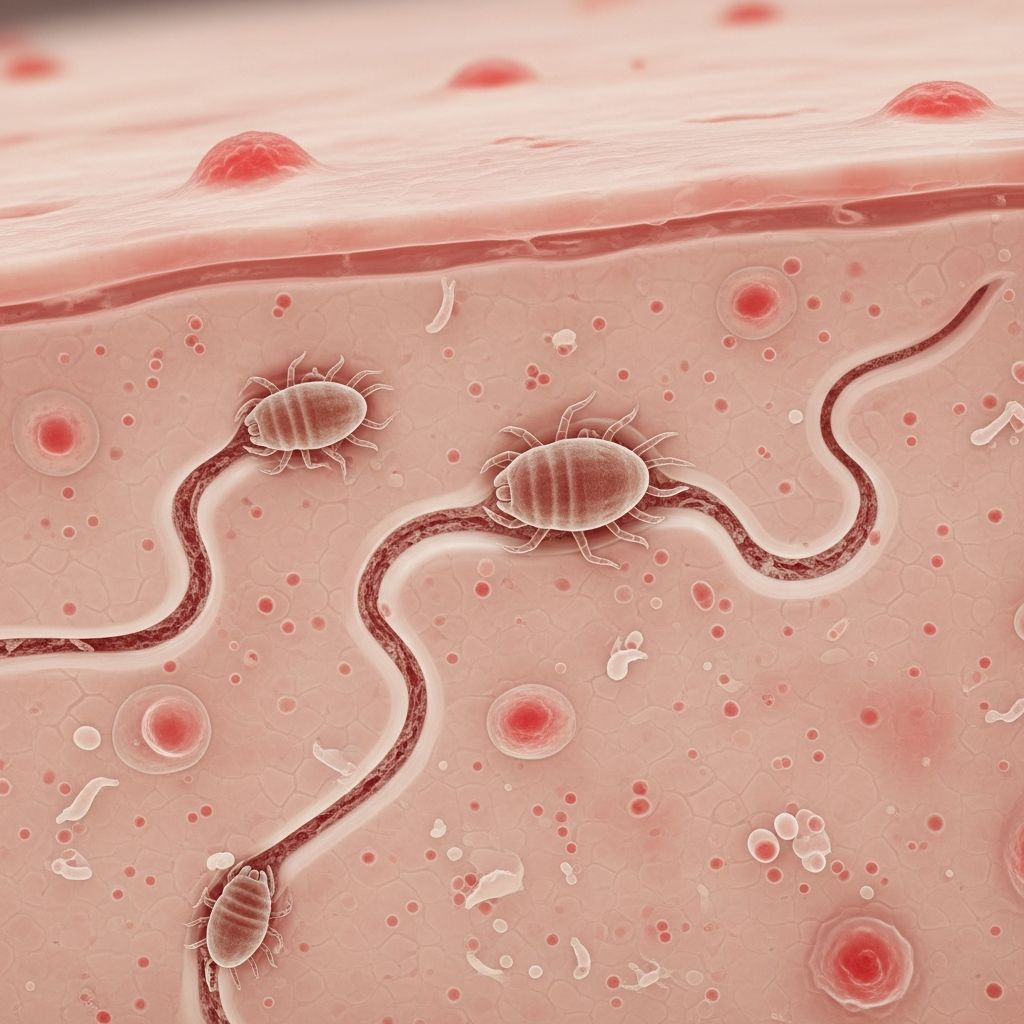
Scabies is a contagious skin infestation caused by the Sarcoptes scabiei mite, a microscopic parasite that burrows into the outer layers of human skin. This condition triggers an intense and often unbearable itchy rash that can significantly disrupt your daily activities and sleep patterns. The infection spreads most commonly through direct skin-to-skin contact with an infected person, making it a concern in close living quarters, healthcare facilities, and crowded environments. Understanding this condition is essential for early recognition and prompt treatment, as prescription medications can effectively eliminate the mites and provide relief from symptoms.
Causes and Transmission
The primary cause of scabies is infestation by the Sarcoptes scabiei mite. These tiny parasites, measuring between 0.2 to 0.45 millimeters in length, are barely visible to the naked eye. Female mites burrow into the skin to lay eggs, creating characteristic tunnels or burrows that appear as thin, wavy lines on the skin surface. Once beneath the skin, the mites trigger an allergic reaction in the body, leading to intense itching and the characteristic rash associated with the condition.
Scabies spreads through various modes of transmission. Direct skin-to-skin contact with an infected individual is the most common route of transmission. The infection can also spread through prolonged contact with contaminated clothing, bedding, towels, and furniture. In healthcare settings, scabies can spread among patients and staff who have close physical contact. Sexual contact significantly increases transmission risk, which is why sexual partners and household members of infected individuals should be treated simultaneously, even if they show no symptoms.
Symptoms and Signs
The primary symptom of scabies is intense itching, which often worsens at night when the body temperature rises and the mites become more active. This itching can be so severe that it disrupts sleep and affects overall quality of life. The characteristic rash appears as small red bumps or pimple-like lesions that may cluster together in linear patterns, reflecting the burrows created by the mites.
Common areas affected by scabies include:
– Hands and fingers, particularly between the fingers- Wrists and forearms- Elbows- Armpits- Waistline and lower abdomen- Genitals- Buttocks- Breasts in women- Areas between skin folds
In infants and young children, scabies may also affect the face, scalp, palms, and soles of the feet. Some individuals may develop secondary skin infections from scratching, which can complicate the condition and require additional treatment.
Types of Scabies
While common scabies affects most infected individuals, certain variants present unique challenges for treatment and management. Crusted scabies, also known as Norwegian scabies, is an especially severe form characterized by extensive scaling and crusting of the skin. Individuals with crusted scabies may harbor up to two million mites on their body, compared to fewer than 15 mites in typical cases. This form is particularly contagious because the thick crusts protect mites from topical medications, making treatment significantly more difficult and prolonged. Crusted scabies typically occurs in immunocompromised individuals, elderly patients, or those with severe developmental or physical disabilities.
Related Stories



Diagnosis
Healthcare providers often diagnose scabies through a combination of clinical examination and medical history. Your provider will ask about symptoms, their duration, and any known exposure to infected individuals. During the physical examination, the provider looks for characteristic burrows and the typical distribution pattern of the rash.
To confirm the diagnosis, your healthcare provider may perform skin scraping. This involves applying mineral oil to the suspected area and using a small scalpel to obtain a skin sample. The sample is then examined under a microscope to identify the presence of mites, eggs, or fecal pellets. Another diagnostic technique involves using the tip of a needle to carefully extract a mite from the end of its burrow for microscopic examination. These confirmatory tests are important because a person can still have scabies even if mites are not immediately found, particularly in cases where fewer than 10-15 mites are present on otherwise healthy individuals.
Treatment Options
Scabies is treatable but can be challenging to eliminate completely. Treatment typically involves prescription medications that kill both the mites and their eggs. Several effective treatment approaches are available, and your healthcare provider will recommend the most appropriate option based on your age, health status, and severity of infestation.
Topical Medications
Topical treatments are applied directly to the skin and are the first-line therapy for most cases. Your healthcare provider will instruct you to apply medication to your entire body from the neck downward, including your hands, palms, and feet. Children with scabies may require medication applied to their faces and scalps as well. Most topical medications must remain on the skin for 8 to 14 hours, typically applied at bedtime and washed off the following morning. Following the package instructions precisely is crucial for treatment success.
Commonly prescribed topical medications include:
– Permethrin Cream: Permethrin is considered the most effective topical treatment and remains the first-line choice for scabies. This pyrethroid insecticide kills mites, eggs, and hatchlings. One application is usually sufficient, though many physicians recommend a second application 3 to 7 days later as a precaution. Permethrin is safe for adults, pregnant women, breastfeeding mothers, and children over 2 months old.- Crotamiton: This alternative topical treatment can be applied as a cream or lotion and must be used for multiple applications, typically for 5 to 7 days.- Sulfur Cream: Sulfur cream is particularly valuable for treating pregnant women, nursing mothers, and infants under 2 months old, as only permethrin or sulfur ointment can be used in this population. This treatment is applied overnight, rinsed off, and reapplied for five consecutive nights.- Lindane Lotion: While effective, lindane is typically reserved for cases resistant to other treatments due to potential neurotoxicity concerns.
Oral Medications
Oral medications provide an alternative for individuals who cannot use topical treatments or require stronger medication. Ivermectin is the most commonly prescribed oral medication for scabies. This antiparasitic pill is typically given in a single dose, followed by a second dose 1 to 2 weeks later. For severe cases, particularly crusted scabies, oral ivermectin at a dose of 200 micrograms per kilogram on days 1, 2, and 8 has proven to be a safe and effective first-line treatment that rapidly reduces symptoms.
However, certain populations cannot take oral ivermectin, including children weighing less than 35 pounds (15 kilograms), pregnant women, and nursing mothers. In these cases, topical medications remain the treatment of choice.
Treatment Duration and Expectations
While scabies is treatable and mites can be eliminated relatively quickly with appropriate medication, complete skin healing may take up to two months. Itching can persist for 2 to 4 weeks following treatment, which doesn’t necessarily indicate treatment failure. If symptoms continue beyond this timeframe, your healthcare provider may recommend retreatment or investigation for potential resistant mites or reinfection.
Certain forms of scabies are inherently more difficult to treat. Crusted scabies requires significantly more intensive treatment protocols, often necessitating multiple applications of topical medication combined with oral ivermectin. The thick crusts protect mites from topical agents, making eradication particularly challenging and prolonged treatment necessary.
Household and Contact Management
Successful treatment of scabies extends beyond individual medication application. All household members and close contacts should be treated simultaneously, even if they show no symptoms, to prevent reinfection. Sexual partners and anyone with prolonged contact during the month before diagnosis should also receive treatment.
Environmental measures are equally important. Bedding, clothing, and towels used during the 3 days before starting treatment should be washed in hot water and dried in a hot dryer to eliminate mites and eggs. Since scabies mites cannot survive more than 3 days away from human skin, additional washing beyond this period is unnecessary. Furniture and other non-washable items used recently should also be cleaned thoroughly or isolated for several days.
Potential Complications
While scabies itself is not life-threatening, complications can arise from the condition. Secondary bacterial skin infections are common, resulting from scratching and breaking the skin barrier. These infections may require additional antibiotic treatment. In severe cases or immunocompromised individuals, systemic complications can develop. Crusted scabies represents a particularly serious complication, requiring aggressive treatment and posing significant transmission risks in institutional settings.
Prevention Strategies
Preventing scabies involves minimizing exposure to infected individuals and maintaining good hygiene practices. Avoid direct skin-to-skin contact with individuals known to have scabies until they have been treated. Be cautious in settings where scabies outbreaks are common, such as nursing homes, hospitals, and crowded living facilities. Regularly wash personal items like bedding, clothing, and towels, and avoid sharing personal care items, clothing, or bedding with others.
In healthcare settings, standard precautions and contact isolation for patients with suspected or confirmed scabies are essential to prevent nosocomial transmission. Education about scabies transmission and treatment compliance is crucial for preventing spread within communities and institutions.
When to Seek Medical Care
You should make an appointment with your healthcare provider if you suspect you or your child has scabies. Your provider can often diagnose scabies by visual examination alone, though confirmatory testing may be performed. Seeking prompt medical attention is important because prescription medications are required for effective treatment, and early intervention can prevent complications and transmission to others.
Frequently Asked Questions
Q: How contagious is scabies?
A: Scabies is highly contagious and spreads through direct skin-to-skin contact with infected individuals. It can also spread through contact with contaminated clothing and bedding. Sexual partners and household members should be treated even if asymptomatic.
Q: How long does scabies treatment take?
A: Mites are typically eliminated within days of starting treatment, but complete skin healing may take up to two months. Itching may persist for 2 to 4 weeks after treatment begins.
Q: Can scabies be treated without prescription medication?
A: No, effective scabies treatment requires prescription medications. Over-the-counter products are not sufficiently effective for eliminating the mite infestation.
Q: Is scabies dangerous during pregnancy?
A: Scabies itself is not dangerous during pregnancy, but it should be treated promptly. Pregnant women can safely use sulfur cream or permethrin cream, which are approved for use during pregnancy and breastfeeding.
Q: Can I get scabies from animals?
A: Scabies affecting humans is caused by a human-specific mite variety. Animal mites may cause temporary skin irritation but do not establish human infestation like Sarcoptes scabiei variety hominis does.
Q: How can I prevent spreading scabies to my family?
A: Start treatment immediately upon diagnosis. Wash all bedding, clothing, and towels in hot water. Have all household members and close contacts treated simultaneously. Avoid direct skin contact until treatment is complete.
Q: What should I do if symptoms persist after treatment?
A: Contact your healthcare provider. Persistent symptoms after 2 to 4 weeks may indicate treatment failure, resistance, or reinfection. Your provider may recommend retreatment or alternative medications.
References
- Scabies: Causes, Symptoms, Treatment & Prevention — Cleveland Clinic. 2024-03-15. https://my.clevelandclinic.org/health/diseases/4567-scabies
- About Scabies — Centers for Disease Control and Prevention (CDC). https://www.cdc.gov/scabies/about/index.html
- Scabies – Diagnosis and Treatment — Mayo Clinic. https://www.mayoclinic.org/diseases-conditions/scabies/diagnosis-treatment/drc-20377383
- Scabies — Wikipedia. https://en.wikipedia.org/wiki/Scabies
- Norwegian Scabies — Cleveland Clinic Journal of Medicine. https://www.ccjm.org/content/86/3/163
- Crotamiton (Scabies): How to Use & Side Effects — Cleveland Clinic. https://my.clevelandclinic.org/health/drugs/18703-crotamiton-topical-cream-or-lotion
- Permethrin: Scabies Treatment & Side Effects — Cleveland Clinic. https://my.clevelandclinic.org/health/drugs/19057-permethrin-skin-cream
Similar Articles








Read full bio of medha deb