Scalp Tumours And Cysts: Complete Guide To Symptoms & Treatment
Comprehensive guide to benign and malignant scalp tumours and cysts, including diagnosis, treatment, and key clinical features.
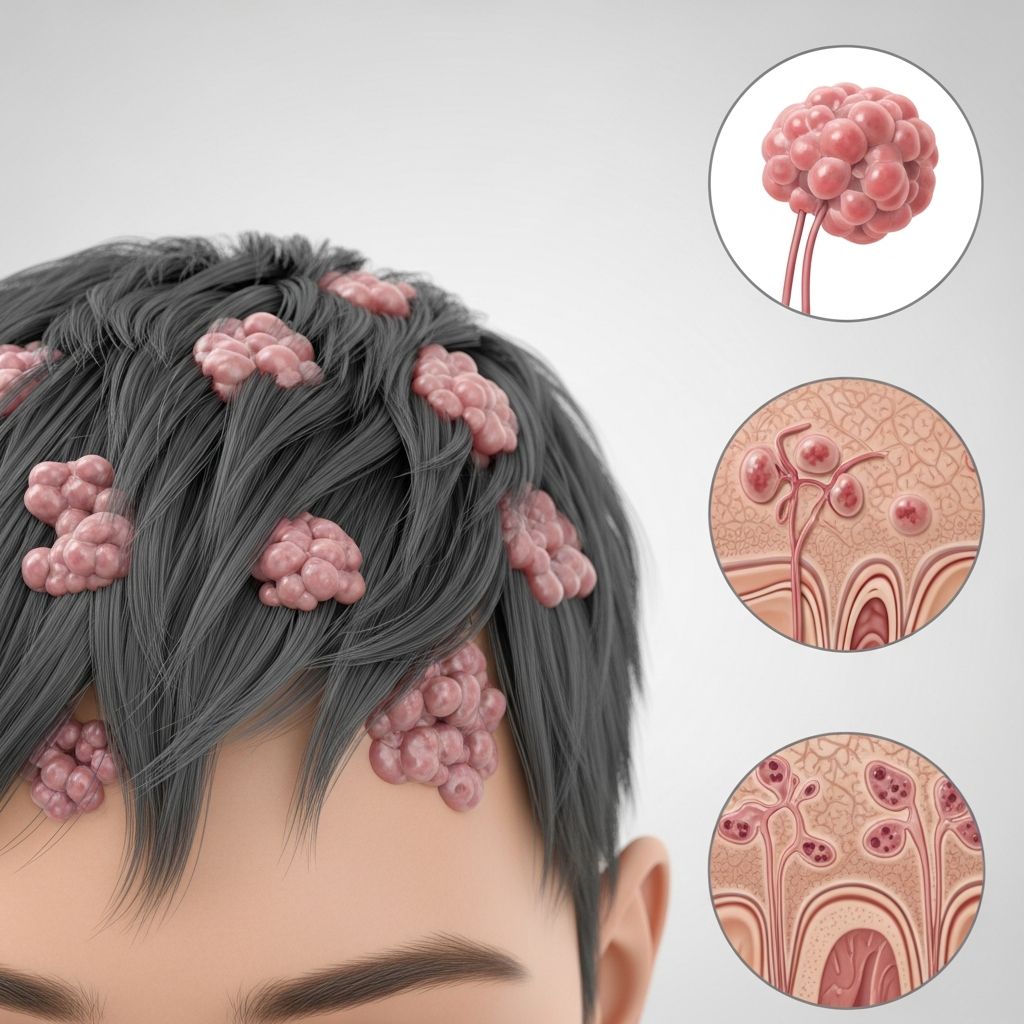
The scalp is a common site for both benign and malignant tumours and cysts due to its rich vascularity, hair follicles, and exposure to environmental factors. Approximately 40–50% of benign scalp tumours are cysts, with trichilemmal (pilar) cysts being especially prevalent, accounting for 80% of scalp cysts in Western populations. The remaining benign lesions include lipomas (~30%) and melanocytic naevi (28%), while seborrhoeic and actinic keratoses increase with age as hair thins. Malignant tumours, though less common, require prompt recognition to prevent metastasis.
What are the most common scalp cysts?
Scalp cysts are typically benign, slow-growing, and keratin-filled sacs arising from hair follicles or epidermal elements. The most frequent is the
trichilemmal cyst
(pilar cyst), which originates from the outer root sheath of the hair follicle and affects about 10% of the population, more commonly women. These cysts present as smooth, flesh-colored, mobile lumps, often multiple, and are hereditary in up to 80% of cases. Epidermoid (sebaceous) cysts, resulting from keratin accumulation in trapped epithelial cells, are also common, forming rounded, firm masses that may become inflamed.- Trichilemmal cyst: Derived from trichilemmal keratinization; 90% on scalp; slow-growing, painless unless ruptured.
- Epidermoid cyst: Keratin buildup under skin; skin-colored or yellow; rarely cancerous.
- Dermoid cyst: Congenital, containing hair, skin, or other tissues; less common.
- Inflammatory pilar cyst: Ruptured variant causing pain, redness, and swelling.
Pilar cysts form when shed skin cells and keratin accumulate in hair follicles, pushing up the skin surface; they are noncancerous but can infect if ruptured, leading to pain, oozing, and systemic symptoms.
Symptoms of scalp cysts
Most scalp cysts are asymptomatic, noticed incidentally while washing hair. Common symptoms include a palpable, rounded, mobile mass that feels soft or firm. Pain arises if inflamed or infected, accompanied by redness, warmth, swelling, itching, or thick white/purulent discharge with foul odor. Rapid growth or rupture signals complications, warranting medical evaluation to rule out malignancy.
| Symptom | Description | Associated Cyst Type |
|---|---|---|
| Palpable mass | Rounded lump, mobile under skin | All types |
| Pain | On touch or spontaneous if infected | Inflammatory pilar, epidermoid |
| Redness/inflammation | Warm, swollen skin overlay | Infected cysts |
| Discharge | Thick, white, or purulent fluid | Ruptured cysts |
| Itching/Rapid growth | Less common; sudden enlargement | Pilar cysts |
Benign scalp tumours
Besides cysts, benign scalp tumours include lipomas (fatty lumps, ~30% of cases), melanocytic naevi (moles, 28%), seborrhoeic keratoses (waxy, stuck-on lesions increasing with age), and actinic keratoses (precancerous rough patches from sun exposure). These are usually asymptomatic but may cause cosmetic concerns or itch.
- Lipomas: Soft, subcutaneous fat tumors; slow-growing, mobile.
- Melanocytic naevi: Pigmented moles; monitor for ABCDE changes (asymmetry, border irregularity, color variation, diameter >6mm, evolving).
- Seborrhoeic keratoses: Common in elderly; greasy, brown-black plaques.
- Actinic keratoses: Sun-damaged precursor to squamous cell carcinoma (SCC).
Malignant scalp tumours
Malignant scalp tumours are rarer but aggressive due to rich vascular/lymphatic supply, facilitating metastasis.
Basal cell carcinoma (BCC)
(80% of skin cancers) appears as pearly nodules, sores, or scars; slow-growing but locally invasive.Squamous cell carcinoma (SCC)
presents as red/pink wart-like growths; higher metastasis risk on scalp.Melanoma
arises from melanocytes; irregular, multicolored lesions with poor prognosis if advanced. Other rare types include Merkel cell carcinoma (rapidly growing red nodule) and angiosarcoma (bruise-like in elderly).Related Stories



Risk factors include UV exposure, fair skin, immunosuppression, and chronic wounds. Early detection via skin exams is crucial.
Diagnosis
Diagnosis begins with clinical examination: history of growth rate, symptoms, family history, and sun exposure. Dermoscopy aids in distinguishing benign vs. malignant. Biopsy (excisional, incisional, or punch) confirms histology, essential for suspicious lesions. Imaging (ultrasound, MRI) assesses depth/invasion for larger tumours.
Treatment
Benign cysts/tumours: Observation if asymptomatic; surgical excision for symptomatic, recurrent, or cosmetic issues. Minimal excision with complete cyst wall removal prevents recurrence (recurrence rate <5%). Avoid squeezing to prevent infection/scarring. Infected cysts require incision/drainage and antibiotics.
Malignant tumours: Wide local excision with margins (4-6mm BCC, 6-10mm SCC); Mohs micrographic surgery for high-risk sites. Sentinel lymph node biopsy for melanoma/SCC. Adjuvant radiotherapy/chemotherapy for advanced cases.
- Cysts: Outpatient excision under local anesthesia.
- Lipomas/naevi: Simple excision.
- Skin cancers: Multidisciplinary approach.
Prevention and monitoring
Protect scalp from UV with hats/sunscreen; regular self-exams and dermatologist visits for high-risk individuals. Familial cyst syndromes warrant screening.
Frequently Asked Questions (FAQs)
Q: Are scalp cysts cancerous?
A: No, most like pilar cysts are benign, but rapid growth or changes require evaluation to exclude malignancy.
Q: Can pilar cysts be removed at home?
A: No, avoid popping; professional excision minimizes recurrence and infection.
Q: Why are scalp cysts common?
A: High hair follicle density and keratin production; hereditary factors play a role.
Q: What if a scalp lump is painful?
A: Seek medical attention; may indicate infection or rarely cancer.
Q: Do benign scalp tumours need treatment?
A: Only if symptomatic, growing, or cosmetic concern; monitor others.
This article provides an overview; consult a dermatologist for personalized advice. (Word count: 1678)
References
- Cysts on the scalp: All our advice — Centre Clauderer. 2023. https://www.centre-clauderer.com/en/hair-loss/scalp-cyst/
- What Is a Pilar Cyst (Trichilemmal Cyst) on the Scalp? — WebMD. 2024-01-15. https://www.webmd.com/skin-problems-and-treatments/what-is-a-pilar-cyst-on-scalp
- Pilar Cyst: Causes, Removal & What it Is — Cleveland Clinic. 2023-11-20. https://my.clevelandclinic.org/health/diseases/23092-pilar-trichilemmal-cyst
- Bump on Head: 10 Common Causes — Healthline. 2024. https://www.healthline.com/health/bump-on-back-of-head
- Scalp Tumours and Cysts — DermNet NZ. 2023. https://dermnetnz.org/topics/scalp-tumours-and-cysts
- Pilar cyst: Causes, treatment, and removal — Medical News Today. 2023-05-10. https://www.medicalnewstoday.com/articles/321405
- Pilar Cyst — StatPearls, NCBI Bookshelf. 2023-07-17. https://www.ncbi.nlm.nih.gov/books/NBK534209/
Similar Articles








Read full bio of Sneha Tete