Schistosomiasis: Parasitic Infection Overview
Comprehensive guide to schistosomiasis: transmission, symptoms, diagnosis, and treatment options.
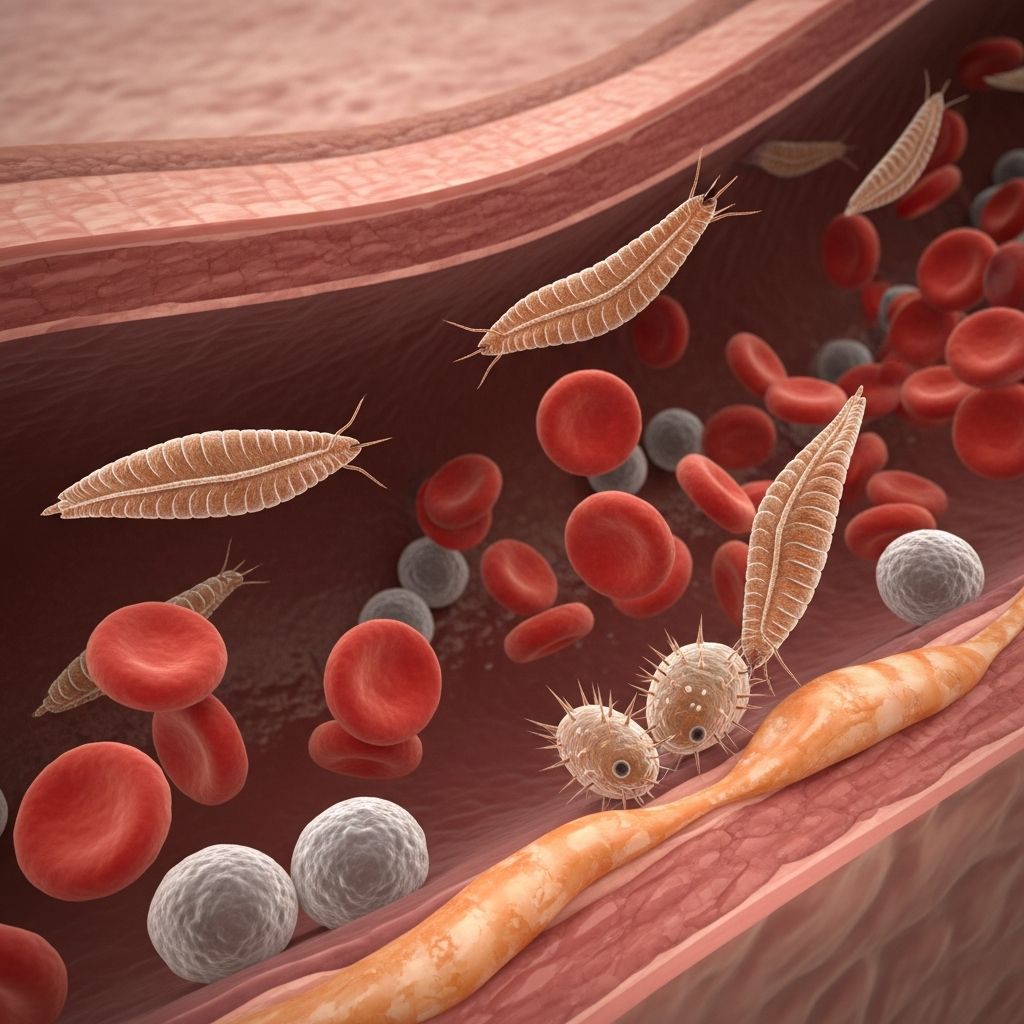
Schistosomiasis: A Parasitic Disease Overview
Schistosomiasis, also known as bilharzia, is a chronic parasitic disease caused by infection with blood flukes (trematode worms) of the genus Schistosoma. The disease represents a significant global health burden, affecting millions of people in tropical and subtropical regions, particularly in sub-Saharan Africa. Schistosomiasis is classified as a disease of poverty that leads to chronic ill-health and substantial economic consequences for affected populations. The infection occurs when individuals come into contact with freshwater infested with the larval forms (cercariae) of parasitic blood flukes shed by infected freshwater snails.
Transmission and Epidemiology
Schistosomiasis is acquired through skin penetration of infecting larvae, known as cercariae, which are shed by freshwater snails. The disease is not transmitted from person to person but rather through contact with contaminated freshwater environments. People become infected when they wade, swim, bathe, or wash in water containing cercariae. The microscopic adult worms subsequently live in the veins draining the urinary tract and intestines, where they remain and reproduce, shedding eggs that lodge in tissues throughout the body.
Several species of Schistosoma are responsible for human infection, with different species causing varying clinical manifestations:
- Schistosoma mansoni — primarily affects the intestines and liver
- Schistosoma haematobium — typically targets the urinary tract
- Schistosoma japonicum — affects the intestines and liver
- Schistosoma mekongi — found in Southeast Asia
- Schistosoma intercalatum — less common species affecting the intestines
Clinical Presentation and Symptoms
The clinical manifestations of schistosomiasis vary depending on the stage of infection and the species involved. Understanding these presentations is crucial for timely diagnosis and treatment.
Acute Schistosomiasis (Katayama Syndrome)
The incubation period for acute schistosomiasis typically ranges from 14 to 84 days following initial exposure to contaminated water. During this period, dermal penetration of cercariae can cause a rash that develops within hours or up to one week after exposure. Initial skin manifestations include pruritus (itching) at the penetration site a few hours after water exposure, followed in 5 to 14 days by an intermittent pruritic, sometimes papular eruption.
Acute schistosomiasis, also known as Katayama syndrome, is characterized by systemic symptoms including:
- Diarrhea
- Fever
- Headache
- Myalgia (muscle pain)
- Respiratory symptoms
- Eosinophilia (elevated eosinophil counts)
- Painful hepatomegaly (liver enlargement) or splenomegaly (spleen enlargement)
Chronic Schistosomiasis
Chronic manifestations of schistosomiasis result from the host’s immune responses to schistosome eggs. Eggs secreted by adult worm pairs living in the bloodstream become lodged in the capillaries of organs and cause granulomatous reactions, leading to tissue damage and functional impairment.
Intestinal and Hepatic Manifestations
Schistosoma mansoni and S. japonicum eggs most commonly lodge in the blood vessels of the liver or intestine. Clinical manifestations include:
- Blood in the stool
- Constipation or diarrhea
- Abdominal pain
- Bowel wall ulceration, hyperplasia, or polyposis due to chronic inflammation
- Periportal liver fibrosis
- Liver enlargement (hepatomegaly)
- Splenomegaly
- Accumulation of fluid in the peritoneal cavity
- Hypertension of the abdominal blood vessels
Related Stories



In children, schistosomiasis can cause anemia, stunting, and reduced ability to learn, although these effects are usually reversible with treatment.
Urogenital Manifestations
Schistosoma haematobium eggs typically lodge in the urinary tract and cause distinct urogenital symptoms. The classic sign of urogenital schistosomiasis is hematuria (blood in urine). Additional manifestations include:
- Dysuria (painful urination)
- Fibrosis of the bladder and ureter
- Kidney damage in advanced cases
- Calcifications in the bladder appearing late in disease progression
- Bladder cancer (possible complication in later stages)
- Increased risk for cervical cancer in women
In women, urogenital schistosomiasis may present with genital lesions, vaginal bleeding, pain during sexual intercourse, and nodules in the vulva. S. haematobium infection has been associated with increased risk of subfertility and HIV transmission in women. In men, urogenital schistosomiasis can induce pathology of the seminal vesicles, prostate, and other organs, potentially leading to infertility.
Diagnosis
Accurate diagnosis of schistosomiasis involves multiple approaches tailored to the species and infection stage.
Parasitological Diagnosis
The gold standard for diagnosis is microscopic identification of parasite eggs:
- Stool examination — for S. mansoni and S. japonicum infections
- Urine examination — for S. haematobium infections
The Kato-Katz method and urine filtration are standard techniques employed in diagnostic assessments.
Serological Testing
Serologic tests are particularly useful for diagnosing light infections where egg shedding might not be consistent, such as in travelers and individuals who have not had schistosomiasis previously. Antibody tests help identify infection in asymptomatic people who might have been exposed during travel and could benefit from treatment. However, it is important to note that antibody tests do not distinguish between past and current infection.
Treatment and Management
Effective treatment of schistosomiasis is essential for controlling the disease and preventing severe complications.
Praziquantel: The Primary Treatment
Praziquantel is the recommended and most effective treatment against all forms of schistosomiasis. The drug is effective, safe, and low-cost, making it suitable for widespread use in endemic regions. Praziquantel is most effective against adult worms and requires the presence of a mature antibody response to the parasite.
Dosage Recommendations
Treatment dosage varies by species of Schistosoma:
| Species | Dosage and Duration |
|---|---|
| S. mansoni, S. haematobium, S. intercalatum | 40 mg/kg per day orally in two divided doses for one day |
| S. japonicum, S. mekongi | 60 mg/kg per day orally in three divided doses for one day |
Treatment Timing
The timing of treatment is important for optimal efficacy. For travelers, treatment should occur at least 6 to 8 weeks after last exposure to potentially contaminated freshwater to allow the parasites to mature and develop an antibody response. One study has suggested an effect of praziquantel on schistosome eggs lodged in tissues.
Pediatric Treatment
WHO reports growing evidence that infected children as young as 1 year old can be effectively treated with praziquantel without serious side effects. The drug is commonly available in the form of large, hard-to-swallow pills; however, pediatric praziquantel in the form of a dispersible tablet is available in some countries. This formulation improves medication adherence in young children.
Re-infection and Long-term Management
Although re-infection may occur after treatment, the risk of developing severe disease is diminished and even reversed when treatment is initiated and repeated in childhood. Repeated treatment in endemic areas helps prevent the accumulation of parasite burden and reduces the likelihood of severe complications.
Public Health Considerations
The economic and health effects of schistosomiasis are considerable, with the disease disabling more than it kills. Public health interventions focus on mass drug administration, improved sanitation, and water safety measures. The WHO emphasizes the importance of preventive chemotherapy programs, particularly targeting school-age children in endemic regions.
Frequently Asked Questions
Q: How is schistosomiasis transmitted?
A: Schistosomiasis is transmitted through contact with freshwater contaminated with cercariae (larvae) shed by infected freshwater snails. The larvae penetrate the skin of individuals wading, swimming, or bathing in contaminated water.
Q: What are the early signs of schistosomiasis infection?
A: Early signs include itching (pruritus) at the penetration site within hours of water exposure, followed by a pruritic rash 5-14 days later. Acute symptoms may include fever, diarrhea, headache, and muscle pain.
Q: Can schistosomiasis be cured?
A: Yes, schistosomiasis can be effectively treated with praziquantel, which is effective against all major Schistosoma species. Treatment is most effective when administered at least 6-8 weeks after exposure to allow parasites to mature.
Q: Is praziquantel safe for children?
A: Yes, WHO reports growing evidence that children as young as 1 year old can be safely treated with praziquantel without serious side effects. Dispersible tablet formulations are available in some countries for easier administration.
Q: What complications can develop from untreated chronic schistosomiasis?
A: Untreated chronic schistosomiasis can lead to severe organ damage, including liver fibrosis, bladder cancer, kidney damage, infertility, and in children, anemia and impaired growth.
Q: Can someone get reinfected after treatment?
A: Yes, re-infection can occur after treatment if individuals have renewed contact with contaminated freshwater. However, repeated treatment prevents the accumulation of severe disease.
References
- Schistosomiasis | Yellow Book – CDC — Centers for Disease Control and Prevention. 2024. https://www.cdc.gov/yellow-book/hcp/travel-associated-infections-diseases/schistosomiasis.html
- Schistosomiasis (Bilharzia) – World Health Organization (WHO) — World Health Organization. 2025. https://www.who.int/health-topics/schistosomiasis
- Schistosomiasis Practical and Precision Assessments Manual — Children Without Worms. 2025. https://childrenwithoutworms.org/wp-content/uploads/2025/08/SCH-Practical-and-Precision-Assessment-Manual_v3.pdf
- Schistosomiasis | Red Book Online | American Academy of Pediatrics — American Academy of Pediatrics. 2024. https://publications.aap.org/redbook/book/347/chapter/5755950/Schistosomiasis
- Clinical Care of Schistosomiasis – CDC — Centers for Disease Control and Prevention. 2024. https://www.cdc.gov/schistosomiasis/hcp/treatment/index.html
- WHO guideline on control and elimination of human schistosomiasis — World Health Organization & National Center for Biotechnology Information. 2024. https://www.ncbi.nlm.nih.gov/books/NBK578397/
Similar Articles








Read full bio of medha deb