Scoliosis Overview: Types, Symptoms, and Treatment
Complete guide to understanding scoliosis: causes, diagnosis, and effective treatment options.
Scoliosis Overview: Understanding Your Spinal Health
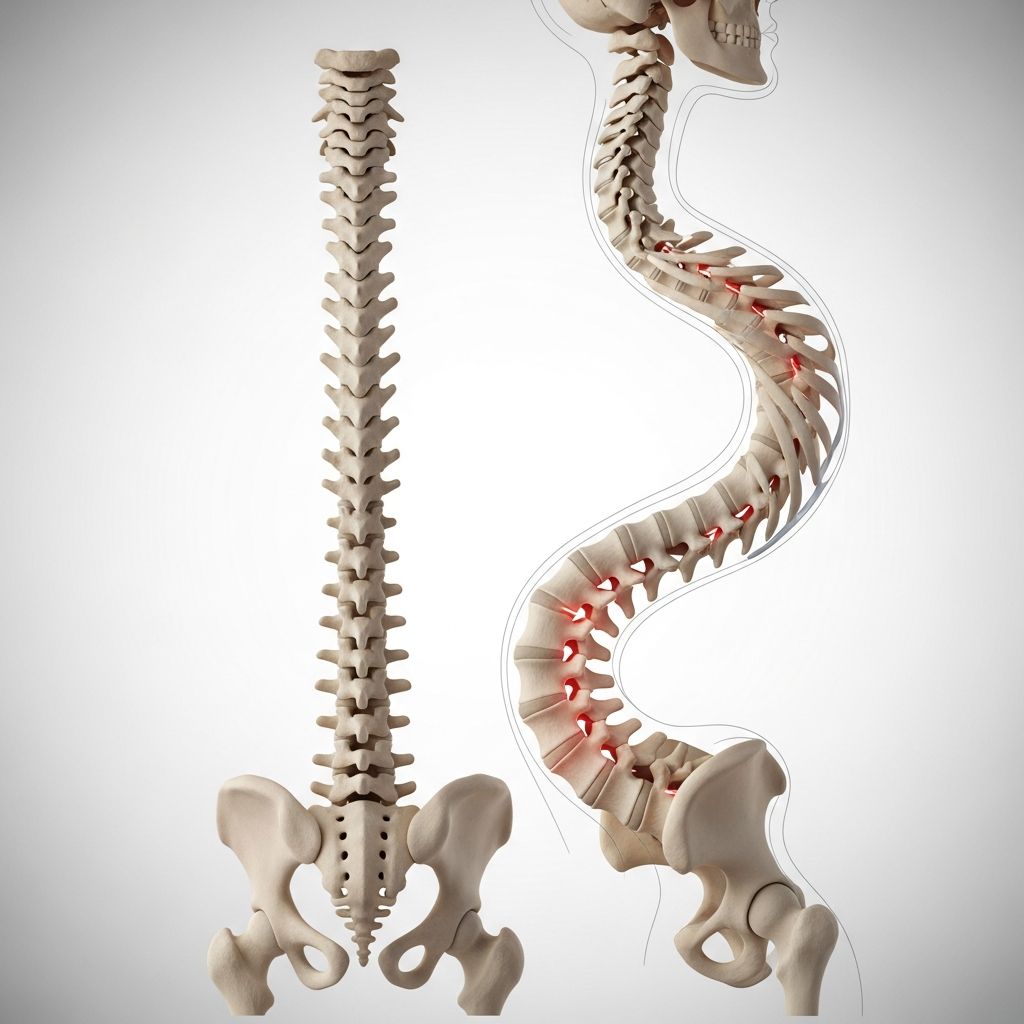
Scoliosis is a medical condition characterized by an abnormal sideways curvature of the spine, often resembling an “S” or “C” shape. This spinal deviation occurs when the spine bends laterally (side to side) and frequently involves rotation of the vertebrae within the curve. For scoliosis to be formally diagnosed, there must be at least a 10-degree deviation from the normal vertical alignment of the spine on X-ray imaging. While scoliosis is primarily a structural condition affecting the skeletal system, it can manifest a range of symptoms from mild to severe, potentially impacting physical activity, posture, and self-esteem.
Scoliosis most commonly appears during childhood or adolescence, particularly during rapid growth spurts of puberty. However, the condition can also develop and progress during adulthood due to degenerative changes such as arthritis, spinal stenosis, or osteoporosis. It is believed that a combination of genetic, hormonal, and environmental factors contribute to the development of scoliosis.
Types of Scoliosis
Scoliosis is a complex spinal condition that can be classified into several distinct types, each with unique characteristics, causes, and management approaches. Understanding the specific type of scoliosis is crucial for developing an effective treatment strategy.
Idiopathic Scoliosis
Idiopathic scoliosis is the most common form, accounting for approximately 80% of all cases. This type arises during childhood or adolescence without an identifiable cause, and the exact mechanisms responsible for its development remain an area of active research. Idiopathic scoliosis typically manifests during growth spurts and can progress until skeletal maturity is reached. The condition is most often diagnosed after age 10 or in the early teen years. Early detection through regular screenings is crucial for effective management and preventing further progression of the spinal curvature.
Experts continue to investigate multiple factors that may contribute to idiopathic scoliosis, including genetics and heredity, soft tissue problems involving bone, muscle, ligaments, and disks, vertebral growth problems, and central nervous system disorders.
Congenital Scoliosis
Congenital scoliosis is present at birth and results from abnormalities in the formation of the vertebrae that occur during fetal development. In congenital scoliosis, part of one or more vertebrae does not form completely, or the vertebrae do not separate properly. This type of scoliosis can lead to severe spinal deformities and is often accompanied by other physical anomalies. Congenital scoliosis can be associated with other health issues, such as heart and kidney problems.
The progression of congenital scoliosis can vary significantly from person to person—some types change quickly with growth, while others remain relatively unchanged. Regular monitoring is essential, and a multidisciplinary treatment approach is necessary to address the complexities associated with congenital scoliosis.
Neuromuscular Scoliosis
Neuromuscular scoliosis is associated with conditions that affect muscle control, coordination, and nerve function. This form develops as a result of muscle imbalance and weakness caused by various medical conditions. Common neuromuscular conditions that can lead to scoliosis include cerebral palsy, muscular dystrophy, and spinal cord injury. Comprehensive care, integrating both surgical and non-surgical interventions, is crucial for managing neuromuscular scoliosis and improving quality of life for affected individuals.
Related Stories



Mild Scoliosis
Mild scoliosis refers to a spinal curve measuring between 10 to 20 degrees, typically diagnosed during childhood or adolescence. Despite being less severe than other forms, mild scoliosis can still present subtle physical asymmetries and discomfort. Unlike more pronounced curvatures, mild scoliosis often goes unnoticed without routine screenings. Mild scoliosis management involves routine monitoring and exercises like the Schroth Method to prevent progression during growth spurts.
Symptoms and Physical Signs
Scoliosis can present differently depending on the severity of the curve and the individual’s age. Understanding these symptoms is essential for early detection and intervention.
Symptoms in Children and Adolescents
In children, scoliosis may be detected through visible physical changes. Common symptoms include:
- Uneven shoulder heights, with one shoulder appearing higher than the other
- One shoulder blade that looks bigger or more prominent than the other
- Uneven waist or torso alignment
- One hip higher than the other
- One side of the rib cage pushing forward
- Visible curve or bend in the spine
- One side of the back poking out when bending forward
- Changes in overall posture
Most often with scoliosis, the spine rotates or twists as well as curving side to side, causing the ribs or muscles on one side of the body to stick out farther than those on the other side.
Symptoms in Adults
Adults with scoliosis may experience a different set of symptoms, often related to degenerative changes in the spine. Common symptoms in adults include:
- Back pain and discomfort
- A visible bulge or uneven posture
- Leg pain or numbness
- Fatigue and reduced activity tolerance
- In severe cases, shortness of breath
- Early fullness when eating (in severe cases)
Adult scoliosis can result from a curve that has progressed since adolescence or from degenerative changes such as arthritis, spinal stenosis, or osteoporosis.
Diagnosis and Assessment
Proper diagnosis of scoliosis involves a thorough clinical evaluation and imaging studies. A healthcare provider will conduct a complete history and physical examination to assess the spine’s curvature and identify any non-idiopathic causes. Physical examination typically includes visual inspection for asymmetry, palpation of the spine, and the Adam’s forward bend test, which helps identify spinal rotation.
Radiographs (X-rays) are the primary diagnostic tool and provide detailed images of the spine’s curvature and vertebral alignment. X-rays allow physicians to measure the degree of curvature in degrees and assess vertebral rotation. A diagnosis of scoliosis is typically confirmed when the spinal curvature measures 10 degrees or more on posterior-anterior radiographs.
Treatment Approaches
Treatment for scoliosis is individualized and depends on several factors, including age, curve magnitude, risk of progression, and the underlying cause of the condition. Treatment goals focus on preventing curve progression, maintaining function, and managing symptoms.
Observation and Monitoring
For mild curves with low risk of progression, regular observation and monitoring may be the primary approach. This involves periodic clinical evaluations and X-rays to assess whether the curve is remaining stable or progressing over time.
Orthotic Management
Bracing is commonly used in growing children with moderate curves to prevent progression during periods of rapid skeletal growth. Orthotic devices are designed to limit further curvature development and are typically worn during childhood and adolescence until skeletal maturity is reached.
Surgical Correction
Surgical intervention may be recommended when curves are severe, progressing rapidly, or causing functional impairment. Both surgical and non-surgical treatment options exist for different types of scoliosis, with comprehensive care approaches tailored to individual circumstances.
Lifestyle and Management Strategies
Beyond medical interventions, genetic and lifestyle factors play critical roles in managing scoliosis symptoms. Several practical approaches can help support spinal health:
- Regular exercise to maintain strength and flexibility
- Proper nutrition to support bone health and overall wellness
- Ergonomic practices in daily activities and work environments
- Specialized exercises like the Schroth Method for mild cases
- Postural awareness to minimize strain on the spine
Prognosis and Long-term Outlook
The prognosis for scoliosis varies depending on the type and severity of the condition. Adolescent idiopathic scoliosis is not life threatening, and most curves do not cause serious problems. Children with scoliosis can lead normal, active lives, including participation in sports.
However, in severe cases, complications can occur. If the curve becomes very large, it can cause heart and lung problems by compressing the chest cavity. A very severe curve can also compress nerves or the spinal cord, which could result in paralysis, though this is extremely rare. Proper treatment and monitoring will prevent the curve from progressing to such a severe degree.
Current Research and Future Directions
At present, the main research focus in idiopathic scoliosis is investigation into the underlying cause of the condition. Scientists are exploring genetic factors, soft tissue problems, vertebral growth issues, and central nervous system involvement. Understanding the etiology of scoliosis may lead to earlier detection strategies and more targeted prevention approaches in the future.
Frequently Asked Questions
Q: What is the main difference between idiopathic and congenital scoliosis?
A: Idiopathic scoliosis develops during childhood or adolescence without an identifiable cause and accounts for about 80% of cases. Congenital scoliosis is present at birth due to abnormalities in vertebral formation that occur during fetal development.
Q: Can children with scoliosis participate in sports and physical activities?
A: Yes, children with scoliosis can lead normal, active lives, including participation in sports. Most curves do not cause serious problems and do not significantly limit physical activity.
Q: How is scoliosis diagnosed?
A: Scoliosis is diagnosed through a combination of physical examination and X-ray imaging. A healthcare provider will assess the spine for curvature and use radiographs to measure the degree of deviation, with diagnosis typically confirmed at 10 degrees or more.
Q: What are the treatment options for scoliosis?
A: Treatment options include observation and monitoring for mild cases, orthotic bracing for growing children to prevent progression, and surgical correction for severe or rapidly progressing curves.
Q: Is scoliosis life-threatening?
A: Adolescent idiopathic scoliosis is not life-threatening, and most curves do not cause serious problems. However, very severe curves can potentially cause heart and lung problems or compress nerves, though such complications are extremely rare with proper treatment.
Q: Can scoliosis develop in adults?
A: Yes, scoliosis can develop and progress during adulthood due to degenerative changes such as arthritis, spinal stenosis, or osteoporosis.
References
- What is Scoliosis? Understanding Your Condition — Rush University Medical Center. 2024. https://www.rushortho.com/news-events/news/what-is-scoliosis-understanding-your-condition/
- Scoliosis Treatment for Adults: Surgical & Nonsurgical — Hospital for Special Surgery (HSS). 2025. https://www.hss.edu/health-library/conditions-and-treatments/scoliosis-in-adults
- Scoliosis: Definition, Causes, Symptoms & More — Hinge Health. 2024. https://www.hingehealth.com/resources/glossary/scoliosis/
- Scoliosis: Review of diagnosis and treatment — PubMed Central/National Center for Biotechnology Information. 2008. https://pmc.ncbi.nlm.nih.gov/articles/PMC2532872/
- Scoliosis Overview — American Academy of Orthopaedic Surgeons (AAOS) OrthoInfo. 2024. https://orthoinfo.aaos.org/en/diseases–conditions/introduction-to-scoliosis/
- Scoliosis – Symptoms and causes — Mayo Clinic. 2025. https://www.mayoclinic.org/diseases-conditions/scoliosis/symptoms-causes/syc-20350716
Similar Articles








Read full bio of medha deb