Sebaceoma Pathology: Diagnosis, Histology, And Management
Comprehensive guide to the pathology, histology, clinical features, and differential diagnosis of sebaceoma, a benign sebaceous neoplasm.
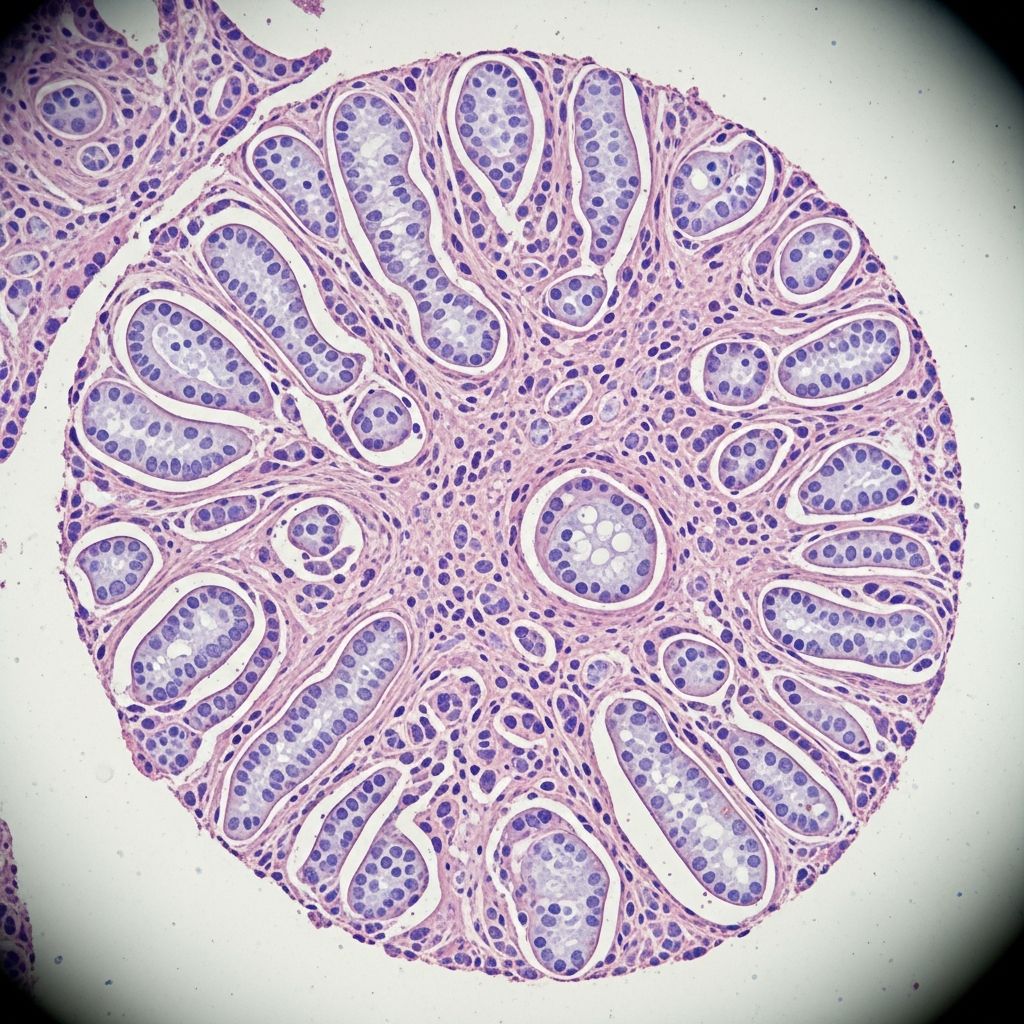
Sebaceoma, also known as sebaceous epithelioma, is a rare benign neoplasm of the sebaceous glands characterized by a predominance of basaloid germinative cells (>50%) intermixed with mature sebocytes. It typically presents as yellow to flesh-colored papules or nodules on the face or scalp, and requires differentiation from malignant counterparts like sebaceous carcinoma.
Clinical features
Sebaceoma manifests as small, firm, yellow-orange papules, nodules, or plaques, often on sun-exposed areas such as the face, particularly the cheeks, nose, or forehead. Lesions range from 2-10 mm in diameter, with a smooth or slightly verrucous surface. While usually sporadic, multiple lesions raise suspicion for Muir-Torre syndrome (MTS), a subtype of Lynch syndrome associated with mismatch repair gene mutations (MLH1, MSH2, MSH6, PMS2) and increased risk of visceral malignancies like colorectal or genitourinary cancers.
In MTS, sebaceomas may appear alongside other sebaceous tumors, keratoacanthomas, or colonic adenomas. Patients with solitary lesions are typically older adults (50-70 years), though pediatric cases linked to nevus sebaceus exist. Dermoscopy reveals yellow clods or globules with arborizing vessels or polymorphous vessels, mimicking sebaceous carcinoma but lacking ulceration or asymmetry.
Thorough systemic evaluation, including colonoscopy and mismatch repair protein immunohistochemistry, is recommended for multiple or suspicious lesions to rule out MTS. Prognosis is excellent for sporadic cases, with low recurrence post-excision.
Pathology
Scanning power view
At low magnification, sebaceoma appears as a well-circumscribed, lobulated nodule in the deep dermis, often connected to the overlying epidermis by thin strands. The tumor measures 1-5 mm, with sharp borders and no infiltration into subcutis. Cystic spaces may form due to ductal dilation, filled with eosinophilic debris.
Low power features
The lesion comprises irregular lobules of densely packed basaloid cells (undifferentiated, hyperchromatic, with scant cytoplasm) occupying over 50% of the tumor volume. Scattered clusters (10-30%) of mature sebocytes—large cells with multivacuolated, foamy cytoplasm—provide sebaceous differentiation. Small ducts lined by crenated, eosinophilic cuticle mimic sebaceous duct epithelium.
- Tumor lobules: Sharply demarcated, nodular or plate-like.
- Epidermal attachment: Frequent, with flattened rete ridges overlying the lesion.
- Cyst formation: Occasional, with holocrine secretion.
- Stroma: Delicate, hyalinized, without desmoplasia.
Medium power
Basaloid cells predominate peripherally, showing peripheral palisading without retraction artifact (unlike basal cell carcinoma). Transitional cells exhibit early sebaceous vacuolization. Mature sebocytes centralize in lobules, displacing nuclei. Mitotic figures are rare (<5 per 10 HPF), lacking atypia. No necrosis, lymphovascular invasion, or pagetoid spread.
Ducts feature stratified cuboidal epithelium with scalloped luminal borders, confirming adnexal differentiation. In nevus sebaceus-associated cases, underlying epidermal papillomatosis, absent follicles, and dilated eccrine ducts are evident.
| Feature | Description | Significance |
|---|---|---|
| Tumor Location | Deep dermis, epidermal attachment | Benign, non-infiltrative |
| Cell Composition | >50% basaloid, <50% sebocytes | Distinguishes from adenoma |
| Mitoses | Rare, no atypia | Supports benignity |
| Ducts | Crenated eosinophilic lining | Sebaceous lineage |
Related Stories



Histological variants
Sebaceoma exhibits diverse patterns:
- Carcinoid-like: Nested basaloid islands in fibrous stroma, mimicking neuroendocrine tumors.
- Sinusoidal/cribriform: Interconnecting lacunae with sebaceous foci.
- Reticulated/rippled: Lace-like sheets with concentric arrangements.
- Verocay-like: Palisaded whorls resembling schwannoma.
These do not alter prognosis but aid recognition.
Special stains and immunohistochemistry
Standard H&E suffices for diagnosis, but IHC refines differentials.
- Adipophilin: Strong granular positivity in sebocytes; negative in basaloid cells.
- EMA: Highlights sebaceous ducts and cytoplasm.
- CK5/6, p40: Basaloid layer positive; p40 distinguishes germinative cells.
- Ki-67: <10% proliferation index, peripheral accentuation.
- Mismatch repair proteins: Loss (e.g., MSH2) suggests MTS.
BerEP4 negative (vs. BCC), CK19 negative (vs. BCC).
Differential diagnosis
Sebaceoma mimics several adnexal tumors:
| Entity | Key Distinguishing Features |
|---|---|
| Sebaceous adenoma | <50% basaloid cells; lobules dominated by mature sebocytes clustered around central duct. Fewer basaloid rims (1-2 layers). |
| Basal cell carcinoma (sebaceous diff.) | Palisading with clefts; retraction artifact; BerEP4+; CK19+; stromal mucin; infiltrative. |
| Sebaceous carcinoma | Atypia, mitoses >10/HPF, necrosis, pagetoid spread, deep invasion, lymphovascular invasion; EMA+ in basaloids. |
| Trichoblastoma (sebaceous) | Retracted stroma, follicular papillae, CK20+ Merkel cells absent; less sebaceous component. |
| Sebocrine adenoma | Poroma-like; ducts lack eosinophilic lining; more eccrine differentiation. |
| Sebaceous hyperplasia | Immature lobules around follicle (<2-layer germinative); no nodules. |
Clinicopathologic correlation is crucial; excision biopsy confirms.
Genetic associations
Sporadic sebaceomas show somatic mutations or promoter hypermethylation. MTS-linked cases exhibit microsatellite instability due to MMR deficiency (MLH1/MSH2 loss). Genomic profiling aids prognosis; absence of MMR loss confirms sporadic nature.
Management and prognosis
Complete surgical excision with narrow margins (1-2 mm) is curative, with <5% recurrence. Mohs micrographic surgery for recurrent or high-risk sites. Monitor MTS patients per NCCN guidelines: annual colonoscopy, urine cytology, etc. No adjuvant therapy needed for benign lesions.
Frequently Asked Questions
Q: Is sebaceoma malignant?
A: No, sebaceoma is benign. Malignant features like atypia or invasion indicate sebaceous carcinoma.
Q: How is sebaceoma diagnosed?
A: By histopathology showing >50% basaloid cells with sebaceous differentiation. IHC rules out differentials.
Q: What is the link to Muir-Torre syndrome?
A: Multiple sebaceomas or MMR loss on IHC suggest MTS; screen for internal cancers.
Q: Does sebaceoma require treatment?
A: Yes, excision prevents growth and confirms diagnosis. Observation possible for small asymptomatic lesions.
Q: Can sebaceoma arise in nevus sebaceus?
A: Yes, especially in children; shows epidermal changes and absent follicles.
References
- The Germinative Preponderance-Sebaceous Epithelioma — Crimson Publishers. 2019-06-01. https://crimsonpublishers.com/tteh/fulltext/TTEH.000524.php
- Sebaceoma pathology — DermNet NZ. 2023-01-15. https://dermnetnz.org/topics/sebaceoma-pathology
- Sebaceous carcinoma pathology — DermNet NZ. 2023-01-15. https://dermnetnz.org/topics/sebaceous-carcinoma-pathology
- Sebaceoma pathology image — DermNet NZ. 2023-01-15. https://dermnetnz.org/imagedetail/18247-sebaceoma-pathology
- Sebaceous Adenoma — Dermatology Advisor. 2024-05-20. https://www.dermatologyadvisor.com/home/decision-support-in-medicine/dermatology/sebaceous-adenoma/
- Genetics of Skin Cancer (PDQ®) — National Cancer Institute (.gov). 2025-10-01. https://www.cancer.gov/types/skin/hp/skin-genetics-pdq
Similar Articles








Read full bio of medha deb