Sebaceous Hyperplasia Images: Clinical, Dermoscopy, Histology
Explore detailed images and clinical insights into sebaceous hyperplasia, a common benign skin condition affecting middle-aged adults.
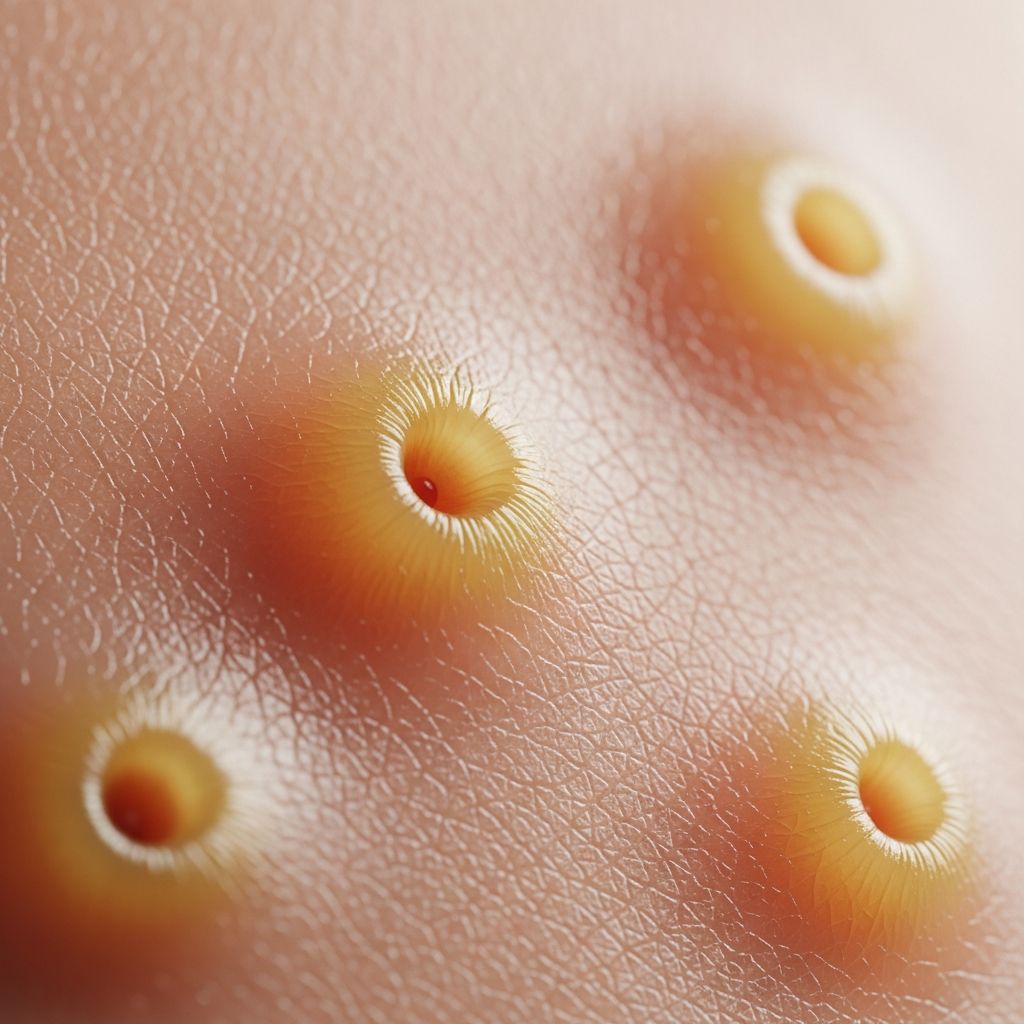
Sebaceous hyperplasia is a frequent benign condition characterized by enlarged sebaceous glands, commonly appearing as small, soft, yellowish papules on the face of middle-aged and older adults. This image gallery provides authoritative visual references to aid in recognition, diagnosis, and differentiation from similar lesions.
What is sebaceous hyperplasia?
Sebaceous hyperplasia involves the benign overgrowth of sebaceous glands associated with hair follicles, resulting in visible yellow-white papules, often with a central dell. It primarily affects individuals over 40, with higher prevalence in men, and is linked to hormonal changes, sun exposure, and immunosuppression.
Clinical images
Clinical presentations typically show multiple, soft, dome-shaped papules measuring 2-6 mm, concentrated on the forehead, cheeks, and nose. Lesions are asymptomatic but may be cosmetically concerning.
- Image 1: Multiple yellowish papules on the forehead of a 60-year-old male, each with subtle central umbilication, characteristic of classic sebaceous hyperplasia.
- Image 2: Close-up of cheek lesions in an elderly woman, displaying soft, waxy papules grouped symmetrically around the nose and malar areas.
- Image 3: Solitary larger lesion (5 mm) on the chin, appearing as a pale yellow nodule with a depressed center, mimicking a basal cell carcinoma.
- Image 4: Extensive involvement on the upper chest of a patient on cyclosporine, showing scattered 3-4 mm papules with minimal inflammation.
Dermoscopy images
Dermoscopy is invaluable for non-invasive diagnosis, revealing crown-like peripheral vessels surrounding a central white-yellow follicular ostium, distinguishing it from malignancies.
- Image 5: Dermoscopic view demonstrating aggregated yellowish lobules with a prominent central crater and branching ‘crown vessels’ encircling the lesion without entering the center.
- Image 6: High-magnification dermoscopy of multiple lesions, highlighting the mulberry-like surface and delicate telangiectatic vessels forming a peripheral crown pattern.
- Image 7: Variant with dilated discoid follicles surrounded by fine vessels, confirming hyperplasia without atypia.
Histopathology images
Histological examination shows mature sebaceous lobules (often >4 per follicle) clustered around a dilated duct, with peripheral germinative cells and central lipid-laden sebocytes. No atypia is present, differentiating from neoplasms.
- Image 8: Low-power H&E stain revealing multiple well-circumscribed sebaceous lobules attached to a central infundibular duct in the superficial dermis.
- Image 9: Higher magnification showing peripheral basaloid germinative layer (1-2 cells thick) transitioning to mature sebocytes with foamy cytoplasm and scalloped nuclei.
- Image 10: Dilated excretory duct filled with holocrine secretion, adjacent to normal epidermis, confirming benign hyperplasia.
Differential diagnosis images
Sebaceous hyperplasia must be differentiated from basal cell carcinoma, sebaceous adenoma, and trichoadenoma through clinical, dermoscopic, and histologic features.
| Condition | Key Features | Image Description |
|---|---|---|
| Basal Cell Carcinoma | Pearly border, arborizing vessels, no crown pattern; histo: basaloid nests with retraction artifact | Image 11: Ulcerated nodule with rolled edges vs. smooth hyperplasia papule |
| Sebaceous Adenoma | >50% mature sebocytes, >2 germinative layers, architectural distortion | Image 12: Lobules with immature eosinophilic cells replacing normal structures |
| Nevus Sebaceus | Present since childhood, papillomatosis, absent hair follicles | Image 13: Superficial malformed glands opening directly to surface |
| Acne Comedones | Inflammatory, younger patients, no yellow hue | Image 14: Blackheads vs. non-extractable waxy papules |
Who gets sebaceous hyperplasia?
This condition predominantly affects fair-skinned individuals over 50, with men affected twice as often as women post-menopause. Risk factors include chronic sun damage, organ transplant immunosuppression (e.g., cyclosporine), and genetic predisposition.
Related Stories



- Middle-aged to elderly adults (peak 60-80 years)
- Males > females
- Immunosuppressed patients
- High sun exposure history
Related images
Additional visuals illustrate variations and associations:
- Image 15: Linear arrangement on the temple, possibly koebnerized from irritation.
- Image 16: Post-treatment electrodessication showing resolved papule with mild hypopigmentation.
- Image 17: Familial clustering in a 45-year-old with multiple facial lesions.
Frequently Asked Questions
What does sebaceous hyperplasia look like?
Small (2-6 mm), soft, yellowish-white papules with a central pore or dell, primarily on the central face.
Is sebaceous hyperplasia cancerous?
No, it is entirely benign with no malignant potential, though it may mimic basal cell carcinoma requiring biopsy for confirmation.
How is sebaceous hyperplasia diagnosed?
Clinically and dermoscopically; biopsy if atypical. Crown vessels and yellow lobules are diagnostic.
Does sebaceous hyperplasia go away on its own?
Rarely; it is chronic but harmless. Treatment is cosmetic.
What is the best treatment for sebaceous hyperplasia?
Options include electrocautery, laser (CO2, pulsed dye), cryotherapy, or topicals like retinoic acid. Recurrence is common.
Management & Treatment Images
Treatment visuals demonstrate efficacy and outcomes:
- Image 18: Pre- and post-laser ablation showing flattened skin with transient erythema.
- Image 19: Hyfrecation craters healing over 2 weeks.
Prevention emphasizes sun protection, gentle skincare, and niacinamide/retinoids to regulate sebum.
References
- Sebaceous Hyperplasia – StatPearls — NCBI Bookshelf / NIH. 2023-07-17. https://www.ncbi.nlm.nih.gov/books/NBK562148/
- Sebaceous Hyperplasia Explained: Causes, Symptoms And Treatment — Dr Jenny Clinic. 2024-05-15. https://www.drjennyclinic.com/sebaceous-hyperplasia-explained/
- Bumps and Blemishes: Causes and Care of Sebaceous Hyperplasia — Dermascope. 2023-11-01. https://www.dermascope.com/bumps-and-blemishes-causes-and-care-of-sebaceous-hyperplasia/
- Sebaceous Hyperplasia — Rixis Dermatology. 2024-02-20. https://www.rixisdermatology.com/sebaceous-hyperplasia
- Sebaceous hyperplasia image — DermNet NZ. 2023-01-01. https://dermnetnz.org/imagedetail/7392-sebaceous-hyperplasia
- Sebaceous Hyperplasia: Diagnosis, Symptoms & Treatment — Cleveland Clinic. 2024-08-12. https://my.clevelandclinic.org/health/diseases/22670-sebaceous-hyperplasia
Similar Articles








Read full bio of Sneha Tete