Sebaceous Hyperplasia: 5 Effective In-Office Treatments
Understanding sebaceous hyperplasia: benign enlarged oil glands causing facial bumps, diagnosis, and effective treatment options.
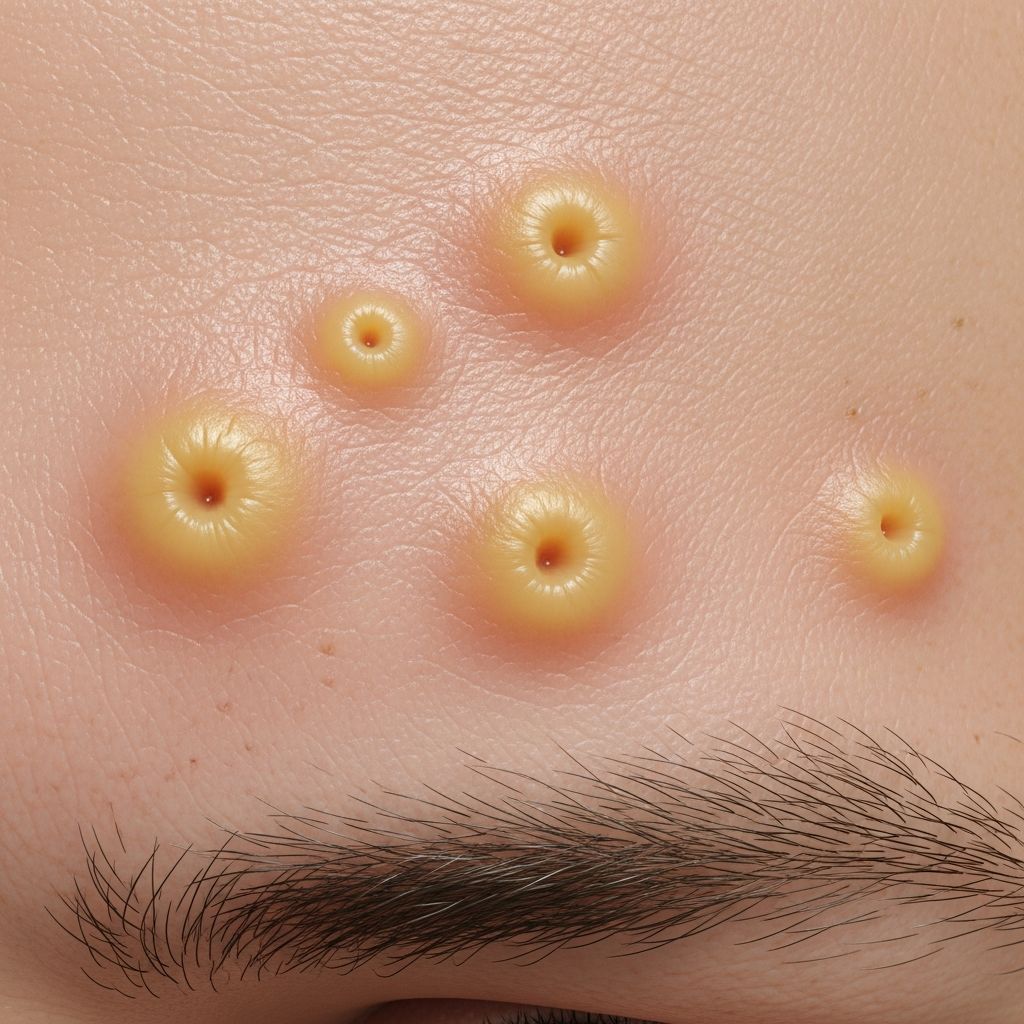
Sebaceous hyperplasia is a benign condition characterized by the enlargement of sebaceous (oil-producing) glands, resulting in small, yellowish papules primarily on the face.
What is sebaceous hyperplasia?
Sebaceous hyperplasia involves the overgrowth of normal sebaceous glands attached to hair follicles. These glands produce sebum, the skin’s natural oil that lubricates and protects the skin. In this condition, the glands become enlarged and more numerous, forming small, soft, yellow-to-flesh-colored bumps. The lesions typically feature a central umbilication (dimple) and are most common on sun-exposed areas like the forehead, cheeks, and nose.
Histologically, sebaceous hyperplasia shows mature sebaceous lobules with increased size and number, often four or more lobules around a central dilated duct. The glands retain normal structure but occupy a more superficial dermal position.
Who gets sebaceous hyperplasia?
This condition predominantly affects middle-aged to older adults, with prevalence increasing with age. It is more common in men than women and in individuals with fair skin types. Risk factors include chronic sun exposure, which damages skin and contributes to gland hyperplasia. Those with a history of acne or oily skin may also be predisposed. Immunosuppressed patients, such as organ transplant recipients on immunosuppressive therapy, have a higher incidence due to altered skin physiology.
- Middle-aged and elderly individuals (peak incidence over 50 years)
- Males more frequently than females
- Fair-skinned people
- Chronic sun exposure
- Immunosuppression (e.g., post-transplant patients)
What causes sebaceous hyperplasia?
The exact cause remains unclear, but several factors contribute. Chronic ultraviolet (UV) radiation from sun exposure is a primary trigger, leading to glandular enlargement. Hormonal influences, particularly androgens like testosterone, stimulate sebum production and gland growth. Genetic predisposition may play a role, as familial cases occur. In immunosuppressed individuals, medications like cyclosporine promote hyperplasia. Sebaceous glands trapped with excess sebum fail to empty properly, exacerbating the condition.
Unlike acne, these enlarged glands do not involve inflammation or bacterial overgrowth but result from structural changes in the pilosebaceous unit.
What are the clinical features of sebaceous hyperplasia?
Lesions appear as multiple, discrete, dome-shaped papules measuring 2–5 mm in diameter. They are soft, yellowish-white, or flesh-colored with a characteristic central dell (umbilication or crater-like depression). Common sites include the central face: forehead, cheeks, nose, and sometimes chin. Less frequently, they occur on the chest, areolas, or genitals.
Symptoms are usually absent; the bumps are asymptomatic unless irritated by trauma, causing mild redness or inflammation. They may cluster and become more prominent over time. Dermoscopically, crown-like peripheral vessels surround aggregated white-yellowish lobules, aiding differentiation from similar conditions.
- Small (1–3 mm), shiny, yellow/white papules
- Central dimple or pit
- Primarily facial (forehead, cheeks, nose)
- Multiple lesions, soft to touch
- No pain or itching unless irritated
Diagnosis
Diagnosis is primarily clinical, based on characteristic appearance during dermatological examination. A dermatoscope reveals pathognomonic features: yellow lobules with crown vessels and central ostium.
If uncertainty exists—particularly to rule out basal cell carcinoma (BCC), which can mimic lesions—a skin biopsy is performed. BCC shows atypical basaloid cells, unlike the mature sebaceous lobules in hyperplasia. Other differentials include acne, milia, trichoepithelioma, or syringoma.
| Feature | Sebaceous Hyperplasia | Basal Cell Carcinoma |
|---|---|---|
| Appearance | Multiple yellow papules, central umbilication | Solitary pearly nodule, telangiectasia |
| Dermoscopy | Crown vessels, yellow lobules | Arborizing vessels, blue-gray ovoids |
| Biopsy | Mature sebaceous lobules | Atypical basaloid cells |
Related Stories



Differential diagnosis
Sebaceous hyperplasia must be distinguished from malignant or other benign lesions:
- Basal cell carcinoma: Solitary, firm, lacks umbilication; dermoscopy shows arborizing vessels.
- Acne: Inflammatory, comedonal; resolves with time or treatment.
- Milia: Smaller, harder white cysts without central dell.
- Syringoma: Multiple small firm papules on lower eyelids.
- Trichoepithelioma: Flesh-colored nodules, often familial.
Biopsy confirms diagnosis when clinical features overlap.
What is the treatment for sebaceous hyperplasia?
Treatment is unnecessary as the condition is harmless, but pursued for cosmetic concerns. Options target gland destruction or size reduction. Recurrence is common since not all glands are eliminated.
In-office procedures
- Electrocautery/electrodesiccation: Heat destroys the gland; quick, effective for isolated lesions.
- Laser therapy: CO2, pulsed dye, or erbium lasers vaporize lesions with minimal scarring; ideal for multiple bumps.
- Cryotherapy: Liquid nitrogen freezes lesions; risk of hypopigmentation.
- Photodynamic therapy (PDT): Photosensitizer activated by light kills glands; good for widespread cases.
- Shave excision/curettage: Mechanical removal; may scar.
Medical therapies
- Topical retinoids (tretinoin): Reduce gland size over months; preventive.
- Trichloroacetic acid (TCA) peels: Chemical destruction; multiple sessions needed.
- Oral isotretinoin: For severe, widespread cases; shrinks glands but systemic side effects.
- Antiandrogens: For hormonally influenced cases in women.
Treatment selection considers lesion number (limited <10, moderate 10-50, frequent <100, very frequent >100), location, skin type, and patient preference. Risks include scarring, pigmentation changes, recurrence.
Prevention
Prevent progression with sun protection: daily broad-spectrum SPF 30+ sunscreen, hats, and shade. Gentle cleansing avoids irritation. Retinoids may prevent new lesions in at-risk individuals. Manage immunosuppression if applicable.
- Daily sunscreen application
- Avoid peak sun hours
- Moisturize to maintain barrier
- Retinoid prophylaxis
Outlook
Lesions persist indefinitely without treatment but do not progress to malignancy. Post-treatment, new bumps may develop due to ongoing glandular activity. Regular dermatologist follow-up monitors changes. Cosmetic outcomes vary; lasers offer best cosmesis.
Frequently Asked Questions
Is sebaceous hyperplasia cancerous?
No, it is a benign enlargement of oil glands, not cancer. Biopsy rules out mimics like BCC.
Does sebaceous hyperplasia go away on its own?
Rarely; it tends to persist and may increase with age or sun exposure.
Can I treat sebaceous hyperplasia at home?
Over-the-counter remedies are ineffective; professional treatments required.
Will sebaceous hyperplasia return after treatment?
Yes, recurrence is common as not all glands are destroyed.
How do I prevent new sebaceous hyperplasia lesions?
Use sunscreen daily and consider topical retinoids.
References
- Sebaceous Hyperplasia Treatment | Causes, Symptoms & Removal — PS Derm Group. 2024. https://www.psdermgroup.com/dermatology/sebaceous-hyperplasia-treatment
- Sebaceous Hyperplasia – StatPearls — NCBI Bookshelf / NIH. 2023-10-15. https://www.ncbi.nlm.nih.gov/books/NBK562148/
- Sebaceous Hyperplasia Treatment in Houston — Heights Dermatology. 2024. https://www.heightsskin.com/sebaceous-hyperplasia
- What Is Sebaceous Hyperplasia Treatment — WebMD. 2024. https://www.webmd.com/skin-problems-and-treatments/what-is-sebaceous-hyperplasia-treatment
- Sebaceous Hyperplasia Treatment In Gainesville, FL — Gainesville Dermatology Skin Surgery. 2024. https://www.gainesvilledermatologyskinsurgery.com/sebaceous-hyperplasia/
- Sebaceous hyperplasia: what is it? — Paula’s Choice EU. 2024. https://www.paulaschoice-eu.com/what-can-you-do-about-sebaceous-hyperplasia
- Sebaceous hyperplasia – DermNet — DermNet NZ. 2024. https://dermnetnz.org/topics/sebaceous-hyperplasia
Similar Articles








Read full bio of medha deb