Seborrhoeic Keratosis Dermoscopy Images: 7 Diagnostic Photos
Detailed dermoscopy images and descriptions of seborrhoeic keratosis for accurate diagnosis and differentiation.
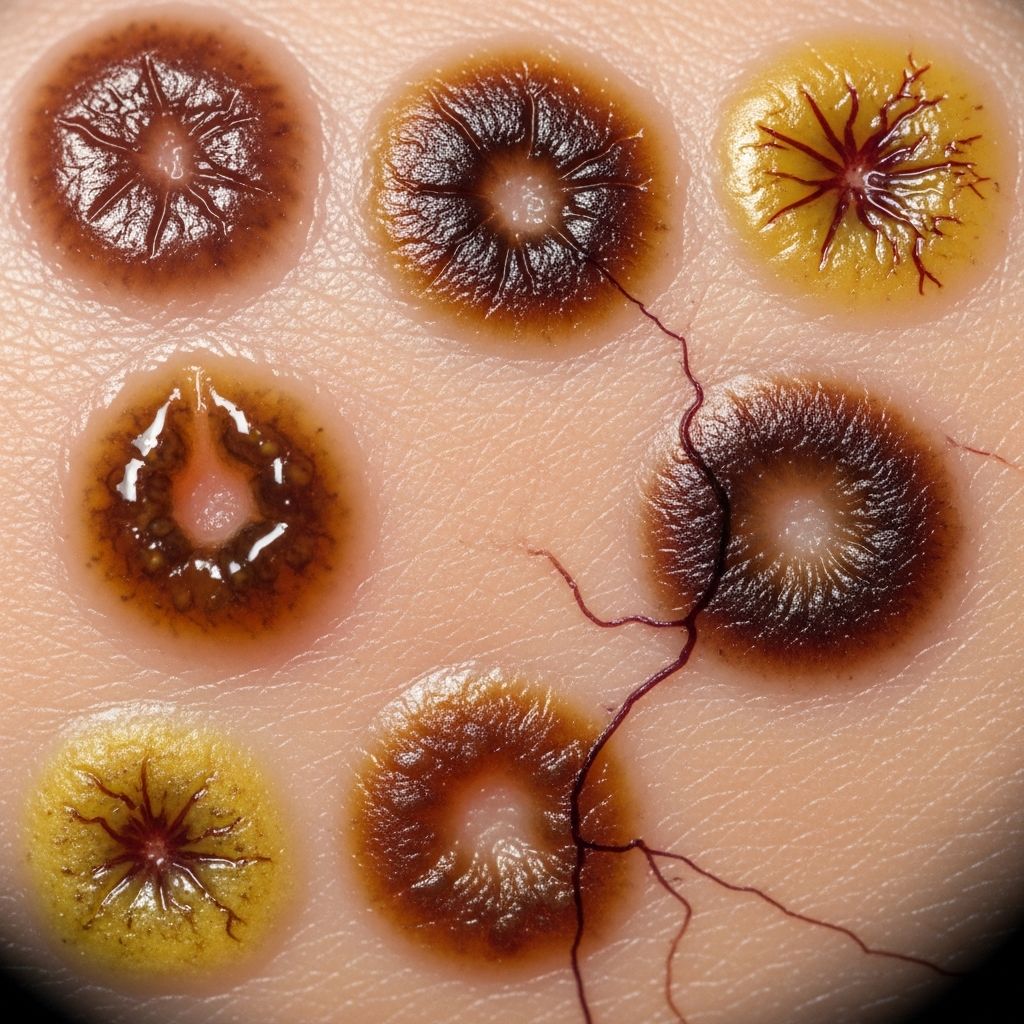
Seborrhoeic Keratosis Dermoscopy Images
Seborrhoeic keratosis, also known as seborrheic keratosis, is one of the most common benign skin tumours, particularly in older adults. Dermoscopy plays a crucial role in its diagnosis, revealing characteristic features that distinguish it from malignant lesions like melanoma or basal cell carcinoma. This article presents a comprehensive collection of dermoscopy images highlighting the classic and variant dermoscopic patterns of seborrhoeic keratosis.
What is Dermoscopy?
Dermoscopy, or dermatoscopy, is a non-invasive diagnostic technique using a handheld dermoscope to examine skin lesions at magnified resolution (typically 10x). It allows visualization of subsurface structures not visible to the naked eye, aiding in the accurate differentiation of benign from malignant lesions. For seborrhoeic keratosis, dermoscopy reveals pathognomonic features such as comedo-like openings and milia-like cysts, with high diagnostic accuracy reported in clinical studies.
Classic Dermoscopic Features of Seborrhoeic Keratosis
The dermoscopic hallmark of seborrhoeic keratosis includes a combination of several specific structures. These features are present in over 90% of cases and enable confident diagnosis without biopsy in most instances.
Comedo-like Openings
Comedo-like openings appear as dark, roundish or linear structures resembling blackheads, corresponding to keratin-filled invaginations in the lesion’s surface. They are the most common dermoscopic finding, observed in up to 70% of lesions. These openings often have a sharp demarcation and may show a central white-yellow core upon closer inspection.
- Typically black or brown due to keratin pigmentation.
- Arranged in a haphazard or linear pattern.
- Differentiates from melanoma’s irregular black blotches.
Milia-like Cysts
Milia-like cysts present as white or yellow round structures, representing small keratin-filled pseudocysts. They are seen in approximately 50% of cases and contribute to the ‘stuck-on’ clinical appearance.
- Size ranges from 0.1 to 1 mm.
- Often clustered in the centre of the lesion.
- Highly specific for benign diagnosis.
Moth-eaten Border
The moth-eaten border is a notched, irregular edge resembling bites taken out of the lesion’s periphery. This feature reflects the papillomatous architecture histologically.
- Seen in 40-60% of flat seborrhoeic keratoses.
- Contrasts with the sharp borders of melanocytic lesions.
Fingerprint-like Structures
Fingerprint-like structures are curved, thin lines at the lesion’s edge, mimicking dermal fingerprints. They occur in about 30% of cases, particularly in lighter lesions.
Network-like Structures
These resemble the pigment network of melanocytic naevi but are thicker and more irregular, formed by keratin and gyri-like extensions.
Dermoscopy Images Gallery
Below is a curated gallery of dermoscopy images demonstrating the spectrum of seborrhoeic keratosis presentations. Each image includes a detailed description of visible features.
Image 1: Classic Presentation with Comedo-like Openings and Milia-like Cysts
This dermoscopy view shows a light brown plaque on the back with prominent black comedo-like openings in a linear arrangement and scattered white milia-like cysts. A subtle moth-eaten border is evident peripherally.
Image 2: Darkly Pigmented Variant
Dark seborrhoeic keratosis on the chest displaying multiple comedo-like openings and a diffuse brown structureless area. Differentiation from melanoma is key; absence of atypical network or blue-white veil supports benignity.
Image 3: Flat Type with Fingerprint Structures
A flat lesion on the face featuring curved fingerprint-like lines along the edge and a thin pseudonetwork centrally.
Image 4: Irritated Seborrhoeic Keratosis
Inflamed lesion with haemorrhage (red dots) and ulceration, but preserved comedo-like openings confirming diagnosis despite clinical atypia.
Image 5: Stucco Keratosis Variant
Small, white-grey keratotic papules on the ankle showing stuck-on appearance with white keratin plugs.
Image 6: Clonal Variant
Multiple round milia-like cysts arranged in a clonal pattern within a larger plaque.
Image 7: Dermatosis Papulosa Nigra
Pigmented facial lesions in darker skin types showing comedo openings and reticular pattern.
Variant Forms and Less Common Features
Acanthotic Type
Characterized by marked acanthosis showing gyri and sulci (cerebriform pattern) with sharp demarcation.
Hyperkeratotic Type
Thick white keratin crust obscuring underlying structures; comedo openings visible beneath.
Melanocanthoma
Lesions with interspersed dark globules mimicking melanoma but with benign structural features.
| Feature | Prevalence (%) | Specificity |
|---|---|---|
| Comedo-like openings | 60-70 | High |
| Milia-like cysts | 40-50 | High |
| Moth-eaten border | 30-50 | Moderate |
| Fingerprint-like | 20-30 | Moderate |
| Pseudonetwork | 20-40 | Moderate |
Differential Diagnosis
While classic features are diagnostic, atypical presentations require consideration of mimics:
- Melanoma: Lacks comedo openings; shows atypical pigment network, blue-white veil.
- Basal Cell Carcinoma: Arborizing vessels, ulceration without keratin cysts.
- Solar Lentigo: Regular pigment network without raised structures.
- Lichen Planus-like Keratosis: Grey-blue granules, peripheral striations.
Clinical Correlation and Management
Seborrhoeic keratoses are benign but may be removed for cosmetic reasons or irritation using cryotherapy, curettage, or laser. Dermoscopy reduces unnecessary biopsies by confirming diagnosis in vivo. Regular skin checks are advised to monitor changes.
Frequently Asked Questions (FAQs)
Q: Can dermoscopy always diagnose seborrhoeic keratosis?
A: Dermoscopy is highly accurate (sensitivity ~92%, specificity ~95%) for classic cases but biopsy may be needed for atypical or obscured lesions.
Q: Do seborrhoeic keratoses turn cancerous?
A: No, they are entirely benign and do not undergo malignant transformation.
Q: When should I worry about a seborrhoeic keratosis?
A: If it rapidly changes in size, colour, or shape, or bleeds spontaneously, seek dermatological evaluation to rule out mimics.
Q: Are these lesions contagious?
A: No, seborrhoeic keratoses are not viral or infectious; they result from epidermal keratinocyte proliferation.
Q: Can children get seborrhoeic keratosis?
A: Rare before age 30; prevalence increases with age, affecting >80% over 70.
References
- Seborrhoeic keratosis pathology — DermNet NZ. 2021-09. https://dermnetnz.org/topics/seborrhoeic-keratosis-pathology
- Seborrhoeic keratosis — Healthify NZ. Accessed 2026. https://healthify.nz/health-a-z/s/seborrhoeic-keratosis
- Seborrhoeic Keratosis (seborrheic warts) — Newcastle Hospitals NHS. Accessed 2026. https://www.newcastle-hospitals.nhs.uk/services/dermatology/patient-dermatology-information-leaflets/seborrhoeic-keratosis-seborrheic-warts/
- Seborrhoeic keratoses images — DermNet NZ. 2011. https://dermnetnz.org/topics/seborrhoeic-keratosis-images
Similar Articles




Read full bio of medha deb