Seborrhoeic Keratosis Images: Photo Guide For Diagnosis
Comprehensive visual guide to seborrhoeic keratosis: clinical images, variants, and diagnostic insights for dermatologists and patients.
What is seborrhoeic keratosis?
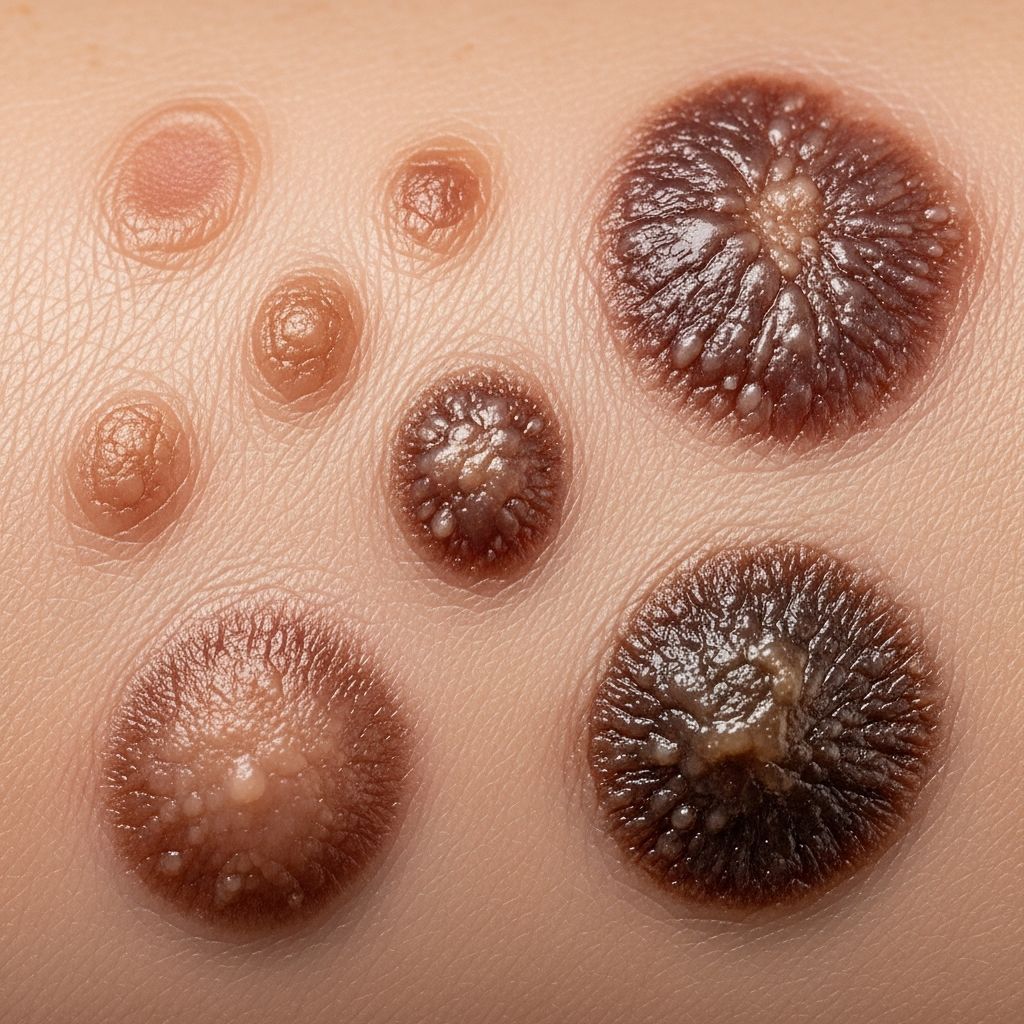
Seborrhoeic keratosis, also known as seborrheic keratosis (using American spelling), is a common benign skin growth that typically appears during adult life as a sign of skin ageing. These harmless warty spots can vary greatly in appearance, from light tan to black, and often have a stuck-on or waxy texture. They are most prevalent in fair-skinned individuals over the age of 40, with prevalence increasing with age—up to 80-100% of people over 70 may develop them.
Although non-cancerous, seborrhoeic keratoses can mimic skin cancers like melanoma or basal cell carcinoma, leading to diagnostic challenges. They are not contagious and do not spread from person to person. Risk factors include genetics, sun exposure, and skin friction in areas like clothing folds.
Clinical features of seborrhoeic keratosis
Seborrhoeic keratoses present as well-defined, raised lesions with a characteristic “stuck-on” appearance. They range in size from 1 mm to several centimetres and can be single or multiple—some individuals develop hundreds. Common sites include the trunk, face, scalp, and extremities, sparing palms, soles, and mucous membranes.
- Colour: Light tan, brown, dark brown, or black.
- Surface: Waxy, scaly, verrucous (warty), or smooth.
- Texture: Greasy or crumbly when scratched.
- Symptoms: Usually asymptomatic, but may itch, bleed if irritated, or become inflamed.
Diagnosis is typically clinical, based on appearance, but dermoscopy reveals features like comedo-like openings, milia-like cysts, and fingerprint-like ridges. Biopsy is reserved for atypical cases suspicious for malignancy.
Types of seborrhoeic keratosis
Seborrhoeic keratoses exhibit morphological variants, each with distinct clinical images:
| Variant | Description | Key Features |
|---|---|---|
| Common | Typical dome-shaped, stuck-on plaques. | Brown-black, waxy surface. |
| Irritated | Inflamed, red, crusted due to trauma. | May trigger dermatitis. |
| Eruptive | Sudden onset of many lesions, often pruritic. | Associated with medications or Leser-Trélat sign. |
| Clonal | Large, hyperpigmented, dermatosis papulosa nigra-like. | Common in darker skin types. |
| Melanacanthoma | Dark, verrucous with melanocytes. | Mimics melanoma. |
| Stucco keratosis | Small, white-grey, on lower legs/ankles. | Multiple, adherent scales. |
Seborrhoeic keratosis images — location
Lesions favour sun-exposed or friction-prone areas:
- Trunk (chest, back, abdomen).
- Face and scalp.
- Upper arms, forearms.
- Legs (especially stucco type).
Image descriptions: Typical examples show multiple brown waxy plaques on the back of an elderly patient, a solitary black lesion on the cheek resembling melanoma, and clustered tan spots on the chest.
Seborrhoeic keratosis pathology
Histologically, seborrhoeic keratoses show basaloid cell proliferation with acanthosis, hyperkeratosis, and horn cysts (pseudohorn cysts). No atypia or mitoses indicate benignity. Variants like irritated types show spongiosis and inflammation.
Diagnosis of seborrhoeic keratosis
Clinical diagnosis suffices for classic lesions. Dermoscopy aids differentiation:
- Comedo-like openings (hair follicle-like).
- Milia-like cysts (white pearls).
- Fissures and ridges (gyri and sulci).
- Sharp borders, network-like pigmentation.
Differentials include melanocytic naevus, basal cell carcinoma, squamous cell carcinoma, actinic keratosis, and melanoma. Atypical lesions warrant biopsy.
Management of seborrhoeic keratosis
Treatment is optional, indicated for cosmetics, irritation, or diagnostic uncertainty. Options include:
- Cryotherapy: Liquid nitrogen spray or cotton swab; effective for thin lesions.
- Curettage ± electrocautery: Scraping under local anaesthesia; ideal for thicker growths.
- Laser ablation: CO2 or erbium:YAG for precise removal.
- Topical therapies: 40% hydrogen peroxide (FDA-approved Eskata, discontinued but similar available); nitric-zinc complexes.
Related Stories



No prevention exists due to genetic/age factors. Sun protection may help. Complications post-treatment: hypopigmentation, scarring, recurrence.
Frequently asked questions about seborrhoeic keratosis
What is seborrhoeic keratosis?
A common, harmless, waxy skin growth linked to ageing, appearing as brown-black stuck-on spots.
Are seborrhoeic keratoses dangerous?
No, they are benign and non-cancerous, but can mimic skin cancer—consult a dermatologist for changes.
Do seborrhoeic keratoses go away?
They persist lifelong without treatment but can be removed if bothersome.
How are seborrhoeic keratoses treated?
Cryotherapy, curettage, electrocautery, or topicals for symptomatic/cosmetic removal.
Can seborrhoeic keratosis be prevented?
No proven prevention; genetics and age predominate. Regular skin checks recommended.
What does seborrhoeic keratosis look like?
Warty, scaly, pigmented plaques with stuck-on appearance; images show variants on trunk/face.
Is seborrhoeic keratosis contagious?
No, it is not infectious or hereditary in a contagious sense, though familial tendency exists.
Related topics on DermNet
- Actinic keratosis
- Dermatosis papulosa nigra
- Leser-Trélat sign
- Melanoma
- Solar lentigo
References
- Seborrheic Keratosis – StatPearls — NCBI Bookshelf / StatPearls Publishing. 2023-09-04. https://www.ncbi.nlm.nih.gov/books/NBK545285/
- Seborrheic keratosis – Symptoms & causes — Mayo Clinic. 2023. https://www.mayoclinic.org/diseases-conditions/seborrheic-keratosis/symptoms-causes/syc-20353878
- Seborrhoeic keratosis — DermNet NZ. 2023. https://dermnetnz.org/topics/seborrhoeic-keratosis
- Seborrheic Keratosis — Cleveland Clinic. 2023-05-31. https://my.clevelandclinic.org/health/diseases/21721-seborrheic-keratosis
- Seborrheic keratosis – Diagnosis & treatment — Mayo Clinic. 2023. https://www.mayoclinic.org/diseases-conditions/seborrheic-keratosis/diagnosis-treatment/drc-20353882
Similar Articles








Read full bio of medha deb