Seborrhoeic Keratosis Pathology: 6 Histopathology Subtypes
Comprehensive pathology of seborrhoeic keratosis: histopathology, clinical features, and diagnostic insights for dermatologists.
Author: Dr Harriet Cheng, Dermatopathologist, Auckland, New Zealand.
Seborrhoeic keratosis (also known as seborrheic keratosis, SK) represents the most common non-malignant epidermal tumour.
It is characterised by proliferation of basaloid cells and is predominantly observed in adults over 50 years of age.
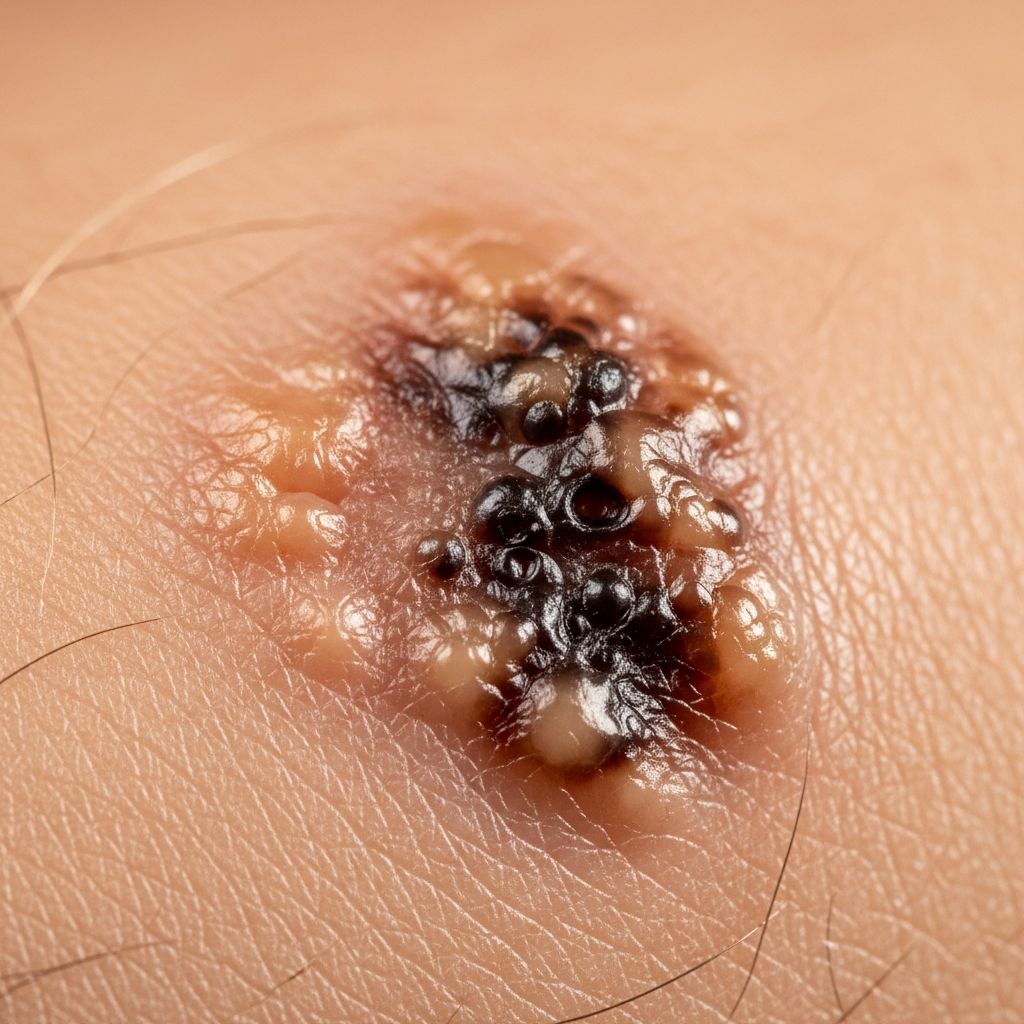
Lesions are typically multiple and exhibit a wide range of clinical morphologies, frequently displaying a “stuck-on” appearance.
Although generally benign, irritated or traumatised lesions may become inflamed or pruritic.
Histologically, the diagnosis is confirmed by the presence of horn cysts and a church spire pattern of orthokeratosis.
Introduction
Seborrhoeic keratoses are among the most prevalent skin tumours encountered in clinical practice. They arise from the proliferation of immature keratinocytes, often referred to as basaloid cells, which give rise to the characteristic histopathological features. These lesions are almost exclusively seen in adults, with prevalence increasing significantly after the age of 50. Multiple lesions are the norm, and they can vary greatly in size, colour, and surface texture, often resembling warts or moles, leading to frequent patient concern about malignancy.
The “stuck-on” appearance is a hallmark clinical feature, where the lesion appears firmly adhered to the skin surface as if glued on. This is due to the sharp demarcation between the tumour and the surrounding epidermis. While benign, mechanical irritation from clothing or scratching can cause inflammation, crusting, or itching, prompting patients to seek removal.
Clinical features
Seborrhoeic keratoses most commonly develop on sun-exposed areas such as the face, trunk, and upper extremities. Lesions present as well-circumscribed plaques ranging from a few millimetres to several centimetres in diameter. Colours vary from light tan to dark brown or black, occasionally with a waxy or greasy surface.
- Slightly raised, flat-topped plaques with a verrucous (warty) surface
- “Stuck-on” appearance, especially for pedunculated lesions
- Multiple lesions, often numbering in the dozens
- Painless, unless irritated
- Itching or irritation in inflamed variants
Key diagnostic factors include localisation on the torso or face, yellow to dark-brown colouration, and a wart-like texture. Dermoscopy reveals comedo-like openings, milia-like cysts, and hairpin vessels, aiding in differentiation from melanoma.
Histopathology
Under microscopic examination, seborrhoeic keratosis displays a proliferation of basaloid keratinocytes originating from the epidermal basal layer. The lesion is sharply demarcated from the surrounding epidermis, with a corrugated base and often a church spire (digitate) pattern of orthokeratosis on the surface.
Characteristic features include:
- Horn cysts (pseudohorn cysts): keratin-filled invaginations appearing as round eosinophilic structures
- Hyperkeratosis, acanthosis, and papillomatosis
- Basaloid cells with small, hyperchromatic nuclei and scant cytoplasm
- Lymphocytic infiltration in irritated lesions
Six main histopathological subtypes are recognised, though lesions may show features of more than one type.
Acanthotic seborrhoeic keratosis
The most common variant, characterised by marked acanthosis (thickening of the spinous layer) of monotonous basaloid cells. Moderate papillomatosis and hyperkeratosis are present, with numerous pseudohorn cysts (horn-filled invaginations from the surface) and occasional true horn cysts (abrupt keratinisation). About one-third show melanocytic hyperplasia and hyperpigmentation.
Hyperkeratotic seborrhoeic keratosis
Related Stories



Features thick compact hyperkeratosis and papillomatosis, creating a stuck-on appearance. Basaloid cell nests are present within papillae, with fewer horn cysts compared to the acanthotic type.
Clonal seborrhoeic keratosis
Characterised by sharply demarcated nests of monotonous basaloid cells within the epidermis, resembling Bowen disease or hidroacanthoma simplex. Minimal surface change and few horn cysts are noted.
Irritated (traumatised) seborrhoeic keratosis
Displays digitate epidermal hyperplasia with squamous cells showing dyskeratosis and parakeratosis. An inflamed stroma rich in plasma cells and a lichenoid infiltrate are common.
Melanoacanthoma
Large dendritic melanocytes scattered among the basaloid cells, which may mimic melanoma. Horn cysts are present.
Melanotic seborrhoeic keratosis
Intense basal pigmentation with abundant melanin in horn cysts and basaloid cells.
| Subtype | Key Features | Common Locations |
|---|---|---|
| Acanthotic | Marked acanthosis, pseudohorn cysts, melanocytic hyperplasia | Trunk, face |
| Hyperkeratotic | Compact hyperkeratosis, papillomatosis | Extremities |
| Clonal | Monotonous cell nests, minimal surface change | Legs |
| Irritated | Digitate hyperplasia, dyskeratosis, inflammation | Trauma-prone areas |
| Melanoacanthoma | Dendritic melanocytes | Face |
| Melanotic | Intense basal pigmentation | Sun-exposed sites |
Differential diagnosis
The clinical mimicry of seborrhoeic keratosis necessitates histopathological confirmation in atypical cases. Key differentials include:
- Melanoma: Asymmetric, irregular borders, colour variation
- Basal cell carcinoma: Pearly borders, telangiectasia
- Solar lentigo: Flat, macular pigmentation
- Lichen planus-like keratosis: Inflammatory changes
- Condyloma acuminatum: Genital localisation, HPV association
Biopsy is recommended for rapidly changing, bleeding, or symptomatic lesions.
Management
As benign lesions, treatment is optional and pursued for cosmetic reasons or irritation. Options include:
- Cryotherapy: Liquid nitrogen freezing, effective for small lesions
- Curettage and electrocautery: Scraping and desiccation, low complication rate
- Shave excision: For raised lesions
- Topical hydrogen peroxide 40%: FDA-approved, well-tolerated
- Laser ablation: For facial or sensitive areas
Complications include hypopigmentation (especially in dark skin), scarring, and recurrence. No preventive measures are known.
Frequently asked questions
What causes seborrhoeic keratosis?
The exact aetiology is unknown, but genetic factors and UV exposure contribute. They increase with age.
Are seborrhoeic keratoses cancerous?
No, they are benign, but can mimic melanoma, warranting biopsy if suspicious.
Do they go away on their own?
Rarely; most persist, though irritated ones may regress after inflammation resolves.
Is treatment painful?
Mild discomfort occurs with cryotherapy or curettage; topical anaesthetics help.
Can they appear suddenly?
The sign of Leser-Trélat describes sudden eruption associated with internal malignancy.
References
- Seborrheic keratosis – Symptoms, diagnosis and treatment — BMJ Best Practice. 2023. https://bestpractice.bmj.com/topics/en-us/617
- Seborrheic Keratosis: Causes and Treatment — Pinehurst Dermatology. 2024-01-15. https://www.pinehurstdermatology.com/conditions/seborrheic-keratosis
- Seborrheic Keratoses — Dermatology Associates. 2023-05-10. https://da-pdx.com/seborrheic-keratoses/
- Seborrheic Keratosis — StatPearls, NCBI Bookshelf. 2024-09-01. https://www.ncbi.nlm.nih.gov/books/NBK545285/
- Seborrheic Keratosis — Hawaii Premier Dermatology. 2023. https://hawaiipremierderm.com/seborrheic-keratosis/
- Seborrheic Keratosis and Aging — Tru-Skin Dermatology. 2024-02-20. https://www.tru-skin.com/blog/seborrheic-keratosis-and-aging
- Seborrhoeic keratosis — DermNet NZ. 2024. https://dermnetnz.org/topics/seborrhoeic-keratosis
Similar Articles








Read full bio of medha deb