Sentinel Lymph Node Biopsy: What To Expect And Key Facts
Detailed guide on sentinel lymph node biopsy procedure, indications, risks, and outcomes for melanoma and other cancers.
A
sentinel lymph node biopsy (SLNB)
is a surgical procedure used to determine if cancer from a primary tumour has spread to the lymphatic system. It targets the first lymph node(s) — known as the sentinel lymph node(s) — that drain lymph from the tumour site. This minimally invasive technique has revolutionized staging for cancers like melanoma and breast cancer, reducing the need for more extensive lymph node dissections.What is the lymphatic system?
The lymphatic system comprises a network of vessels, nodes, and organs that transport lymph fluid — a clear fluid containing white blood cells — throughout the body. Lymph nodes, small bean-shaped structures (typically 1–2 cm), filter lymph and trap pathogens or cancer cells. There are approximately 600–700 lymph nodes in the body, concentrated in areas like the neck, armpits (axilla), groin, chest, and abdomen.
Cancer cells can invade lymphatic vessels and travel to regional lymph nodes. The
sentinel lymph node
is the first node(s) receiving drainage from the tumour, making it the initial site for potential metastasis detection.What is a sentinel lymph node biopsy?
SLNB identifies, removes, and examines the sentinel lymph node(s) to check for cancer cells. It is performed after a cancer diagnosis, usually alongside tumour excision, to stage the disease accurately. Staging guides treatment: negative nodes suggest localized disease; positive nodes indicate possible spread, prompting further intervention.
This procedure replaced complete axillary or groin dissections for many patients, minimizing complications like lymphoedema while providing essential prognostic information.
Who needs a sentinel lymph node biopsy?
SLNB is indicated for early-stage cancers where lymphatic spread risk exists but complete dissection is unwarranted. Common applications include:
- Melanoma: tumours ≥1.0–2.0 mm thick (Breslow depth), or thinner lesions with ulceration, high mitotic rate, or regression.
- Breast cancer: clinically node-negative (cN0) early-stage invasive tumours, especially T1–T2.
- Other cancers: Merkel cell carcinoma, penile cancer, vulval cancer, some head/neck and anal cancers.
Contraindications include advanced disease with known nodal involvement, pregnancy (due to radioisotope), or prior surgery disrupting lymphatic drainage.
How is a sentinel lymph node biopsy performed?
SLNB involves preoperative mapping and intraoperative node localization/removal. It typically occurs under general anaesthesia in an operating theatre.
Preoperative lymphoscintigraphy (lymph node mapping)
Performed 1–24 hours pre-surgery in nuclear medicine:
- A radioactive tracer (e.g., technetium-99m sulfur colloid) is injected intradermally/subcutaneously around the tumour (peritumoural) or excision biopsy scar.
- The tracer travels via lymphatics to sentinel node(s).
- A gamma camera images drainage over 30–60 minutes, marking skin projection(s) with indelible ink. Up to 4–6 hot spots may be identified.
- Images guide the surgeon intraoperatively.
Intraoperative procedure
Steps include:
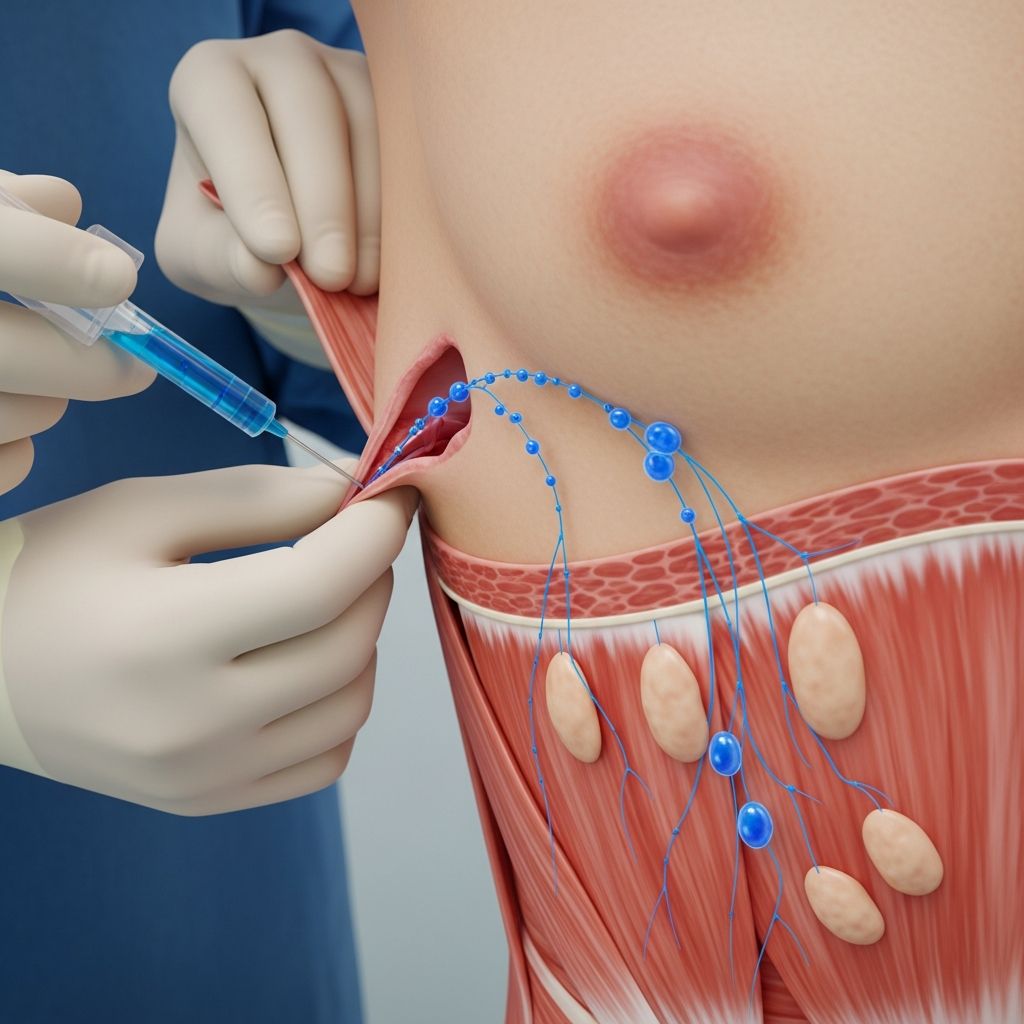
- Tracer injection: Additional tracer or blue dye (isosulfan/patent blue V, 1–5 mL) injected around the scar/tumour site.
- Incision: Small cut (2–4 cm) over marked hot spot(s).
- Detection: Handheld gamma probe localizes ‘hot’ nodes (≥10x background radioactivity). Blue-stained nodes confirm visually.
- Excision: Sentinel node(s) removed; basin declared negative if no residual radioactivity.
- Confirmation: Probe verifies ex vivo node radioactivity.
- Closure: Wound sutured; tumour excision often simultaneous.
Related Stories



Procedure duration: 30–90 minutes. Multiple sentinel nodes (average 2–3) may be removed.
Pathology examination
Excised nodes undergo:
- Touch imprint cytology: Intraoperative rapid assessment (frozen section) for immediate results (sensitivity 60–90%).
- Standard processing: Fixed in formalin, embedded in paraffin, sliced at 2–3 levels, stained with H&E.
- Serial sectioning/Immunohistochemistry (IHC): For equivocal cases; markers like S100 (melanoma), cytokeratins (carcinoma). Detects micrometastases (<2 mm).
- RT-PCR: Molecular detection of cancer-specific genes (research setting).
Results available: intraoperative (20–60 min), final (1–3 days).
What are the benefits of sentinel lymph node biopsy?
| Benefit | Description |
|---|---|
| Accurate staging | Identifies occult metastases in 15–25% melanoma, 20–30% breast cancer cases. |
| Minimally invasive | Avoids full dissection morbidity; smaller incision, shorter hospital stay. |
| Prognostic value | Positive SLNB predicts poorer outcomes, guides adjuvant therapy (e.g., immunotherapy). |
| Reduced complications | Lymphoedema risk <5% vs. 20–30% with dissection. |
What are the limitations and risks?
Despite advantages, SLNB has drawbacks:
- False negatives: 5–10% (cancer missed due to failed drainage, IHC-negative micrometastases).
- Multiple/tumour-positive sentinels: Up to 20–60% positive nodes beyond first sentinel.
- Neoadjuvant therapy effects: Alters lymphatic flow.
**Complications** (incidence <10%):
- Haematoma/seroma (1–2%).
- Infection (<1%).
- Allergic reaction to blue dye (anaphylaxis rare, <1%).
- Lymphoedema (axillary 4–7%, inguinal higher 10–15%).
- Nerve injury, shoulder stiffness.
- Radioisotope risks: minimal radiation exposure.
After the procedure
Postoperative care:
- Day surgery common; observe 4–6 hours.
- Wound care: keep dry 48 hours, shower after.
- Arm exercises prevent stiffness (especially axillary).
- Pain: paracetamol/NSAIDs; ice packs.
- Follow-up: pathology results 1–2 weeks; discuss management.
Interpretation of results
- Negative: Cancer unlikely spread; no further nodal surgery needed. Surveillance continues.
- Positive: Confirms metastasis. Proceed to completion lymph node dissection (CLND) or adjuvant therapy (e.g., checkpoint inhibitors for melanoma). Recent trials (MSLT-I/II) question CLND routine benefit post-positive SLNB.
Frequently Asked Questions
What if the sentinel node is positive?
Further treatment like CLND or systemic therapy is considered, based on burden and primary tumour features.
Is SLNB painful?
Injections cause brief stinging; surgery under anaesthesia is painless. Mild postoperative soreness managed with analgesics.
Can pregnant patients have SLNB?
Generally avoided due to radiation; alternatives like ultrasound-guided biopsy used.
How reliable is SLNB for melanoma?
95% accuracy; false-negative rate ~5% with dual-tracer technique.
Does blue dye cause skin tattooing?
Temporary blue discoloration fades in 24–48 hours; rare persistent tattoo.
References
- Sentinel Lymph Node Biopsy — MedlinePlus (U.S. National Library of Medicine). 2023-05-01. https://medlineplus.gov/lab-tests/sentinel-lymph-node-biopsy/
- Sentinel Lymph Node Biopsy — Yale Medicine. 2024-01-15. https://www.yalemedicine.org/clinical-keywords/sentinel-lymph-node-biopsy
- Sentinel Lymph Node Biopsy | Skin Cancer — Mercy Health. 2023-11-20. https://www.mercy.com/health-care-services/cancer-care-oncology/specialties/skin-cancer-treatment/treatments/sentinel-lymph-node-biopsy
- Sentinel node biopsy — Mayo Clinic. 2024-08-10. https://www.mayoclinic.org/tests-procedures/sentinel-node-biopsy/about/pac-20385264
- Sentinel lymph node biopsy for melanoma skin cancer — Cancer Research UK. 2023-09-05. https://www.cancerresearchuk.org/about-cancer/tests-and-scans/sentinel-lymph-node-biopsy-for-melanoma-skin-cancer
- Sentinel Node Biopsy — Henry Ford Health. 2023-07-12. https://www.henryford.com/Services/Breast-Cancer/Diagnosing-Breast-Cancer/Screenings-Diagnosis/Sentinel-Node-Biopsy
- Sentinel Node Biopsy (SLNB): Procedure and Recovery — Cleveland Clinic. 2024-02-28. https://my.clevelandclinic.org/health/diagnostics/9192-sentinel-node-biopsy
- Axillary Sentinel Lymph Node Biopsy — StatPearls (NCBI Bookshelf). 2023-10-15. https://www.ncbi.nlm.nih.gov/books/NBK553184/
Similar Articles








Read full bio of Sneha Tete