Skeletal Muscle: Structure, Function & Anatomy
Understanding skeletal muscles: voluntary muscles that enable movement and support your body.
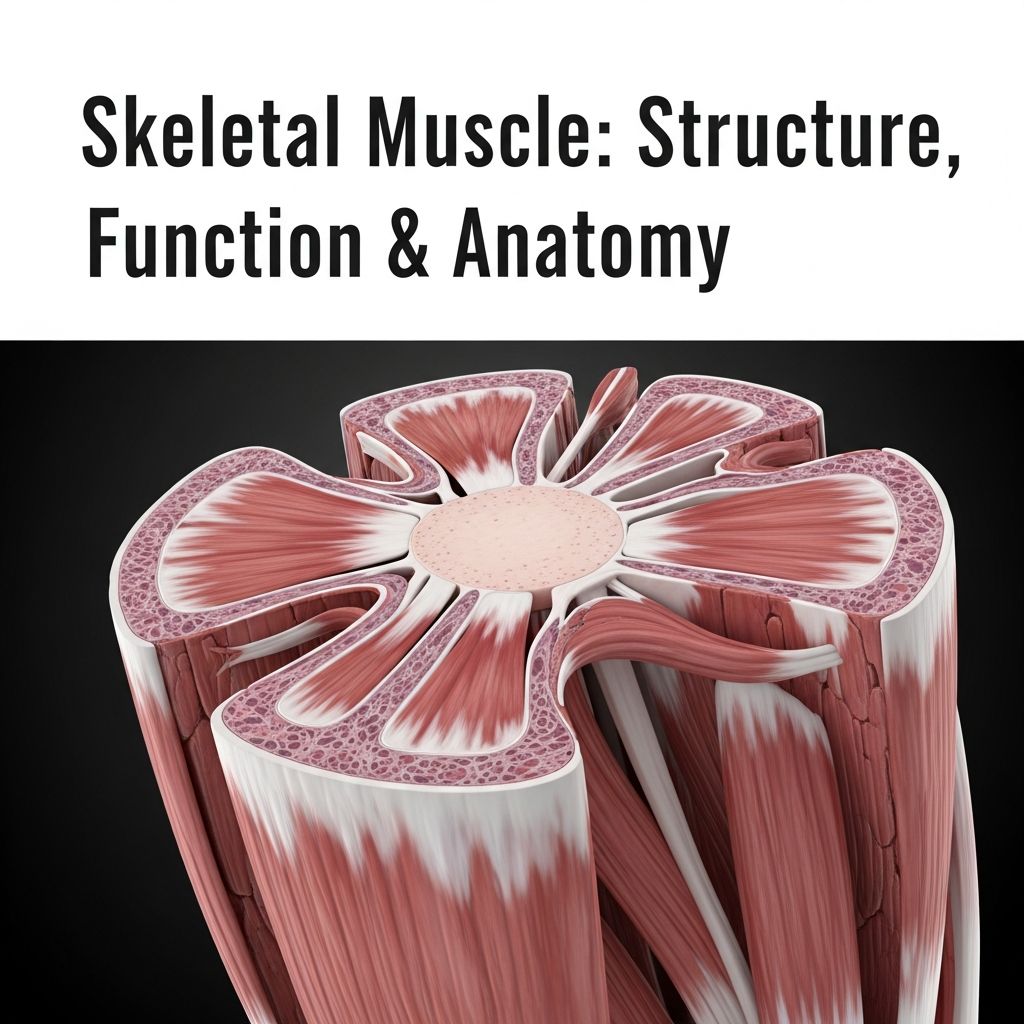
Skeletal muscles are the most common type of muscle tissue in your body and play a vital role in enabling movement and maintaining posture. Unlike other muscle types, skeletal muscles are voluntary muscles, meaning you consciously control their movement. These powerful tissues work in coordination with your bones, tendons, and ligaments to support your body’s weight, maintain proper posture, and facilitate all the movements you make throughout the day.
What Are Skeletal Muscles?
Skeletal muscles are a specialized type of muscle tissue composed of long, cylindrical cells called muscle fibers. These fibers are multinucleated, meaning each cell contains multiple nuclei, which allows them to grow and repair efficiently. The distinctive appearance of skeletal muscle comes from the regular pattern of red and white lines that cross through the tissue, giving it a striated or striped appearance. This characteristic striped pattern is what distinguishes skeletal muscle from smooth muscle, which appears uniform and lacks striations.
Your skeletal muscles are attached to bones throughout your body by tough, fibrous connective tissues called tendons. These tendons anchor muscle tissue to the skeletal system, enabling the transfer of muscular force directly to your bones. When a skeletal muscle contracts, it pulls on the bone to which it is attached, creating movement at the joint. This mechanical relationship between muscle and bone is fundamental to how your body moves.
Structure of Skeletal Muscle
Understanding the structure of skeletal muscle helps explain how these tissues function. Skeletal muscle has a complex, hierarchical organization that begins at the microscopic level and builds up to the structures you can see and feel.
Muscle Fibers and Composition
Skeletal muscle fibers are among the largest cells in your body. Each fiber is wrapped in a membrane called the sarcolemma, which helps maintain the fiber’s shape and integrity. Inside each fiber, you’ll find specialized organelles called myofibrils, which are the contractile units responsible for muscle contraction. These myofibrils contain thick and thin filaments made of proteins, primarily myosin and actin, that slide past each other during muscle contraction to generate force.
The fibers themselves contain lots of tiny, elastic fibers that allow muscles to contract and extend. Sheaths of tough connective tissue hold these fibers together, providing structural support and protecting the delicate contractile machinery within. This connective tissue framework also provides pathways for blood vessels to deliver oxygen and nutrients, and for nerves to transmit signals that control muscle contraction.
Organizational Hierarchy
Skeletal muscle is organized in a hierarchical structure. Individual muscle fibers are bundled together into groups called fascicles. These fascicles are surrounded by a connective tissue sheath called the perimysium. Multiple fascicles together form the complete muscle, which is enclosed in an outer connective tissue layer called the epimysium. This layered organization provides strength and flexibility while maintaining the muscle’s functional integrity.
Types of Skeletal Muscle Fibers
Not all skeletal muscle fibers are identical. Your body contains two main types of skeletal muscle fibers, each with distinct characteristics and functions:
| Fiber Type | Characteristics | Primary Function |
|---|---|---|
| Fast-Twitch Fibers | Contract quickly, use short bursts of energy, fatigue faster | Sprinting, jumping, powerful movements |
| Slow-Twitch Fibers | Contract slowly, sustained contractions, fatigue-resistant | Posture, endurance activities, stability |
Related Stories



Fast-twitch fibers are optimized for rapid, powerful contractions and are frequently used during activities requiring explosive force. However, they tire relatively quickly because they rely primarily on anaerobic metabolism. In contrast, slow-twitch fibers are designed for endurance and sustained contractions. These fibers contain more mitochondria and have a rich blood supply, allowing them to generate energy through aerobic metabolism over extended periods. Your back muscles, which help maintain posture throughout the day, are primarily composed of slow-twitch fibers.
Functions of Skeletal Muscles
Skeletal muscles serve numerous essential functions in your body beyond just enabling movement:
Movement and Locomotion
The primary function of skeletal muscles is to enable voluntary movement. Working in coordinated groups, skeletal muscles contract and relax to move your limbs, torso, and head. Different muscle groups work together as agonists (muscles that create the desired movement) and antagonists (muscles that oppose the movement), allowing for smooth, controlled, and precise movements.
Posture and Stability
Skeletal muscles play a critical role in maintaining your body’s posture and stability. Postural muscles contract continuously but with minimal effort to keep your body aligned against gravity. These muscles are primarily composed of slow-twitch fibers and work throughout the day to maintain proper spinal alignment and prevent slouching or collapse.
Support and Protection
Skeletal muscles provide structural support for your internal organs. The deep abdominal muscles, for example, support your digestive organs and help maintain intra-abdominal pressure. Muscles surrounding your spine provide additional support and protection for this critical structure.
Heat Generation
Muscle tissue generates considerable heat through metabolic activity. During exercise or in cold environments, your skeletal muscles increase their metabolic rate to generate additional heat, helping maintain your body’s core temperature through a process called thermogenesis.
Metabolic Function
Skeletal muscles are significant metabolic organs. They consume glucose and fatty acids for energy and are responsible for a substantial portion of your body’s total energy expenditure, both during activity and at rest.
Major Skeletal Muscle Groups
Your body contains hundreds of individual skeletal muscles working in coordinated groups. Healthcare providers organize these muscles by location and function:
Upper Body Muscles
The muscles of your arms, shoulders, and chest enable fine motor movements and powerful actions. Your arm muscles help with small, precise movements such as wiggling your fingers or fastening a button, while also enabling larger movements like lifting and throwing. The shoulder muscles stabilize the shoulder joint, which is the most mobile joint in your body, allowing an extensive range of motion.
Core Muscles
Your core includes deep abdominal and spinal muscles that stabilize your trunk and transfer force between your upper and lower body. These muscles are essential for maintaining posture, enabling proper breathing, and facilitating all rotational movements.
Back Muscles
Your back muscles are organized into three distinct layers: superficial, intermediate, and intrinsic muscles. Superficial back muscles help you move your shoulders and are the ones people typically see when looking at the back. Intermediate back muscles assist with breathing by moving your ribs. The intrinsic muscles form the deepest layer and are closest to your spine, helping control fine movements and providing stability to your spinal column.
Leg Muscles
Your leg muscles are among the strongest muscles in your body. The upper leg muscles support your entire body weight and enable walking, running, jumping, and maintaining posture. The lower leg muscles stabilize your foot and ankle, allowing you to move your foot in various directions and maintain balance during activities.
Neck Muscles
You have approximately 30 neck muscles extending from the base of your skull and jaw down to your shoulder blades and collarbone. These muscles support and stabilize your head and neck while allowing movement in multiple directions. They also assist with essential functions like chewing, swallowing, and breathing.
How Skeletal Muscles Work
Skeletal muscle function depends on an intricate process of nerve signaling and chemical events:
The Contraction Process
When you decide to move, your brain sends electrical signals through motor neurons to the skeletal muscles you want to contract. These signals travel from your nervous system to specialized junctions between nerves and muscle fibers called neuromuscular junctions. At these junctions, the neurotransmitter acetylcholine is released, triggering a cascade of events inside the muscle fiber that causes the thick and thin filaments to slide past each other, shortening the muscle and generating force.
Energy Requirements
Muscle contractions require substantial energy in the form of ATP (adenosine triphosphate). Your muscle fibers obtain this energy through metabolic pathways that break down carbohydrates, fats, and proteins. During intense exercise, your muscles may exceed the oxygen available through aerobic metabolism and rely on anaerobic pathways, which produces lactate as a byproduct.
Integration with the Musculoskeletal System
Skeletal muscles don’t work in isolation. They are part of a larger musculoskeletal system that includes bones, cartilage, ligaments, tendons, and connective tissues. This integrated system works together to support your body’s weight, maintain your posture, and enable movement. The skeletal system provides the rigid framework to which muscles attach, while muscles provide the force necessary to move this framework.
Common Skeletal Muscle Conditions
Skeletal muscles are vulnerable to various conditions that can affect function and cause discomfort. Muscle strains, which occur when muscle fibers are stretched or torn, are among the most common injuries. While most muscle strains are minor and resolve with rest, some serious muscle injuries require medical attention. Other conditions affecting skeletal muscles include muscular dystrophy, myasthenia gravis, and various inflammatory myopathies.
Maintaining Healthy Skeletal Muscles
Keeping your skeletal muscles strong and healthy is essential for maintaining mobility, independence, and overall quality of life. Regular physical activity, including both cardiovascular exercise and resistance training, helps maintain muscle strength and endurance. Adequate protein intake supports muscle repair and growth, while proper hydration ensures optimal muscle function. As you age, maintaining muscle mass becomes increasingly important, as muscle naturally declines with aging.
Frequently Asked Questions
Q: What is the difference between skeletal muscle and cardiac muscle?
A: Both skeletal and cardiac muscles are striated and under voluntary control initially, but cardiac muscle is only found in your heart and contracts automatically. Skeletal muscles are found throughout your body and require conscious control to contract.
Q: Are skeletal muscles voluntary or involuntary?
A: Skeletal muscles are voluntary muscles, meaning you consciously control their movement by thinking about moving that part of your body. This distinguishes them from smooth and cardiac muscles, which operate involuntarily.
Q: How many skeletal muscles does the human body have?
A: The human body contains hundreds of individual skeletal muscles. While exact numbers vary by how muscles are counted and grouped, most estimates range between 600 and 840 named skeletal muscles.
Q: What attaches skeletal muscles to bones?
A: Tendons attach skeletal muscles to bones throughout your body. These tough, fibrous connective tissues transmit the force generated by muscle contractions to your skeleton, enabling movement.
Q: Can skeletal muscles regenerate after injury?
A: Yes, skeletal muscles have some capacity to regenerate after injury. Muscle satellite cells can proliferate and differentiate into new muscle fibers, though the extent of regeneration depends on the severity of the injury and individual factors like age and overall health.
References
- Neck Muscles: What They Are, Types, Anatomy & Function — Cleveland Clinic. 2024. https://my.clevelandclinic.org/health/body/21670-neck-muscles
- Muscles of the Body: Types, Groups, Anatomy & Functions — Cleveland Clinic. 2024. https://my.clevelandclinic.org/health/body/21887-muscle
- Skeletal Muscle: Definition & Function — Britannica Encyclopedia. Revised 2024. https://www.britannica.com/science/skeletal-muscle
- Back Muscles: Anatomy and Function of Upper, Middle & Lower Back — Cleveland Clinic. 2024. https://my.clevelandclinic.org/health/body/21632-back-muscles
- Leg Muscles: Anatomy and Function — Cleveland Clinic. 2024. https://my.clevelandclinic.org/health/body/22220-leg-muscles
- Musculoskeletal System: Arthritis, Lower Back Pain, Bones, Muscles — Cleveland Clinic. 2024. https://my.clevelandclinic.org/health/articles/12254-musculoskeletal-system-normal-structure-function
- Skeletal System: What It Is, Function, Care & Anatomy — Cleveland Clinic. 2024. https://my.clevelandclinic.org/health/body/21048-skeletal-system
Similar Articles








Read full bio of Sneha Tete