Skin Biopsy: Essential Guide To Types, Results, Healing
Essential guide to skin biopsy procedures, types, techniques, and diagnostic importance in dermatology.
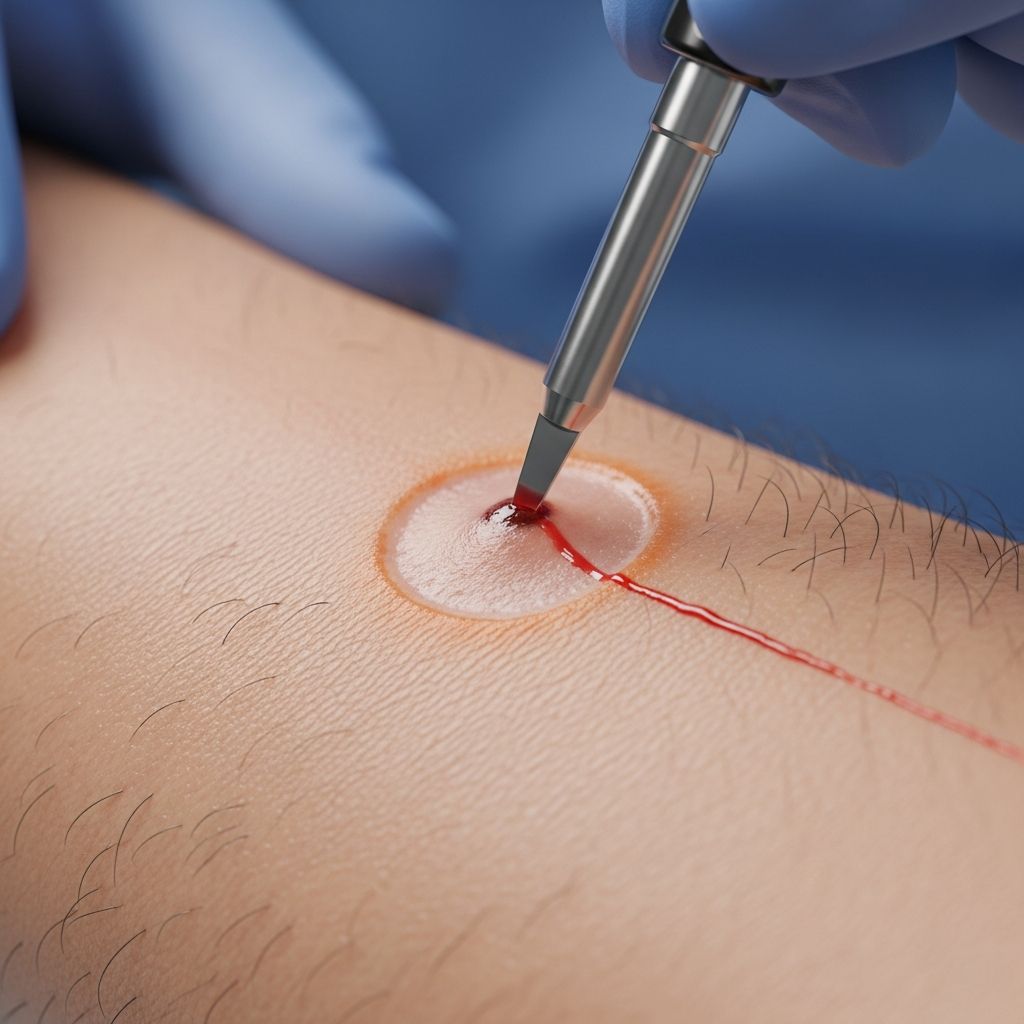
A
skin biopsy
is the removal of a sample of skin tissue for microscopic examination to aid in diagnosing skin conditions. It is typically performed under local anaesthesia to numb the area, with the injection causing brief stinging.Introduction
Skin biopsies are a cornerstone of dermatological diagnosis, providing histopathological insights invisible to the naked eye. The procedure allows pathologists to examine the epidermis, dermis, and often subcutis, revealing inflammatory patterns, infections, neoplasms, or other abnormalities. Common indications include persistent rashes, suspicious lesions, non-healing ulcers, or unexplained pigmentation changes.
The choice of biopsy type depends on the lesion’s characteristics, suspected diagnosis, and anatomical location. Proper technique ensures adequate sampling while minimising complications.
Uses of Skin Biopsy
Skin biopsies are indicated when clinical examination alone cannot confirm a diagnosis. Key uses include:
- Identifying inflammatory skin diseases (e.g., psoriasis, lichen planus, vasculitis).
- Diagnosing infections (bacterial, fungal, viral).
- Evaluating neoplasms (benign, premalignant, malignant like basal cell carcinoma or melanoma).
- Assessing blistering disorders (e.g., pemphigus, bullous pemphigoid).
- Confirming drug reactions or connective tissue diseases.
Biopsies provide definitive diagnosis in up to 80-90% of cases when performed correctly, guiding targeted therapy.
Types of Skin Biopsy
Several biopsy techniques exist, each suited to specific lesions. The table below summarises common types:
| Type | Description | Indications | Depth/Sample |
|---|---|---|---|
| Punch biopsy | Circular tool (2-6 mm) removes full-thickness skin column. | Most versatile for rashes, small lesions; preferred first-line. | Epidermis, dermis, subcutis. |
| Shave/tangential biopsy | Horizontal slice using blade or razor. | Superficial lesions (e.g., seborrhoeic keratosis, superficial BCC). | Epidermis/dermis only. |
| Excision biopsy | Complete elliptical removal of lesion with margins. | Suspicious malignancies (e.g., melanoma), full diagnosis/treatment. | Full thickness, complete lesion. |
| Incisional biopsy | Partial wedge/segment removed. | Large lesions where full excision impractical. | Representative sample. |
| Curettage | Spoon-shaped tool scrapes tissue. | Superficial benign lesions (e.g., warts). | Fragments, superficial. |
| Fine needle aspiration (FNA) | Needle extracts cells. | Metastatic nodules, subcutaneous lesions. | Cells only. |
The
punch biopsy
is generally the most useful due to its speed, small wound size, and full-thickness sampling.Choosing the Type and Site of Biopsy
Selecting the appropriate biopsy type and site is critical to avoid misdiagnosis. Consider lesion morphology, location, and differential diagnosis.
- Lesion selection: Choose the most representative or active area. Avoid ulcerated centres or healing edges; sample inflamed borders or indurated margins.
- Suspicious neoplasms: For actinic keratosis vs. squamous cell carcinoma (SCC), ensure deep dermis sampling—superficial shaves risk missing invasion (up to 20% underdiagnosis).
- Melanoma: Prefer narrow excisional biopsy (2 mm margins) to assess heterogeneity; partial biopsies risk sampling regression areas yielding false negatives.[10]
- Basal cell carcinoma (BCC): Punch or shave for superficial types; excision if aggressive patterns suspected (15% sampling error).
- Anatomical sites: Avoid flexures, face, genitals if possible; prefer cosmetically less visible areas. For widespread rashes, biopsy from trunk or proximal limbs.
Consult dermatopathologist if uncertain—clinical images aid selection.
Completing the Request Form
A detailed request form optimises pathological interpretation.
- Patient details: Demographics, allergies, medications.
- Lesion info: Precise anatomical site, size, duration, progression, clinical description (e.g., colour, texture).
- Clinical differentials: Suspected diagnoses, prior biopsies.
- Images: Clinical/dermoscopic photos enhance accuracy.
- Specimen orientation: For excisions, mark margins (e.g., ink, sutures).
Include punch size for small samples.
The Biopsy Sample
Post-procedure handling ensures viability:
- Fixation: Place in 10% neutral buffered formalin immediately (within 30 min for optimal morphology).
- Transport: Label clearly; multiple samples in separate pots if needed.
- Special studies: Note if immunofluorescence (for blisters: Michel’s medium), microbiology, or molecular tests required.
Related Stories



Pathologists process via embedding, sectioning (4-6 µm), staining (H&E routine; specials like PAS, IHC as needed).
Complications
Biopsies are safe (outpatient, local anaesthetic), but risks include:
- Pain/bruising: Transient; managed with paracetamol.
- Bleeding: Rare; pressure/alum haemostasis, sutures if needed.
- Infection: <1%; prophylactic antibiotics unnecessary unless immunocompromised.
- Scarring: Minimal with punches; hypertrophic possible on chest/back.
- Poor healing: In venous legs, consider pinch graft.
- Artefacts: Crush from poor technique mimics pathology.
Wound care: Clean daily, occlusive dressing 48 hrs, avoid water immersion 24 hrs.
Results
Reports issued in 1-3 days (routine) or 24 hrs (urgent). Include:
- Macro description: Size, colour, cut-up.
- Micro diagnosis: Pattern, key features, differentials.
- Comment: Clinical correlation, further tests (e.g., IHC for melanoma).
Discordant results? Re-biopsy or clinicopathological review. Emerging AI aids: CNNs achieve 95-99% accuracy in BCC/melanoma detection vs. pathologists.
Frequently Asked Questions (FAQs)
Q: Does a skin biopsy hurt?
A: Local anaesthetic stings briefly; procedure painless. Post-op soreness mild, lasts 1-2 days.
Q: How long do results take?
A: 1-3 days typically; urgent cases same-day possible.
Q: Will I have a scar?
A: Small linear/white scar from punch/excision; fades over months. Avoid sun exposure.
Q: When is punch biopsy preferred?
A: For most inflammatory rashes/small lesions; full-thickness sample ideal.
Q: Can biopsy spread cancer?
A: No evidence; safe for suspected malignancies if margins clear.
Q: What if biopsy is negative?
A: Clinical correlation needed; re-biopsy active site or monitor.
Author: Dermatology experts. Last updated: 2025. Images: Conceptual diagrams of biopsy types (not displayed).
References
- Skin biopsy in the diagnosis of neoplastic skin disease — RACGP. 2017-05-01. https://www.racgp.org.au/afp/2017/may/skin-biopsy-in-the-diagnosis-of-neoplastic-skin-di
- Common skin lesions. Processing skin biopsies — DermNet. 2024. https://dermnetnz.org/cme/lesions/processing-skin-biopsies
- Mini review on skin biopsy: traditional and modern techniques — PMC (Frontiers in Medicine). 2025. https://pmc.ncbi.nlm.nih.gov/articles/PMC11919677/
- Skin biopsy — DermNet NZ. 2024. https://dermnetnz.org/topics/skin-biopsy
- Mini review on skin biopsy: traditional and modern techniques — Frontiers in Medicine. 2025-01-28. https://www.frontiersin.org/journals/medicine/articles/10.3389/fmed.2025.1476685/full
- What is dermatopathology? — DermNet NZ. 2024. https://dermnetnz.org/topics/dermatopathology
Similar Articles








Read full bio of medha deb