Skin Cancer Detection Through Touch, Technology and Teamwork
Master skin cancer detection using tactile methods, cutting-edge AI devices like DermaSensor, and strong patient-provider teamwork for early intervention.
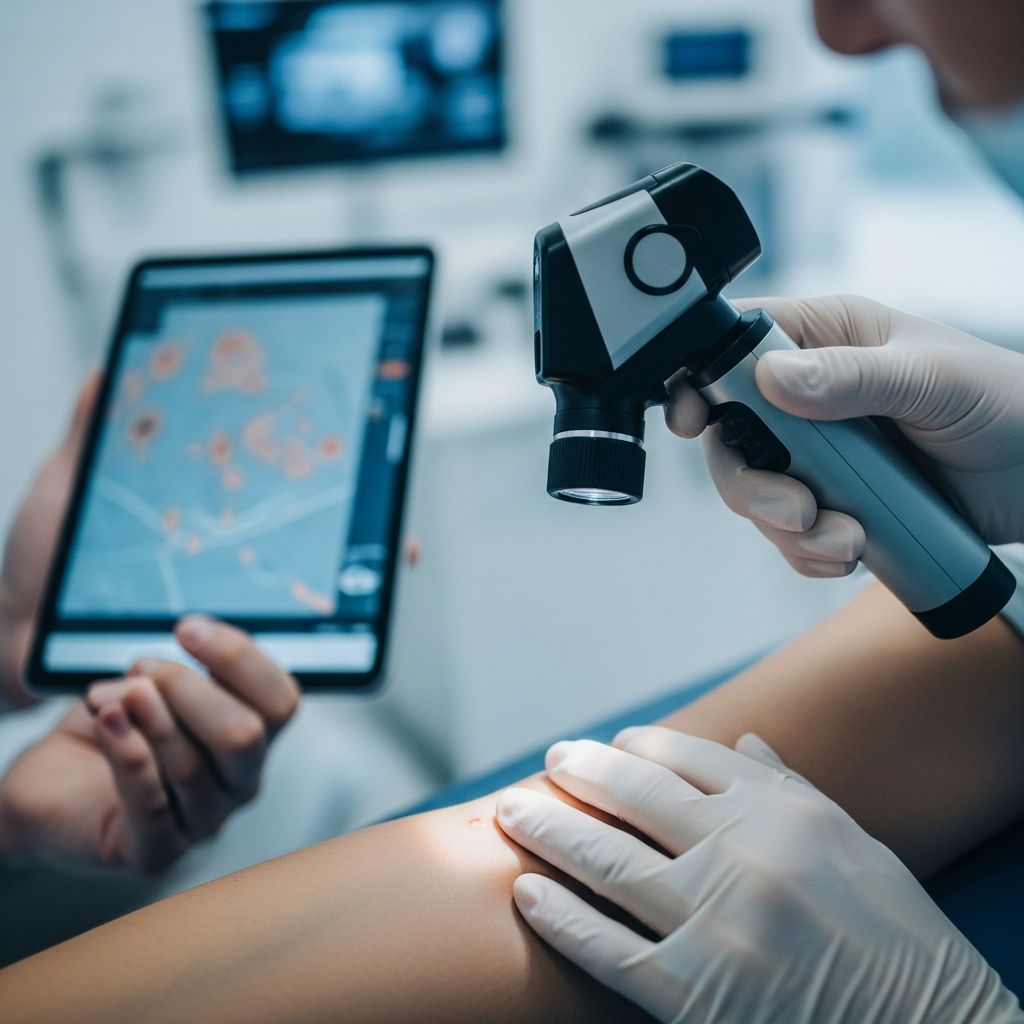
Focusing on touch, leveraging advanced technology, and maintaining open communication with healthcare providers are powerful strategies for staying ahead of skin cancer. These approaches are especially valuable for visually impaired individuals but benefit everyone seeking early detection of this prevalent disease. Skin cancer affects one in five Americans over their lifetime, making proactive screening essential.
A Tactile Approach
Detecting skin cancer without relying solely on visual inspection presents unique challenges, yet it is entirely feasible through a tactile-focused method. By emphasizing touch, incorporating supportive technologies, and fostering regular dialogue with medical professionals, individuals can effectively monitor their skin health.
“I have had visually impaired patients whose cancers were detected by feel,” explains Beth Goldstein, MD, a dermatologist in Chapel Hill, NC. “Tactile detection works for many nonmelanoma skin cancers.” This hands-on technique allows identification of abnormalities through texture, elevation, and other sensory cues that do not require sight.
Basal cell carcinoma (BCC), the most common skin cancer, often reveals itself through palpable signs. These include a sore that repeatedly bleeds, oozes, or crusts; a persistent patch of rough, itchy skin; or an unusually smooth, scar-like area that feels firm or pearly. These tactile indicators can prompt timely medical evaluation before the lesion progresses.
Squamous cell carcinoma (SCC), another frequent nonmelanoma type, presents with distinct touchable features such as raised, rough bumps; horn-like growths that protrude; or scaly, thickened patches that may feel tender or inflamed. Early recognition via touch can prevent local invasion or metastasis, which occurs in advanced cases.
Even precancerous actinic keratosis (AK) lesions, resulting from chronic sun exposure, are often felt before seen. These rough, sandpaper-like spots on sun-damaged skin signal the need for intervention to halt progression to SCC.
- BCC Tactile Signs: Bleeding/oozing sore, itchy rough patch, smooth scar-like area.
- SCC Tactile Signs: Raised bumps, horn-like growths, scaly patches.
- AK Tactile Signs: Rough, sandpaper-textured spots on sun-exposed areas.
Regular self-exams using fingertips to sweep across the skin—especially on the back, scalp, and between fingers/toes—can uncover these changes. For visually impaired individuals, enlisting trusted family members or caregivers enhances thoroughness.
The Melanoma Problem
While tactile detection excels for nonmelanoma cancers, melanoma poses greater challenges. “It can be more difficult to detect melanoma in a tactile way,” notes Dr. Goldstein. Early-stage melanomas are often flat and blend seamlessly with surrounding skin, lacking the elevation or texture changes detectable by touch.
Most melanomas are caught at a prognostically favorable stage, but flat lesions evade palpation. “Once a melanoma is elevated, that’s often a strong indicator that it is also growing deeper into the skin,” Dr. Goldstein adds. Tumor depth, measured by Breslow thickness, directly correlates with metastasis risk and mortality. Elevated melanomas signal advanced invasion, underscoring the need for earlier, non-tactile methods.
Despite these hurdles, combining touch with visual or tech-assisted checks remains crucial. The American Academy of Dermatology stresses annual professional exams alongside monthly self-checks using the ABCDE rule (Asymmetry, Border irregularity, Color variation, Diameter >6mm, Evolving).
Artificial Intelligence (AI) and Skin Cancer Detection
Related Stories



Artificial intelligence is transforming dermatology by augmenting human assessment. A 2020 study revealed that most surveyed patients appreciate AI’s benefits, including faster diagnostics and broader healthcare access. While not specifically targeting visually impaired users, these tools hold promise for inclusive skin monitoring.
“AI and other technology might be of use in this population,” Dr. Goldstein suggests. “This could evolve to be an option for visually impaired patients to monitor their skin.” Devices like DermaSensor exemplify this evolution, offering point-of-care analysis without biopsies.
DermaSensor: Breakthrough FDA-Cleared Technology
DermaSensor, cleared by the FDA in 2024, represents a pivotal advancement in noninvasive skin cancer detection. This handheld device, powered by elastic scattering spectroscopy (ESS) pioneered by Boston University professor Irving J. Bigio, uses light pulses and AI to differentiate benign from malignant lesions in seconds.
The FDA designated it a breakthrough device, prioritizing review due to its potential impact. Pivotal trials demonstrated 96% sensitivity across 224 skin cancers, effectively detecting BCC, SCC, and melanoma. It could halve missed cancers in primary care, where many lesions go unnoticed.
ESS works by directing light at tissue and analyzing backscattered spectra, revealing cellular differences between healthy and cancerous cells. Malignant tissues scatter light uniquely due to nuclear and structural changes. The AI algorithm, refined by Eladio Rodriguez-Diaz (BU PhD), processes data for a binary result: refer or no refer.
How DermaSensor Works (3-Step Process):
- Identify Lesion: Spot a suspicious mark suggestive of skin cancer.
- Scan: Place the device tip on the lesion; it captures five spectral recordings in under a minute.
- Result: AI delivers a referral decision in 30 seconds, enhancing clinician confidence.
Validated across 5,000 lesions in 15 studies, DermaSensor performs consistently on diverse skin tones. Bigio’s decades of NIH-funded research extended ESS to tumor detection, polyp differentiation, and more, culminating in this first market-ready consumer device.
| Cancer Type | DermaSensor Sensitivity | Key Benefit |
|---|---|---|
| Basal Cell Carcinoma (BCC) | 96% | Detects pearly nodules early |
| Squamous Cell Carcinoma (SCC) | 96% | Identifies scaly growths |
| Melanoma | 96% | Catches flat, invasive lesions |
Primary care providers can now triage effectively, referring high-risk cases to dermatologists while reassuring low-risk patients, reducing unnecessary biopsies.
Teamwork: The Power of Patient-Provider Communication
No detection method succeeds in isolation. Frequent, open communication between patients and providers amplifies all strategies. Patients should report new, changing, or symptomatic lesions promptly, describing tactile findings: “It feels rough and bleeds easily.”
Providers, empowered by tools like DermaSensor, can validate concerns objectively. For visually impaired patients, discussing self-exam routines and scheduling regular checks builds a safety net. Dr. Goldstein emphasizes partnering with patients: regular touch-based self-exams combined with tech and professional oversight maximize early detection.
Teamwork extends to multidisciplinary care: primary physicians, dermatologists, and oncologists collaborate for holistic management. Public health initiatives promote awareness, urging sun protection and screening.
Other Innovative Technologies
Beyond DermaSensor, tools like SkinIO app enable smartphone-based imaging reviewed by dermatologists, creating digital skin records for change tracking. FotoFinder offers total body mapping for high-risk patients, comparing images over time.
These complement tactile and AI methods, providing comprehensive screening layers.
Frequently Asked Questions (FAQs)
Q: Can skin cancer be detected by touch alone?
A: Yes, especially nonmelanoma types like BCC and SCC, which often have distinct textures like roughness or elevation. Melanoma is harder early on.
Q: How does DermaSensor detect skin cancer?
A: It uses ESS to shine light on lesions, analyzes backscattered light with AI, and provides a 30-second referral decision with 96% sensitivity.
Q: Is DermaSensor suitable for all skin tones?
A: Yes, its optical technology performs consistently across skin types.
Q: Who should use tactile detection methods?
A: Everyone, particularly visually impaired individuals, as recommended by dermatologists like Dr. Goldstein.
Q: How often should I check my skin?
A: Monthly self-exams and annual professional screenings, per AAD guidelines.
Conclusion: Empowering Early Detection
Integrating tactile examination, AI innovations like DermaSensor, and collaborative teamwork equips us to combat skin cancer effectively. Early detection saves lives—adopt these strategies today.
References
- Innocent Mole or Skin Cancer? FDA Clears Device with BU Technology — Boston University. 2024-05-15. https://www.bu.edu/articles/2024/fda-clears-device-with-bu-technology-that-makes-skin-cancer-detection-easier/
- Skin Cancer Detection Through Touch, Technology and Teamwork — Skin Cancer Foundation. 2023-08-10. https://www.skincancer.org/blog/skin-cancer-detection-through-touch-technology-and-teamwork/
- DermaSensor: Advanced Skin Cancer & Melanoma Detection — DermaSensor. 2024-01-01. https://dermasensor.com
- Breakthrough Technology for Early Melanoma Detection — Midwest Dermatology. 2024-06-20. https://midwestderm.com/breakthrough-technology-for-early-melanoma-detection-now-available-at-midwest-dermatology/
- SkinIO | Enabling Earlier Detection of Skin Cancer — SkinIO. 2024-03-12. https://www.skinio.com
Similar Articles








Read full bio of medha deb