Skin Immune System: 5 Essential Defense Mechanisms Explained
Discover how the skin's immune system safeguards against infections, cancer, toxins, and autoimmunity as the body's frontline defense.
The
skin immune system
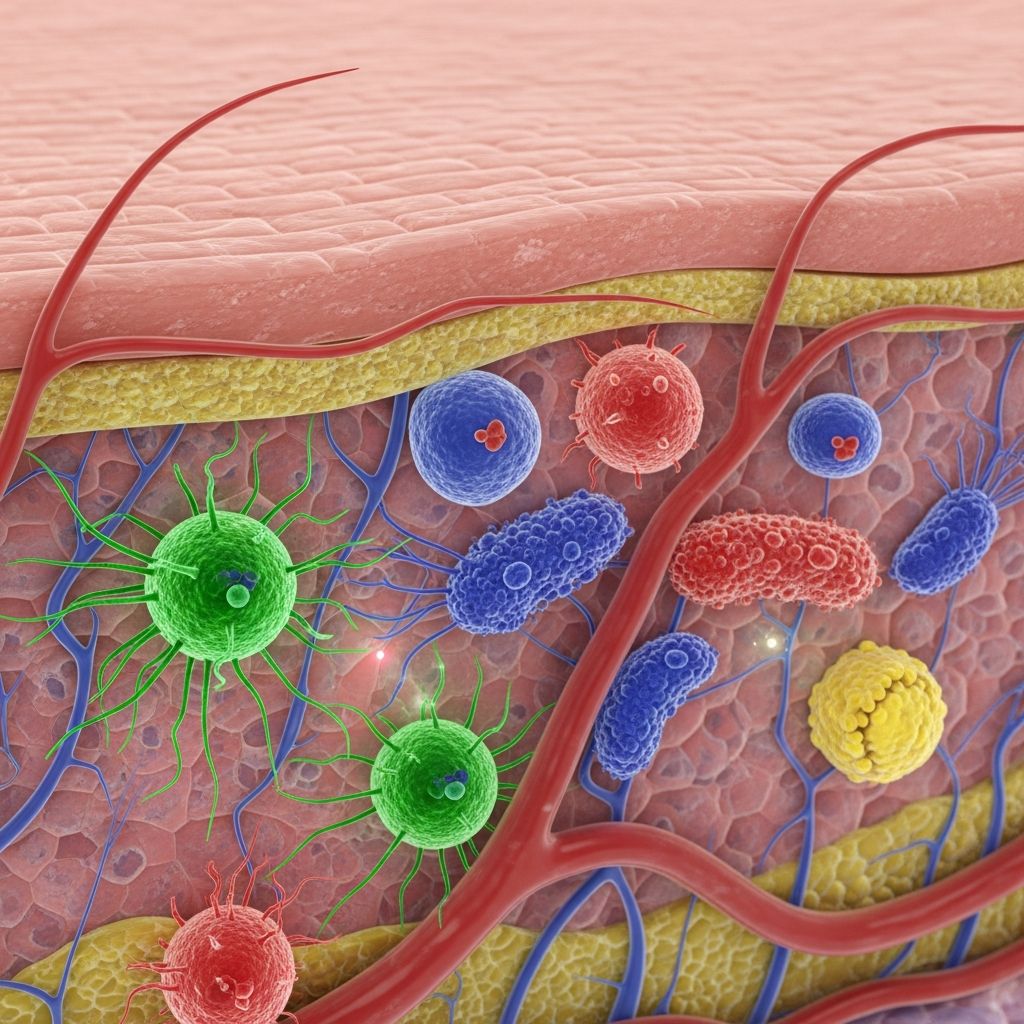
serves as the body’s primary defense, protecting against infections, cancer, toxins, and autoimmunity while acting as a physical barrier to the external environment. Known asskin-associated lymphoid tissue (SALT)
, it integrates elements of both theinnate
(nonspecific) andadaptive
(specific) immune systems, with immune cells residing in the epidermis and dermis.Introduction
The skin, the largest organ, functions beyond its physical barrier role by hosting a sophisticated immune network. This system detects and responds to threats like pathogens, ultraviolet radiation, and allergens. SALT encompasses resident immune cells, lymph nodes, and circulating cells that traffic continuously between the skin, blood, and draining lymph nodes. The skin microbiome also plays a key role in maintaining immune homeostasis by modulating responses and preventing overreactions.
Function
The skin immune system’s core functions include rapid threat detection, pathogen elimination, and immune memory formation to prevent reinfection. It balances vigorous defense against foreign invaders with tolerance to self-antigens to avoid autoimmunity. Key activities involve:
- Physical barrier via stratified keratinocytes and lipid matrix.
- Chemical defense through antimicrobial peptides (AMPs) like defensins.
- Immune surveillance by resident and recruited cells.
- Antigen presentation to activate adaptive responses.
- Regulation to control inflammation and promote healing.
This multifaceted function ensures the skin not only blocks entry but actively combats breaches.
Innate immune response
The
innate immune response
provides immediate, non-specific protection without prior exposure. It activates within minutes of threat detection via pattern recognition receptors (PRRs).Keratinocytes
**Keratinocytes**, the epidermis’s main cells, form the first innate defense line. They express
Toll-like receptors (TLRs)
, PRRs that recognize pathogen-associated molecular patterns (PAMPs) like bacterial lipopolysaccharides. Upon detection, keratinocytes release cytokines (e.g., IL-1, TNF-α), chemokines, and AMPs to initiate inflammation, recruit immune cells, and directly kill microbes. This response creates a hostile environment for invaders.Neutrophils
**Neutrophils** arrive first at infection sites via chemotaxis. They employ phagocytosis to engulf pathogens and release antimicrobial granules containing reactive oxygen species, proteases, and neutrophil extracellular traps (NETs) for extracellular killing.
Dendritic cells
Epidermal and dermal
dendritic cells (DCs)
bridge innate and adaptive immunity. In innate phases, they produce type I interferons and cytokines to limit viral spread and activate natural killer (NK) cells.Natural killer cells
**NK cells**, cytotoxic lymphocytes in the skin, target virally infected or cancerous cells without antigen priming. They release perforin and granzymes to induce apoptosis and secrete cytokines like IFN-γ to amplify responses.
Complement system
The
complement system
enhances innate immunity through over 30 proteins that activate via classical, lectin, or alternative pathways. In the skin, it opsonizes pathogens for phagocytosis, lyses microbes via membrane attack complex, and promotes chemotaxis and inflammation. Keratinocytes and immune cells produce complement components locally, amplifying responses during skin infections. Dysregulation links to conditions like psoriasis.Related Stories



Adaptive immune response
The
adaptive immune response
is antigen-specific, memory-forming, and slower (days to activate). It relies onantigen-presenting cells (APCs)
like Langerhans cells and dermal DCs.Major histocompatibility complex
**MHC molecules** display peptides on cell surfaces.
MHC class I
(on all nucleated cells) presents intracellular antigens to CD8+ T cells;MHC class II
(on APCs) presents extracellular antigens to CD4+ T cells. Skin cells upregulate MHC during inflammation for enhanced surveillance.T cells
The skin hosts resident memory T cells and recruits circulating ones. Naïve T cells mature upon APC-presented antigens:
- **CD8+ cytotoxic T cells** kill infected or malignant cells.
- **CD4+ T helper (Th) cells** subtypes include:
- **Th1**: Produce IFN-γ for antiviral/antibacterial defense.
- **Th2**: IL-4, IL-5, IL-13 for humoral immunity and allergies.
- **Th17**: IL-17, IL-22 against fungi/bacteria; implicated in psoriasis.
- **Th22**: IL-22, TNF-α for epithelial repair; psoriasis role.
- **Tregs**: Suppress responses to prevent autoimmunity.
T cell trafficking involves skin-homing receptors like CLA, ensuring targeted responses.
Key immune cells in the skin
The skin harbors diverse immune cells stratified by layer.
| Layer | Key Cells | Functions |
|---|---|---|
| Epidermis | Keratinocytes, Langerhans cells (CD1a+ DCs), T cells (mostly γδ), NK cells | Barrier, antigen capture/presentation, cytotoxicity |
| Dermis | Dermal DCs, macrophages, mast cells, T cells (αβ), B cells, neutrophils, eosinophils | Phagocytosis, degranulation, antibody production, trafficking |
**Langerhans cells**: Epidermal DCs that capture allergens, migrate to lymph nodes for T cell priming.
Macrophages
: Phagocytose debris, secrete cytokines.Mast cells
: Release histamine, heparin for immediate hypersensitivity. Theskin microbiome
influences these cells, promoting tolerance or defense.Frequently Asked Questions (FAQs)
What is the skin immune system?
The skin immune system, or SALT, protects against pathogens, cancer, and autoimmunity via innate and adaptive mechanisms.
How do keratinocytes contribute to immunity?
Keratinocytes detect pathogens via TLRs, releasing AMPs and cytokines to initiate inflammation.
What role do dendritic cells play?
Dendritic cells present antigens to T cells, bridging innate and adaptive immunity.
What is the difference between innate and adaptive immunity in skin?
Innate is rapid and nonspecific; adaptive is specific with memory.
How does the complement system work in skin?
It opsonizes, lyses pathogens, and recruits cells locally produced by skin components.
Which T cell subsets are important in skin?
Th17, Th22 for infections; Tregs for regulation; CD8+ for cytotoxicity.
This comprehensive overview highlights the skin’s dynamic immune capabilities. Disruptions lead to infections, allergies, or autoimmune diseases like psoriasis.
References
- Skin immune system — DermNet NZ. 2023-10-15. https://dermnetnz.org/topics/skin-immune-system
- The skin’s role in immunity — GSCARR, GSC Online Press. 2024-05-11. https://gsconlinepress.com/journals/gscarr/sites/default/files/GSCARR-2024-0511.pdf
- The structure of normal skin — DermNet NZ. 2023-10-15. https://dermnetnz.org/topics/the-structure-of-normal-skin
- Herpes simplex virus-mediated skin infections: cytokines and its role in immunity — Exploration of Immunology. 2023-01-01. https://www.explorationpub.com/Journals/ei/Article/1003148
- The immune system summarised — DermNet NZ. 2023-10-15. https://dermnetnz.org/topics/the-immune-system
- Autoimmune diseases in dermatology — DermNet NZ. 2023-10-15. https://dermnetnz.org/topics/autoimmune-diseases-in-dermatology
Similar Articles








Read full bio of medha deb