Fitzpatrick Skin Type: 6 Skin Types, Risks, And Care
Understanding Fitzpatrick skin phototypes: Classify your skin's UV response for better sun protection and dermatological care.
The
Fitzpatrick skin type
(or phototype) is a widely used classification system that categorizes human skin based on its response to ultraviolet (UV) radiation from sunlight. Developed in 1975 by Harvard dermatologist Thomas B. Fitzpatrick, this scale primarily assesses the skin’s tendency to burn or tan, which is largely determined by the amount and type ofmelanin
pigment present in the epidermis. Melanin acts as a natural photoprotectant, absorbing UV rays and reducing damage, making it crucial for predicting skin cancer risk, tailoring sunscreen use, and dosing phototherapy.This constitutional trait is present at birth and influenced by genetics, with lighter skin types (I-II) burning easily due to low eumelanin (dark pigment) and higher pheomelanin (red-yellow pigment), while darker types (V-VI) rarely burn thanks to abundant eumelanin. Importantly, photosensitivity from medications or conditions can mimic burning but does not alter true tanning ability. The scale remains a cornerstone in dermatology despite limitations in precision for diverse populations.
What is skin phototype?
Skin phototype refers to the skin’s inherent sensitivity to UV exposure, quantified by its melanin content and reaction patterns. Constitutional skin color—white, brown, or black—sets the baseline, modified by UV-induced tanning. Pale skin burns readily and tans minimally, requiring stringent protection, whereas darker skin resists burning but risks postinflammatory hyperpigmentation (PIH) after injury.
Originally designed for phototherapy dosing to avoid burns during psoriasis treatment, the Fitzpatrick scale estimates the
minimal erythema dose (MED)
—the UV amount causing detectable redness after 24 hours—without needing cumbersome solar simulators. Lower phototypes have lower MEDs, indicating higher burn risk; higher types tolerate more UV. Modern tools like pigment protection factor (PPF) via spectroscopy offer objective alternatives, correlating better with actual responses across tones.Fitzpatrick classification
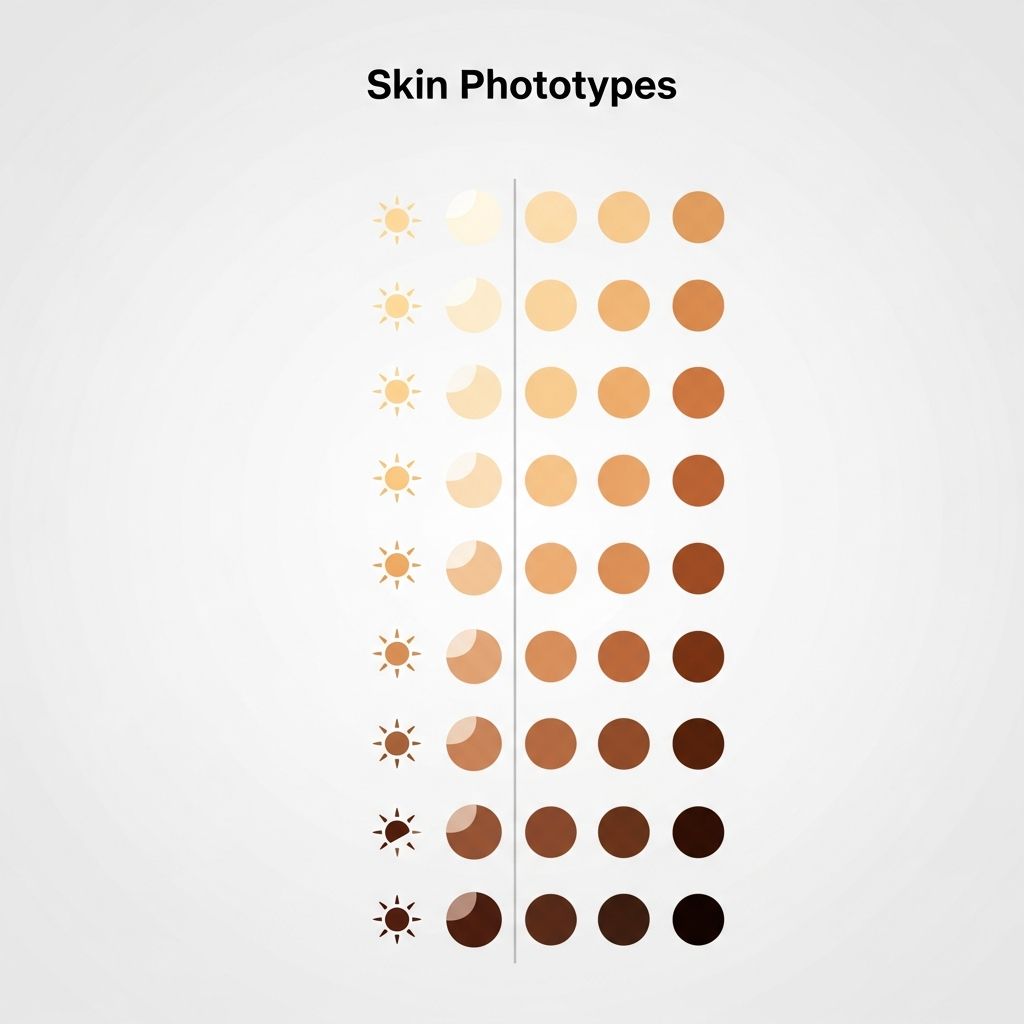
The Fitzpatrick scale divides skin into six types (I-VI), based on observed reactions to sun exposure. Types I-III were defined by burning/tanning history in lighter-skinned patients; IV-VI added later by color for darker skins. Self-assessment is common, though clinical evaluation improves accuracy.
| Fitzpatrick skin type | Skin colour | Eye colour | Hair colour | Typical features | UV response |
|---|---|---|---|---|---|
| I | Pale white | Blue/green | Blond/red | Many freckles | Always burns, does not tan |
| II | White | Blue, grey or green | Blond | Few freckles | Burns easily, tans poorly |
| III | Fair white | Hazel or light brown | Dark blond, light brown | Sensitive skin | Burns moderately, tans gradually to wheatish |
| IV | Olive, light brown | Dark brown | Dark brown, black | Minimal freckling | Burns minimally, always tans well |
| V | Brown | Dark brown or black | Black | – | Rarely burns, tans darkly easily |
| VI | Dark brown or black | Black | Black | – | Never burns, tans profusely |
This table summarizes traits: Type I (e.g., red-haired Celts) is most UV-sensitive; Type VI (e.g., darker Africans) least. Distribution varies: ~30% Northern Europeans are I-II; most Africans V-VI.
Clinical implications
Fitzpatrick types guide dermatological practice profoundly. In
photodermatology
, they predict phototherapy tolerance—Type I needs lower UVA doses for PUVA; Type V-VI higher. Forlaser treatments
(e.g., hair removal, resurfacing), darker types risk burns or PIH, favoring longer wavelengths like Nd:YAG over Alexandrite.**Skin cancer risk** inversely correlates: Types I-II face 2-4x higher melanoma rates due to poor repair of UV-induced DNA damage; Types V-VI have lower incidence but aggressive presentations.
Cosmeceuticals
like hydroquinone for hyperpigmentation work better in lighter types; darker skins need caution against hypopigmentation. Sun protection is universal but intensified for I-III: SPF 50+, UPF clothing.Related Stories



Limitations of Fitzpatrick skin phototype
Despite utility, the scale has flaws. It’s
subjective
, relying on recall prone to error—e.g., office workers overestimate tanning. Types V-VI based on color, not tested reactions, underrepresent variability in Asians/Hispanics. Doesn’t account forseasonal tanning
, age, hormones, or precise melanin (eumelanin vs. pheomelanin).In diverse populations, mismatches occur: some Type III tan like IV; PIH risk unrelated to phototype. MED studies show poor correlation with self-reports, especially darker skins. Thus, it’s a starting point, not definitive—combine with objective measures.
Alternatives to Fitzpatrick skin phototype
Modern systems address gaps:
- Pigment Protection Factor (PPF): Spectroscopy measures UV protection objectively in seconds, outperforming Fitzpatrick for erythema/pigmentation prediction across tones.
- Roberts Skin Type: Assesses phototype, hyperpigmentation, photoaging, scarring for injury response; ideal for lasers.
- Goldman Classification: Incorporates race, burning, tanning, PIH.
- Kawada (Japanese): UV sensitivity, sunburn, tanning for East Asians.
- Von Luschan Scale: 36 chromatic tiles for color matching.
- Glogau Wrinkle Scale: Photoaging in whites.
Genetic tools like MC1R testing predict red hair/freckling risks. Individual MED testing remains gold standard.
Frequently asked questions
How do I determine my Fitzpatrick skin type?
Self-assess via the table: note your color, hair/eyes, burn/tan history from ~30min unprotected summer sun. Apps/clinicians refine via questionnaire or lamp exam.
Can my skin phototype change?
No, it’s genetic/constitutional; tanning is temporary. Aging thins skin, increasing sensitivity.
Does darker skin need less sunscreen?
Yes, burns less (higher MED), but still needs SPF 30+ for cancer prevention—melanoma occurs in all types.
Why use Fitzpatrick in lasers?
Guides settings to avoid burns/PIH; darker types need adjusted fluences/wavelengths.
Is Fitzpatrick outdated?
Not fully—useful clinically despite limits; pair with PPF/MED for precision.
Related topics
- Skin cancer prevention
- Photodermatoses
- Phototherapy
- Hyperpigmentation
- Sunscreens
References
- Skin phototype (Fitzpatrick skin type) — DermNet NZ. 2023-10-15. https://dermnetnz.org/topics/skin-phototype
- Fitzpatrick Skin Types: Types, Purpose, Limitations — Healthline. 2022-08-30. https://www.healthline.com/health/beauty-skin-care/fitzpatrick-skin-types
- Fitzpatrick Scale | What is My Skin Color? — U.S. Dermatology Partners. 2024-01-12. https://www.usdermatologypartners.com/fitzpatrick-scale/
- Understanding Fitzpatrick Skin Type: A Critical Guide — Mahogany Dermatology. 2023-05-20. https://www.mahoganydermatology.com/news/understanding-fitzpatrick-skin-type-a-critical-guide-for-dermatology-nurse-practitioners
- TABLE 1, Fitzpatrick Classification of Skin Types I through VI — NCBI Bookshelf. 2023-11-05. https://www.ncbi.nlm.nih.gov/books/NBK481857/table/chapter6.t1/
- Fitzpatrick skin phototype — ARPANSA (Australian Radiation Protection and Nuclear Safety Agency). 2022-07-14. https://www.arpansa.gov.au/sites/default/files/legacy/pubs/RadiationProtection/FitzpatrickSkinType.pdf
Similar Articles








Read full bio of Sneha Tete