Skin Problems in Food Handlers and Catering
Comprehensive guide to occupational skin disorders affecting chefs, cooks, and food handlers in the catering sector.

Skin Problems in Food Handlers and the Catering Industry
The food and catering industry employs millions worldwide in settings like restaurants, hotels, resorts, and fast-food outlets. Workers in these environments face unique occupational hazards leading to skin disorders at rates twice that of other sectors. Occupational hand dermatitis alone accounts for significant ill health, with 55% of cases linked to water, soaps, and detergents, and 40% to food contact. These conditions often prolong sick leave and may force career changes.
Introduction
Food handlers, including chefs, cooks, kitchen assistants, bakers, and waitstaff, are exposed to wet work, irritants, allergens, heat, and mechanical stresses daily. The skin’s natural barrier, crucial for protection against irritants, allergens, and pathogens, is frequently compromised. This leads to a spectrum of issues from irritant contact dermatitis to severe infections and burns. Strict hygiene standards exacerbate risks, as hands must be washed frequently—often over 20 times daily—to prevent food contamination.
Statistically, restaurant workers report dermatitis twice as often as average employees. New cases of occupational hand dermatitis emerge at double the industry norm, with recovery times extended due to ongoing exposure. Apprentices and those with prior eczema, asthma, or atopy are particularly vulnerable.
Occupational Risks
Key risks stem from the industry’s demands:
- Wet work: Hands wet >2 hours/day or washed >20 times/day defines high-risk exposure, defatting skin and impairing barrier function.
- Frequent handwashing: Required for food safety but strips natural oils.
- Direct food contact: Proteins in meats, fish, fruits, vegetables act as irritants or allergens.
- Cleaning agents: Detergents, sanitizers, and disinfectants cause irritation.
- Heat and mechanical stress: Hot surfaces, cutting, repetitive motions lead to injuries.
- Glove use: Occlusive gloves trap moisture, promoting sweat and allergies.
Compromised skin heightens susceptibility to secondary issues like infections.
Causes of Skin Problems
Skin disorders in food handlers arise from four primary factors:
- Irritants (wet work, foods, cleaners).
- Allergens (nickel, fragrances, proteins).
- Infections (bacterial, fungal, viral).
- Physical trauma (cuts, burns).
Common irritants:
| Irritant | Source |
|---|---|
| Water and frequent washing | Hand hygiene protocols |
| Meats, seafood, fruits/vegetables | Food preparation |
| Soaps, detergents, sanitizers | Cleaning |
| Flours, spices (e.g., chili) | Baking, seasoning |
| Alcohol, paper towels | Beverages, drying |
Contact Dermatitis
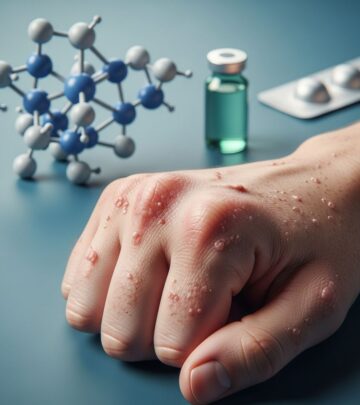
The predominant issue, contact dermatitis manifests as redness, swelling, itch, dryness, scaling, fissuring, primarily on hands, wrists, forearms, and face. It divides into:
Irritant Contact Dermatitis (ICD)
Non-immune reaction from cumulative exposure. Accounts for most cases (55% water/soap-related). Symptoms develop gradually; at-risk individuals include those with atopy.
Allergic Contact Dermatitis (ACD)
Immune-mediated, less common but severe. Nickel allergy affects ~11% of adult women, from utensils/tools. Other allergens: fragrances, preservatives (thiuram, carbamates in gloves), chromate (cements), tetrachloroisophthalonitrile (flour treatment), imazalil (fruit coating), benzisothiazolinone (paints), PTBP resin (adhesives).
ACD often follows ICD, amplifying damage. Rings trap irritants, worsening onset.
Other Dermatoses
Contact Urticaria
Rapid-onset itchy wheals from histamine release post-contact. Common triggers: proteins in fish, seafood, meats, vegetables, fruits. Affects chefs, butchers, fish workers. Diagnosed via prick testing; prognosis variable.
Infections
Dermatitis predisposes to secondary infections:
- Bacterial: Impetigo, boils, folliculitis by Staphylococcus aureus or Streptococcus pyogenes. Infected workers must take leave to prevent food contamination.
- Fungal: Chronic paronychia or interdigital erosio blastomycetica by Candida albicans, from wet occluded skin.
- Viral: Butcher’s warts (HPV-7) in meat/poultry/fish handlers.
Mechanical Injury
Cuts from knives, abrasions from graters, fissures from dry skin. Compromised skin risks infection.
Thermal Burns
Common (6% prevalence in 3 months), from hot oil, steam, ovens, scalding fluids. Affects hands, forearms, face.
Other Issues
Calluses, paronychia, heat rash, allergic urticaria to prawns/lobster.
Workplace Risk Assessment
Employers must evaluate hazards using approaches like HSE’s APC (Avoid, Protect, Check):
- Avoid: Minimize unprotected contact—use dishwashers, tongs, food processors.
- Protect: Provide non-latex gloves (nitrile/vinyl), cotton liners; food-safe emollients from dispensers (hypoallergenic, non-tainting).
- Check: Train on skin care, monitor health, encourage early reporting.
Personal Protective Equipment
Appropriate PPE is vital:
- Waterproof gloves for wet/cleaning tasks, lined to absorb sweat.
- Avoid prolonged occlusive wear.
- Remove rings; use tongs/deli papers.
Emollients restore barrier: apply frequently, especially post-shift.
Diagnosis and Treatment
Diagnosis involves history, exam, patch/prick testing. Treatment:
- Eliminate triggers: Job modification/leave.
- Topicals: Corticosteroids for inflammation; antifungals/antibacterials for infections.
- Emollients: Barrier creams pre-exposure, moisturizers after.
- Severe cases: Oral steroids, immunosuppressants; consider career change.
Prevention trumps treatment: education, hygiene balance, PPE.
Frequently Asked Questions (FAQs)
Q: What is the most common skin problem for food handlers?
A: Irritant contact dermatitis from wet work and irritants like water, soaps, and foods.
Q: How can I prevent dermatitis in the kitchen?
A: Use tongs, dishwashers, gloves, emollients; avoid rings; dry with soft towels.
Q: Are food handlers with infections allowed to work?
A: No, bacterial/fungal infections require leave until resolved to prevent contamination.
Q: What allergens should food workers watch for?
A: Nickel, glove chemicals, food proteins (fish, fruits); test via patch/prick.
Q: Can dermatitis be cured completely?
A: Early intervention yields good prognosis; chronic exposure may require job change.
References
- Skin disorders in chefs and restaurant workers — DermNet NZ. 2023. https://dermnetnz.org/topics/occupational-skin-disorders-in-chefs-and-restaurant-workers
- Skin problems in food handlers and the catering industry — DermNet NZ. 2023. https://dermnetnz.org/topics/skin-problems-in-food-handlers-and-the-catering-industry
- Skin problems in catering businesses — Health and Safety Executive (HSE). 2024-01-15. https://www.hse.gov.uk/skin/employ/highrisk/catering.htm
- Food handlers — Occupational Dermatology Research and Education Centre. 2023. https://www.occderm.asn.au/resources-about-skin-health/food-handlers/
- Occupational dermatoses in restaurant, catering and fast-food workers — PubMed (Adisesh et al.). 2009-07-28. https://pubmed.ncbi.nlm.nih.gov/19297338/
- Occupational contact urticaria caused by food — Wiley Online Library (Kawano et al.). 2016. https://onlinelibrary.wiley.com/doi/10.1111/cod.12653
Similar Articles



Read full bio of Sneha Tete