Protecting Your Vision During Solar Eclipses
Essential strategies to safeguard your eyes while observing celestial events
Solar eclipses represent one of nature’s most spectacular astronomical phenomena, drawing millions of observers worldwide. However, the intense solar radiation during these events poses a serious threat to unprotected eyes. Understanding the risks and implementing proper protective measures is essential for anyone wishing to witness this celestial marvel safely.
Understanding the Optical Threat: How the Eye Becomes Vulnerable
The human eye possesses a remarkable optical system that functions similarly to a camera or magnifying lens. The cornea and lens work together to focus incoming light onto the retina, the light-sensitive tissue lining the back of the eye. During normal circumstances, this biological optics system serves us well. However, when directed at the sun, even briefly, this same focusing mechanism concentrates the sun’s intense rays onto a tiny spot on the retina.
What makes solar eclipses particularly dangerous is a false sense of security they create. During an eclipse, the moon blocks a portion of the sun’s visible light, naturally darkening the sky. Many people mistakenly believe this reduction in brightness means the sun has become safer to observe. This misconception has led to widespread eye injuries. The sun’s ultraviolet and infrared radiation remain equally potent regardless of whether a partial eclipse is occurring, and these wavelengths are invisible to the human eye.
The Nature of Eclipse-Related Eye Injury
Direct solar observation without proper protection can cause a condition known as solar retinopathy or eclipse retinopathy. This damage occurs when intense light burns the macula, the central portion of the retina responsible for sharp, detailed vision. A retina specialist at Baylor College of Medicine notes that even brief, unprotected viewing can result in permanent vision loss that may not become immediately apparent.
The insidious nature of this injury is that initial damage may not cause immediate pain or obvious symptoms. Some individuals experience a delay between exposure and the onset of vision problems, making it difficult to connect cause and effect. The resulting vision loss can be permanent, potentially affecting central vision for the remainder of a person’s life.
Common Misconceptions About Eye Protection
Several widespread myths persist regarding eclipse viewing safety. Understanding what does not provide adequate protection is as important as knowing what does.
- Regular sunglasses: Even the darkest conventional sunglasses do not block enough light to prevent retinal damage. They may feel comfortable to wear while looking at the sun, creating a dangerous false sense of security. Regular sunglasses are designed to reduce bright visible light but do not adequately filter ultraviolet and infrared radiation.
- Smoked glass or welding glass: These materials are not reliable protectors and may not meet safety standards for solar observation.
- Cloud cover: Clouds block only a negligible portion of the sun’s harmful ultraviolet rays. Observing the eclipse on an overcast day without proper eyewear remains dangerous.
- Unfiltered optical devices: Telescopes, binoculars, cameras, and magnifiers without proper solar filters should never be used for eclipse viewing, even when wearing eclipse glasses. These devices concentrate solar rays and can damage protective filters and eye tissue.
Related Stories



The Gold Standard: ISO 12312-2 Approved Eclipse Glasses
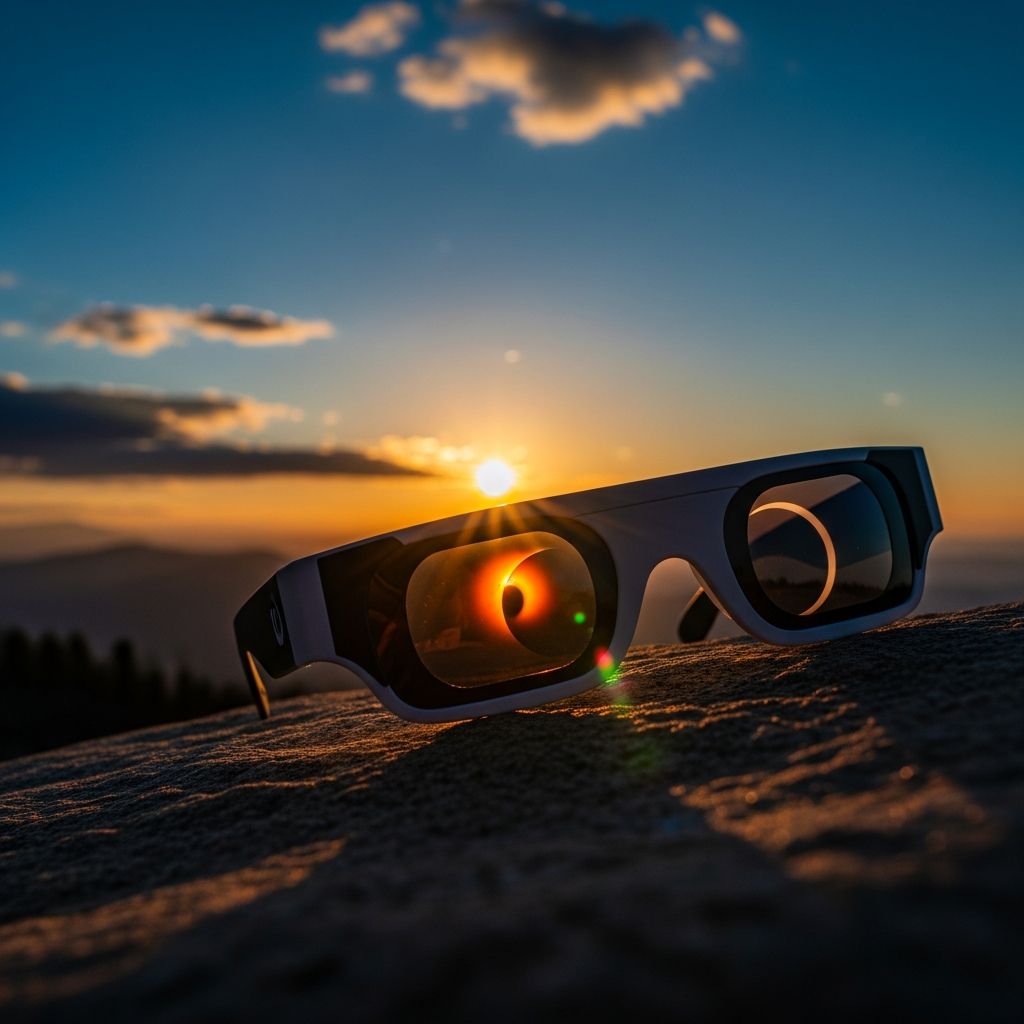
The only safe method for viewing a partially eclipsed sun involves special-purpose solar filters designed specifically for this purpose. These approved eclipse glasses or handheld solar viewers meet the international standard ISO 12312-2, which establishes rigorous safety criteria for solar filters.
Approved solar eclipse glasses are thousands of times darker than regular sunglasses and block not only intense visible light but also ultraviolet and infrared radiation that can cause eye damage. When selecting eclipse glasses, verification of the ISO 12312-2 label is critical. This designation confirms that the product has undergone testing and meets established safety requirements.
Before use, inspect eclipse glasses carefully for any damage such as tears, scratches, or punctures. Even minor damage can compromise the protective filter’s effectiveness. If any damage is visible, discard the glasses and obtain a new pair from a reliable source.
Proper Viewing Technique and Best Practices
Simply possessing approved eclipse glasses is not sufficient; users must employ correct viewing technique to maximize protection.
| Step | Instructions |
|---|---|
| 1. Preparation | Before looking at the sky, place the eclipse glasses over your eyes or position your handheld solar viewer in front of your face |
| 2. Orientation | Look downward initially, then gradually raise your gaze toward the eclipse |
| 3. Viewing Duration | Observe briefly; avoid prolonged continuous staring even with proper protection |
| 4. Removal | Before removing your eclipse glasses, turn your head away from the sun and lower your gaze |
| 5. Prescription Glasses | If you wear corrective lenses, wear eclipse glasses over them or hold your solar viewer in front of them |
The Exception: Viewing During Totality
The path of totality represents the only circumstance where eclipse glasses can be safely removed during a solar eclipse. During the brief window when the moon completely blocks the sun’s disk, the area around the eclipse becomes safe to observe without special filters.
However, this exception applies only to those situated within the narrow band of totality and only while the sun remains completely obscured by the moon. This period typically lasts three to four minutes at most. The moment any portion of the sun’s disk reappears, eclipse glasses must be immediately replaced. The transition from totality to partial eclipse occurs suddenly, and even a sliver of exposed sun can cause retinal damage.
Special Considerations for Children
Young children present unique challenges for eclipse safety. Parents and guardians must ensure that children understand the importance of keeping eclipse glasses on throughout viewing. For very young children unable to follow such instructions, alternative viewing methods such as projection techniques may be more appropriate.
If a child views the eclipse without proper protection and subsequently exhibits vision changes such as blind spots, abnormal color perception, or persistent visual discomfort, immediate evaluation by an eye care professional is necessary.
Optical Devices and Solar Filters
Many enthusiasts wish to photograph or magnify the eclipse using cameras, telescopes, or binoculars. Using these devices for eclipse observation requires specialized equipment and expertise. Standard solar filters can be attached to the front of optical devices, but only under specific conditions and preferably under guidance from experienced astronomers.
Critically, never attempt to use optical devices while wearing eclipse glasses or holding a solar viewer. The concentrated solar rays passing through the device can damage the protective filter and cause eye injury.
Recognizing Symptoms of Solar Eye Damage
Vision problems may not appear immediately after improper eclipse viewing. However, anyone experiencing the following symptoms after an eclipse should seek prompt evaluation from a retina specialist or qualified eye care professional:
- Blind spots or dark areas in central vision
- Distorted or wavy vision
- Seeing abnormal colors or color distortion
- Persistent eye discomfort or pain
- Blurred vision that does not improve
- Difficulty reading or performing detailed tasks
Frequently Asked Questions About Eclipse Eye Safety
What should I do if I accidentally looked at the eclipse without protection?
Do not panic. Brief, accidental exposure may not cause permanent damage, but monitor your vision carefully over the following days. If you develop any vision problems, contact an eye care professional immediately for evaluation.
Can I view the eclipse through a window?
No. Window glass does not provide protection against solar radiation. Eclipse observation through windows requires the same approved solar filters as outdoor viewing.
Is there a safe amount of time to look at the sun without protection?
No. There is no safe duration for unprotected solar observation. Even momentary exposure can potentially cause retinal damage.
Can clouds make it safe to view the eclipse without glasses?
Clouds filter only minimal ultraviolet radiation. Always use proper eclipse protection regardless of weather conditions.
Where can I obtain approved eclipse glasses?
Reputable sources include educational institutions, planetariums, science museums, and established optical retailers. Verify the ISO 12312-2 label before purchase.
Conclusion: Balancing Wonder With Responsibility
Solar eclipses inspire awe and curiosity about our place in the cosmos. This natural inclination to observe and understand celestial phenomena should not come at the cost of permanent vision loss. By understanding the genuine risks, obtaining approved protective equipment, and following established safety guidelines, observers can experience the eclipse safely.
The investment in proper eclipse glasses is minimal compared to the potential consequence of inadequate protection. With appropriate preparation and vigilance, eclipse viewing can remain a memorable and safe experience for individuals and families.
References
- Total solar eclipse eye safety — Baylor College of Medicine. Accessed 2026. https://www.bcm.edu/news/total-solar-eclipse-eye-safety
- Solar Eclipses and Eye Safety — American Optometric Association (AOA). Accessed 2026. https://www.aoa.org/healthy-eyes/caring-for-your-eyes/solar-eclipses
- Total solar eclipse: 5 tips to protect your eyes — UCHealth Today. Accessed 2026. https://www.uchealth.org/today/total-solar-eclipse-5-tips-to-protect-your-eyes/
- How to safely watch the solar eclipse — UChicago Medicine. 2024. https://www.uchicagomedicine.org/forefront/health-and-wellness-articles/2024/march/how-to-safely-watch-the-solar-eclipse
- Eye safety tips you need to know ahead of the solar eclipse — Glance by Eyes on Eyecare. 2024. https://glance.eyesoneyecare.com/stories/2024-03-27/eye-safety-tips-you-need-to-know-ahead-of-the-solar-eclipse/
- How to View a Solar Eclipse Safely — American Astronomical Society. Accessed 2026. https://eclipse.aas.org/eye-safety
- How to safely view a solar eclipse with kids — Children’s Hospital. Accessed 2026. https://www.childrens.com/health-wellness/how-to-safely-view-a-solar-eclipse-with-kids
Similar Articles








Read full bio of Sneha Tete