Spider Telangiectasis Images: 7 Clinical Examples
Detailed visual guide to spider telangiectasis: clinical images, causes, diagnosis, and management strategies for healthcare professionals.
Authoritative facts about spider telangiectasis (spider naevus, spider angioma, arterial spider) from DermNet New Zealand Trust. Topic: 8279 Created: Unknown Revised: Unknown Copyright: 2024. Confidential: NO
What is spider telangiectasis?
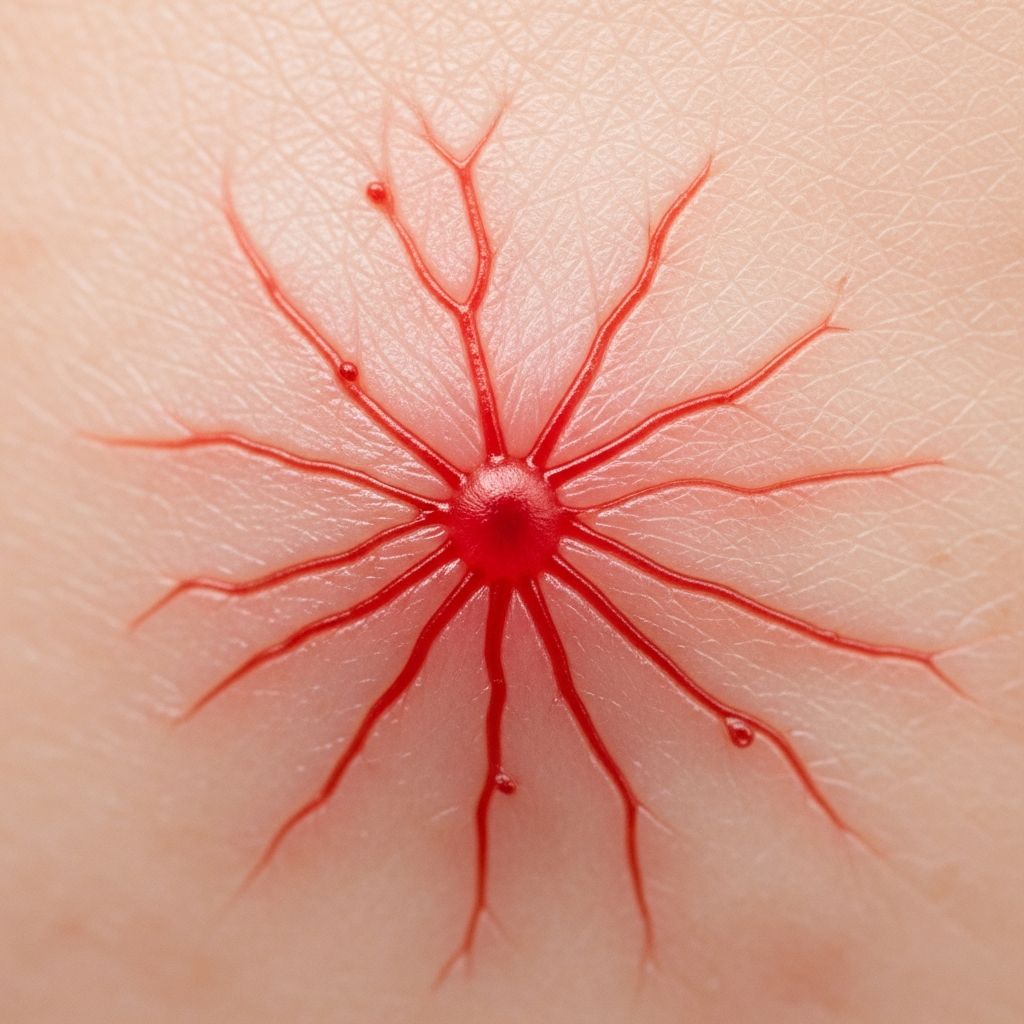
Spider telangiectasia, also known as spider angioma, spider naevus, or arterial spider, is a vascular lesion characterized by a central arteriole with radiating thin-walled capillary branches resembling a spider’s web. These lesions feature a central red punctum that blanches on pressure and quickly refills from the centre outwards. They typically measure 1 6 mm in diameter and are most common on the face, neck, upper chest, hands, and forearms, though they can appear anywhere on the body.
Spider telangiectasias are usually asymptomatic but may occasionally bleed if traumatized. While often benign, multiple lesions can signal underlying systemic conditions such as chronic liver disease (e.g., cirrhosis), pregnancy, hyperestrogenism, or thyrotoxicosis. In healthy individuals, solitary spiders occur in about 15% of young adults, typically fewer than three lesions.
Who gets spider telangiectasis?
Spider telangiectasias affect individuals across all ages but are more prevalent in certain groups:
- Children and young adults (solitary lesions, 10 615% prevalence)
- Pregnant women (due to elevated estrogen levels)
- Patients with chronic liver disease (multiple lesions, 95% specificity for cirrhosis)
- Those with rheumatoid arthritis, thyrotoxicosis, or severe malnutrition
- Females more commonly than males, linked to hormonal factors
Genetic predisposition plays a role, though exact mechanisms remain unclear. Risk increases with conditions causing hyperestrogenism or vascular endothelial growth factor (VEGF) elevation.
What causes spider telangiectasis?
The precise aetiology involves failure of the sphincteric muscle surrounding cutaneous arterioles, leading to persistent dilatation of the central arteriole and capillary branches. Key contributing factors include:
- Hyperestrogenism: Elevated estrogen levels in pregnancy, oral contraceptives, or liver cirrhosis impair hepatic metabolism of steroid hormones
- Liver dysfunction: In cirrhosis, inadequate clearance of vasodilators like substance P and increased VEGF/bFGF promotes angiogenesis
- Alcohol effects: Direct vasodilation from chronic alcohol use
- Other: Hormonal therapies, malnutrition, or idiopathic in healthy individuals
Pathophysiology centres on arteriolar dilation with freely flowing blood through radiating capillaries, distinguishing spiders from simple telangiectasias.
What does spider telangiectasis look like?
Classic appearance: A central red dot (arteriole) with 3 615 fine, reddish extensions (1 62 mm long) radiating outward like spider legs. The centre blanches under glass slide pressure (diascopy) and refills centrally. Colours range from bright red to purple; sizes vary from pinpoint to 1.5 cm. Lesions may be flat or slightly raised.
Spider telangiectasis images
This gallery showcases diverse clinical presentations:
- Classic facial spider angioma: Central red punctum with radiating legs on the cheek, blanching on pressure.
- Large spider naevus: 1 cm diameter on the neck, prominent in fair skin.
- Multiple spiders in cirrhosis: Clusters on upper trunk and arms, indicating systemic disease.
- Pregnancy-associated spiders: Small lesions on hands and forearms, resolving postpartum.
- Orbital spider telangiectasia: Near eye, risking cosmetic concern or bleeding.
- Extensive facial mats: Confluent spiders resembling rosacea telangiectasia.
- Pedal spider angioma: Rare on foot dorsum, post-trauma.
Related Stories



(Note: Images depict high-resolution dermatoscopic and clinical views, highlighting blanching refill pattern diagnostic of true spider angiomas versus linear telangiectasias.)
How is spider telangiectasis diagnosed?
Diagnosis is clinical, based on characteristic morphology and diascope test:
| Feature | Description | Differential |
|---|---|---|
| Central punctum blanching | Refills from centre | Venous lakes (peripheral refill) |
| Radiating legs | 3 615 fine branches | Campbell de Morgan spots (no legs) |
| Location | Face, upper body | Leg telangiectasia (gravity-related) |
| Multiplicity | >10 suggests systemic | Solitary = benign |
Dermatoscopy confirms arteriolar centre. Multiple lesions warrant liver function tests (ALT, AST, bilirubin), estrogen levels, or thyroid studies. Biopsy rarely needed, showing dilated arteriole with radiating capillaries.
Treatment of spider telangiectasis
Asymptomatic lesions require no treatment. Interventions target cosmetics or bleeding risk:
- Laser therapy: Pulsed dye laser (585 695 nm) or Nd:YAG (1064 nm) ablates vessels with minimal scarring; 1 63 sessions
- Electrocoagulation: Fine needle current to central arteriole; effective for small spiders
- Intense pulsed light (IPL): Broad-spectrum for facial mats
- Sclerotherapy: Rare, for larger lesions
- Observation: Pregnancy-related resolve spontaneously
Treat underlying cause (e.g., liver disease management). Recurrence possible; sun protection prevents exacerbation.
What is the outcome for spider telangiectasis?
Benign prognosis for solitary lesions; resolve without intervention in 90% of healthy cases. Multiple spiders indicate need for systemic evaluation—cirrhosis-associated lesions persist until liver function improves. Post-treatment, 80 695% clearance with lasers, low recurrence if cause addressed. Cosmetic improvement enhances quality of life, especially facial lesions.
Frequently asked questions about spider telangiectasis
Q: Are spider telangiectasias dangerous?
A: No, they are harmless but multiple lesions may signal liver disease or pregnancy. Seek medical review if numerous or symptomatic.
Q: Do spider angiomas go away on their own?
A: Solitary ones in children often involute; pregnancy spiders fade postpartum. Chronic cases persist.
Q: Can laser treatment permanently remove spider naevi?
A: High success rate (90%+ clearance), but recurrence occurs in 10 620% if underlying factors persist.
Q: How to differentiate spider telangiectasia from rosacea?
A: Spiders have central blanching punctum; rosacea shows diffuse flushing without discrete legs.
Q: Should I worry about spiders on my face?
A: Cosmetic concern primarily; rule out systemic disease if multiple. Lasers offer excellent results.
References
- What Are Telangiectasias? Causes and Treatment for Spider Veins 6 GoodRx. 2024. https://www.goodrx.com/health-topic/dermatology/telangiectasia-spider-veins-causes-treatment
- Spider Angioma – StatPearls 6 NCBI Bookshelf. 2023-08-08. https://www.ncbi.nlm.nih.gov/books/NBK507818/
- Telangiectasia: Causes, Diagnosis, Prevention & Treatment 6 Hospital for Special Surgery (HSS). 2024. https://www.hss.edu/health-library/conditions-and-treatments/telangiectasia-and-autoimmune-disease
- Spider Angioma (Spider Nevus) 6 Cleveland Clinic. 2023-11-06. https://my.clevelandclinic.org/health/diseases/23200-spider-angioma
- Telangiectasia 6 Health Encyclopedia, FloridaHealthFinder. 2024. https://quality.healthfinder.fl.gov/health-encyclopedia/HIE/1/003284
Similar Articles








Read full bio of medha deb