Spinal Cord: Structure, Function & Health
Understanding your spinal cord: anatomy, functions, and how to keep it healthy.
Understanding Your Spinal Cord: A Comprehensive Guide
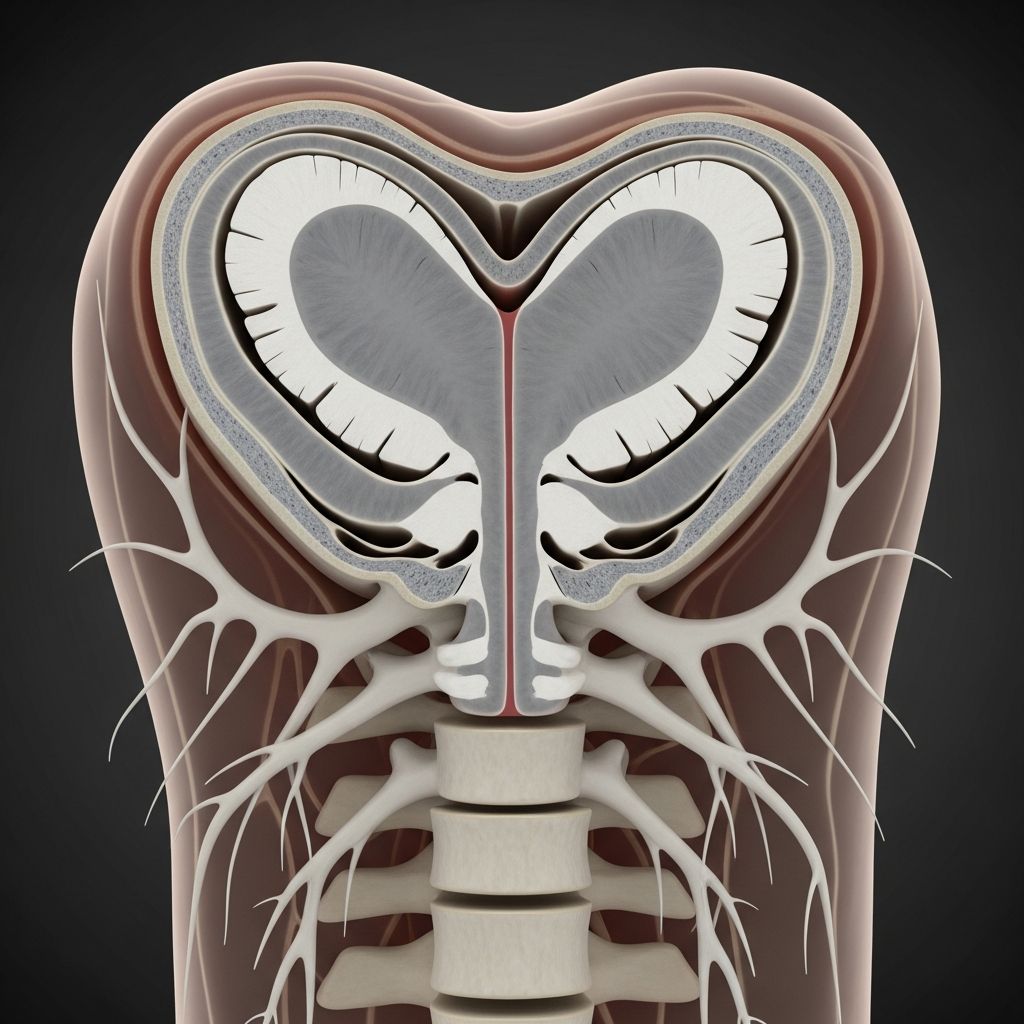
Your spinal cord is one of the most critical structures in your body, serving as the main highway for communication between your brain and the rest of your body. This remarkable bundle of nerve tissue is responsible for transmitting signals that control movement, sensation, and vital organ functions. Understanding the anatomy and function of your spinal cord can help you appreciate its importance and recognize when something might be wrong.
What Is the Spinal Cord?
The spinal cord is a column of nerve tissue that extends from the base of your brain (the medulla oblongata) down through your backbone to approximately the level of your first lumbar vertebra (L1). It is one of the two main components of your central nervous system, working alongside your brain to process information and coordinate bodily functions. Despite its relatively modest size—roughly the thickness of your index finger—the spinal cord contains millions of nerve fibers that handle an enormous volume of communication traffic every second.
Encased within the vertebral column for protection, the spinal cord runs through a specialized channel called the spinal canal. This protective housing is essential because damage to the spinal cord can result in serious consequences, including paralysis or loss of sensation. The spinal column itself consists of 33 vertebrae stacked like building blocks, separated by cushioning discs that absorb shock and allow flexibility.
The Structure of the Spinal Cord
Vertebrae and Segments
The spinal cord is organized into five distinct regions, each containing specific numbers of vertebrae:
- Cervical spine: Seven vertebrae (C1-C7) in your neck region
- Thoracic spine: Twelve vertebrae (T1-T12) in your mid-back
- Lumbar spine: Five vertebrae (L1-L5) in your lower back
- Sacrum: Five fused vertebrae forming the base of your spine
- Coccyx: Four fused vertebrae forming your tailbone
Key Anatomical Components
Several important structures work together to support and protect your spinal cord:
Intervertebral Discs: These flat, round cushioning pads sit between each vertebra and act as shock absorbers for your spine. Each disc has a tough outer layer called the annulus and a soft, gel-like center known as the nucleus pulposus. When these discs become damaged or herniated, they can put pressure on nearby nerves, causing pain and other symptoms.
Nerve Roots and Spinal Nerves: As the spinal cord travels through the spinal canal, it branches into 31 pairs of nerve roots that exit through small openings between the vertebrae called neural foramina. These nerve roots then branch further into nerves that travel throughout your body, carrying signals to and from your brain.
Protective Structures: Ligaments and muscles surround your spine, providing stability and support. Ligaments connect bone to bone, while muscles enable movement and flexibility. Together, these structures create a stable framework that protects your spinal cord while allowing for a wide range of motion.
Functions of the Spinal Cord
Related Stories



Signal Transmission and Communication
The primary function of your spinal cord is to serve as the communication highway between your brain and your body. Every conscious action you perform—from walking and typing to holding a coffee cup—requires signals traveling from your brain down the spinal cord to the appropriate muscles. Similarly, sensations like touch, temperature, and pain travel from your body back up the spinal cord to your brain for interpretation.
Regional Functions by Spinal Segment
Different regions of your spinal cord control different areas of your body:
Cervical Spine (C1-C8): The nerve roots in your cervical spine control sensation and movement in your neck, shoulders, arms, and hands. Eight pairs of spinal nerves exit this region, labeled C1 through C8. The first two vertebrae are particularly unique: the atlas (C1) holds your head upright, while the axis (C2) allows your head to rotate side to side.
Thoracic Spine (T1-T12): These nerves transmit signals between your brain and major organs, including your heart, lungs, stomach, and liver. The thoracic spine and rib cage work together to provide protection for your vital organs. This region also controls sensation and movement in your chest and abdomen.
Lumbar Spine (L1-L5): The nerves branching from your lumbar spine control movement and sensation in your legs, as well as bladder and bowel function. Below the L1 vertebra, the spinal cord ends and transitions into a bundle of nerve roots called the cauda equina, which continues to provide nerve supply to the lower body.
Movement and Motor Control
Your spinal cord enables all voluntary movements through motor signals that travel from your brain to your muscles. When you decide to move, your brain sends electrical impulses down the spinal cord to the appropriate nerve roots, which then activate the muscles needed for that movement. Your lumbar and thoracic muscles, working together with your abdominal muscles, allow you to bend, rotate, and move your trunk and lower back.
Sensation and Sensory Processing
Sensory information from your skin, joints, and internal organs travels up the spinal cord to your brain, allowing you to feel touch, temperature, pain, and proprioception (awareness of your body’s position in space). This sensory feedback is essential for coordinating movement and responding to your environment safely.
Reflex Actions
The spinal cord can also generate reflexive responses without input from your brain. When you touch something hot, for example, nerve signals in your spinal cord can trigger an immediate muscle contraction to pull your hand away before pain signals even reach your brain. This reflex protection is crucial for survival.
Spinal Cord Protection
Your spinal cord is protected by multiple layers of defense. The vertebral column itself provides the primary physical barrier, with each vertebra forming a protective ring around the delicate nerve tissue. Additionally, three membranes called meninges surround the spinal cord: the dura mater (outer layer), arachnoid mater (middle layer), and pia mater (inner layer). Cerebrospinal fluid fills the space between the meninges, providing cushioning and nutrient delivery.
The natural curves of your spine also play a protective role. A healthy spine has three natural curves that create an S-shape when viewed from the side. These curves help the spine distribute body weight evenly and absorb stress effectively, protecting the spinal cord from excessive trauma.
Common Spinal Cord Conditions
Several conditions can affect spinal cord health and function:
- Spinal Cord Injury: Traumatic injuries from accidents can damage nerve fibers, potentially resulting in partial or complete loss of function below the injury site.
- Stenosis: Narrowing of the spinal canal can compress nerve roots and the spinal cord, causing pain, numbness, or weakness.
- Herniated Discs: When the inner gel of an intervertebral disc protrudes through the outer layer, it can press on spinal nerves.
- Degenerative Disc Disease: Age-related wear and tear of the discs can lead to chronic pain and reduced flexibility.
- Arthritis: Joint inflammation in the spine can restrict movement and cause nerve compression.
Maintaining Spinal Cord Health
While you cannot directly exercise your spinal cord, you can support its health through general spine care:
- Maintain Good Posture: Proper alignment reduces unnecessary stress on your spine and spinal cord.
- Stay Active: Regular exercise strengthens the muscles that support your spine.
- Lift Properly: Use your legs, not your back, when lifting heavy objects.
- Avoid Excessive Impact: High-impact activities can traumatize the spine; balance them with lower-impact exercises.
- Maintain Healthy Weight: Extra weight places additional stress on your spine.
- Practice Ergonomics: Ensure your workspace supports good spinal alignment.
- Wear Protective Gear: Helmets and proper equipment prevent traumatic spinal injuries.
Spinal Cord Regeneration and Treatment
Unlike peripheral nerves, the spinal cord has very limited ability to regenerate after injury. However, emerging treatments show promise. Functional Electrical Stimulation (FES) is an innovative technology that uses electrical impulses to stimulate muscles, helping people with spinal cord injuries regain movement in their arms or legs, control bladder and bowel function, prevent pressure sores, and improve circulation. Ongoing research continues to explore new approaches to repair spinal cord damage and restore function following injuries.
The Connection Between Spinal Cord and Brain
Your spinal cord serves as the critical link between your brain and body. Every thought, sensation, and movement depends on the smooth functioning of this remarkable structure. The brain sends out commands through the spinal cord, and the spinal cord returns sensory information back to the brain. This constant two-way communication happens thousands of times per second, coordinating every aspect of your physical existence.
Frequently Asked Questions
Q: Where does the spinal cord begin and end?
A: The spinal cord begins at the base of your brain (the medulla oblongata) and extends down through your spinal canal, ending at approximately the level of your first lumbar vertebra (L1). Below this point, only nerve roots continue downward in a bundle called the cauda equina.
Q: How many nerve roots branch from the spinal cord?
A: Your spinal cord branches into 31 pairs of nerve roots that exit through openings between the vertebrae. These nerve roots then branch further into individual nerves that travel throughout your body.
Q: Can the spinal cord repair itself after injury?
A: The spinal cord has very limited ability to regenerate after injury, unlike peripheral nerves. However, new treatments like Functional Electrical Stimulation (FES) are helping people with spinal cord injuries recover some function.
Q: What is the difference between the spinal cord and the spine?
A: The spinal cord is the column of nerve tissue running through the center, while the spine (or vertebral column) is the bony structure made up of vertebrae that protects the spinal cord.
Q: How does the spinal cord control bodily functions?
A: The spinal cord transmits signals between your brain and body through nerve roots and spinal nerves. Motor signals travel down to control muscles, while sensory signals travel up to provide feedback about your environment and internal state.
Q: What role do intervertebral discs play in spinal cord health?
A: Intervertebral discs cushion the vertebrae and allow flexibility in your spine. When these discs are healthy, they help protect your spinal cord and maintain proper spacing between vertebrae, preventing nerve compression.
References
- Thoracic Spine: What It Is, Function & Anatomy — Cleveland Clinic. 2024. https://my.clevelandclinic.org/health/body/22460-thoracic-spine
- The Structure and Function of a Healthy Spine — Cleveland Clinic Abu Dhabi. 2024. https://www.clevelandclinicabudhabi.ae/en/health-hub/health-resource/diseases-and-conditions/the-structure-and-function-of-a-healthy-spine
- Cervical Spine (Neck): What It Is, Anatomy & Disorders — Cleveland Clinic. 2024. https://my.clevelandclinic.org/health/articles/22278-cervical-spine
- Lumbar Spine: What It Is, Anatomy & Disorders — Cleveland Clinic. 2024. https://my.clevelandclinic.org/health/articles/22396-lumbar-spine
- Spine: Anatomy, Function, Parts, Segments & Disorders — Cleveland Clinic. 2024. https://my.clevelandclinic.org/health/body/10040-spine-structure-and-function
- Spinal Cord Injury Programs — Cleveland FES Center. 2024. https://fescenter.org/research/clinical-trials/spinal-cord-injury-programs/
- Nervous System: What It Is, Parts, Function & Disorders — Cleveland Clinic. 2024. https://my.clevelandclinic.org/health/body/21202-nervous-system
Similar Articles








Read full bio of medha deb