Spinal Muscular Atrophy: Causes, Symptoms & Treatment
Understanding SMA: Genetic inheritance, progressive symptoms, and modern disease-modifying treatments available today.
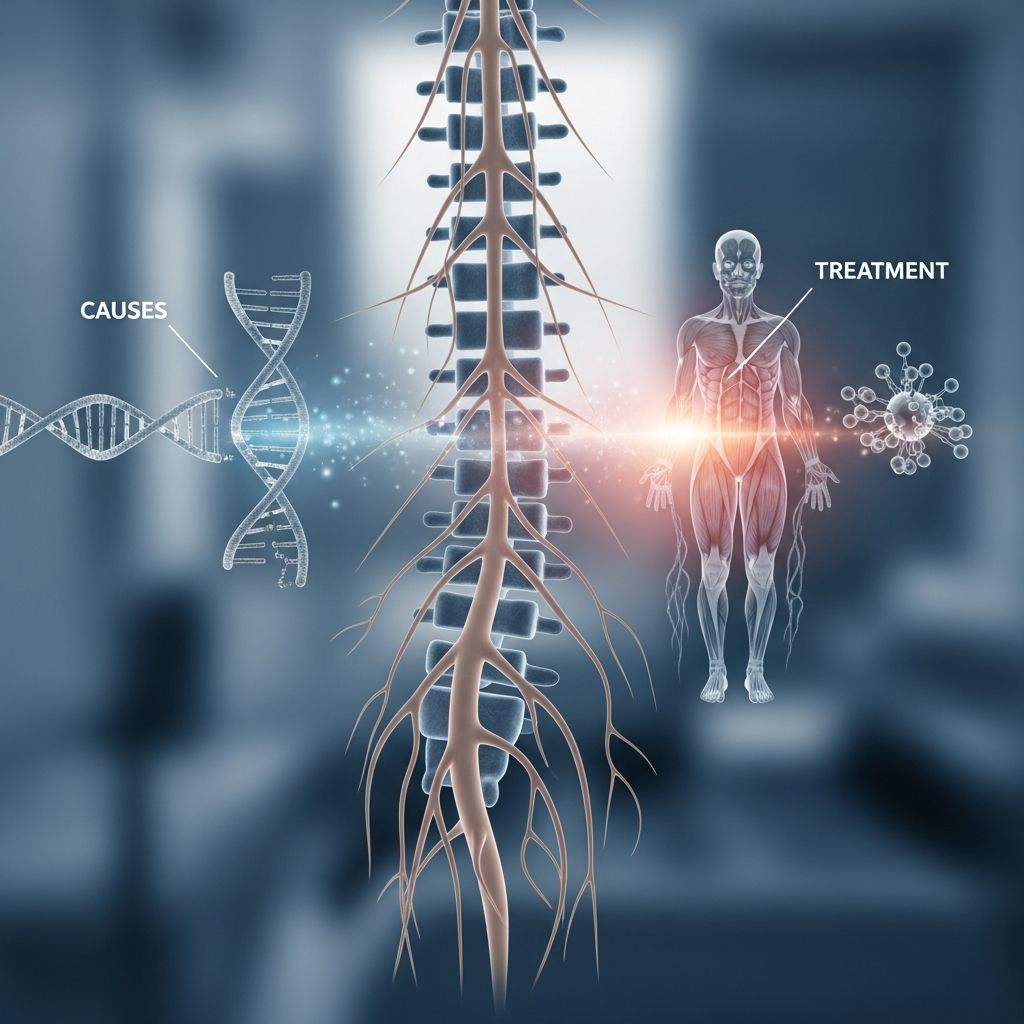
Spinal Muscular Atrophy: A Comprehensive Overview
Spinal muscular atrophy (SMA) is a rare inherited neuromuscular disorder characterized by the progressive loss of nerve cells in the spinal cord called lower motor neurons. These specialized nerve cells, also known as anterior horn cells, are responsible for transmitting electrical signals that control voluntary muscle movement. When these motor neurons degenerate or are lost, muscles become progressively weaker and begin to atrophy, or waste away. SMA represents a significant clinical challenge, affecting individuals across all age groups, from infants to adults, with varying degrees of severity.
The most common form of SMA is related to a deficiency of the SMN protein, caused by variants in the SMN1 gene located on chromosome 5, known as classic SMA or chromosome 5 SMA. However, other forms of SMA arise from variants in different genes on different chromosomes, with varying severity and muscle involvement patterns. This comprehensive guide focuses primarily on classic SMN-related SMA while acknowledging the broader spectrum of this condition.
Understanding the Genetics of Spinal Muscular Atrophy
What Causes SMA?
SMA is caused by deletion or variants in the SMN1 gene, which encodes a protein known as survival motor neuron (SMN). This protein plays a crucial role in the functioning and maintenance of motor neurons, and its deficiency directly leads to the neurological symptoms characteristic of SMA. Approximately 95-98% of affected individuals have deletions in the SMN1 gene, while 2-5% have point variants that result in decreased production of the SMN protein.
The SMN protein functions as a critical regulator of gene expression specifically in motor neurons. Without adequate levels of this protein, motor neurons cannot maintain their normal functions, leading to their progressive degeneration and the subsequent loss of muscle control and strength.
Inheritance Pattern
Most types of SMA are inherited in an autosomal recessive pattern, meaning that a child must inherit the altered SMN1 gene from both parents to develop the condition. Parents who carry the altered gene typically do not have SMA themselves, a phenomenon known as “carrying” the gene. In the majority of cases, SMA can only be passed on when both parents carry the altered gene. This inheritance pattern has important implications for genetic counseling and family planning, making it essential for affected individuals and their families to seek genetic counseling recommendations.
Recognizing Symptoms and Signs
Clinical Manifestations
The signs and symptoms of SMA are direct consequences of lower motor neuron loss and include muscle weakness, muscle atrophy (wasting), reduced muscle tone (hypotonia), decreased or absent reflexes, and involuntary muscle fiber twitching (fasciculations). While SMA presents as a disease spectrum with variable manifestations, the condition typically produces proximal muscle weakness, meaning that muscles closest to the center of the body are more severely affected than distal muscles farther from the body’s center.
Individuals with SMA commonly experience muscle weakness in the hips, legs, thighs, and upper back. Additional complications may include spinal curvature, difficulty sitting or maintaining posture, challenges with walking, and progressive loss of motor function. Muscle weakness tends to worsen over time, progressing at different rates depending on the SMA type and individual factors.
Related Stories



SMA Classification System
Although SMA is a disease spectrum, five subtypes are classified based on age of symptom onset and maximum motor function achieved. This classification system was established prior to genetic testing availability and disease-modifying treatment development:
– Type 1 (Infantile-onset): Symptoms appear before 6 months of age; most severe form- Type 2 (Intermediate): Symptom onset between 6-18 months; intermediate severity- Type 3 (Juvenile-onset): Symptom onset after 18 months; milder progression- Type 4 (Adult-onset): Symptom onset in adulthood; slowest progression- Type 0 (Prenatal-onset): Severe symptoms present before birth
Diagnosis and Screening
Newborn Screening
Newborn screening plays a vital role in facilitating early identification of infants with SMA, allowing treatment to begin before symptom onset. Infants identified through SMA newborn screening are urgently referred for confirmatory testing, discussion of available treatments, and comprehensive care planning. Early treatment prior to symptom onset provides the best clinical outcomes, making screening programs an important public health initiative.
Diagnostic Testing
Confirmation of SMA diagnosis involves genetic testing to identify mutations or deletions in the SMN1 gene. Additional genetic analysis may examine the SMN2 gene, which influences disease severity and therapeutic response. A multidisciplinary diagnostic approach may include clinical neurological examination, family history assessment, and specialized testing of motor nerve function.
Treatment Options and Management
Comprehensive Care Approach
The treatment of SMA requires a multidisciplinary team approach that includes neurologists, medical geneticists, physical therapists, speech pathologists, pulmonologists, respiratory therapists, medical social workers, nutritionists, psychologists, and specialized nurses. SMA management encompasses two main components: disease-modifying therapy that slows disease progression, and supportive therapy that manages symptoms and improves quality of life.
Disease-Modifying Therapies
Since 2016, therapies that can improve the disease course have emerged and shown promising results. The FDA has approved three SMN-enhancing treatments that target the genetic basis of SMA:
Nusinersen (Spinraza)
Approved by the FDA in 2016, nusinersen was the first disease-modifying therapy for SMA, treating both children and adults. This medication is administered via intrathecal injection directly into the fluid surrounding the spinal cord. Nusinersen acts by modifying the splicing of the SMN2 gene product (mRNA), allowing the production of more full-length, functional SMN protein. Including preparation and recovery time, therapy administration takes at least two hours, with treatments typically performed several times followed by maintenance doses every four months. Studies indicate the medication may help approximately 40% of people with SMA achieve increased strength and slow symptom progression.
Risdiplam (Evrysdi)
Risdiplam functions by preventing the SMN2 gene from being turned off, thereby raising SMN protein levels inside nerve cells. This oral medication represents a significant advancement as it can be administered outside clinical settings, offering greater convenience for patients and families.
Onasemnogene Abeparvovec (Zolgensma)
This innovative gene therapy involves replacing the problematic SMN1 gene and is used for children under 2 years of age. During treatment, medical teams place a small tube (catheter) directly into a vein in the child’s arm or hand, delivering a healthy copy of the SMN1 gene to specific spinal cord cells. Clinical studies showed this medicine may help children reach developmental milestones faster and improve their ability to control their head and sit without assistance.
Supportive Therapies
In addition to disease-modifying treatments, comprehensive symptom management remains essential for maintaining quality of life and function:
Physical and Occupational Therapy
Physical therapy, exercises, and stretches help maintain strength, prevent joint stiffness, improve posture, and slow progressive muscle weakness. Occupational therapy focuses on maintaining functional abilities and independence in daily activities. These interventions use regular daily activity and structured exercise to protect joints and preserve remaining muscle strength.
Respiratory Support
SMA, particularly types 1 and 2, can involve weak muscles that impede normal breathing patterns. Respiratory management may include breathing exercises, special masks or mouthpieces, BiPAP (bi-level positive airway pressure) devices to manage hypoventilation, and mechanical insufflation-exsufflation devices to support weak cough and facilitate airway clearance.
Mobility and Orthotic Support
Mobility equipment including walking frames, wheelchairs, leg braces, and orthotics (specialized shoe inserts) can make walking easier and improve functional independence. Additional supports for the arms or legs through splints or braces help maintain proper positioning and prevent joint contractures.
Spinal Care
When SMA begins in childhood, progressive spinal curvature can develop. Physicians may recommend wearing a back brace while the spine is still growing. Once spinal growth is complete, surgical intervention may be considered to correct significant curvature and prevent respiratory complications.
Nutritional Support
Monitoring nutritional status and providing appropriate interventions helps maintain overall health and prevent complications such as failure to thrive or inadequate growth in affected children.
Prognosis and Outcomes
Although there is currently no complete cure for SMA, the discovery of its genetic cause has led to the development of several transformative treatment options. Individuals treated with early disease-modifying therapy, particularly those identified through newborn screening before symptom onset, demonstrate improved developmental motor milestone achievement and enhanced survival rates compared to historical cohorts. The introduction of disease-modifying treatments has fundamentally changed the natural history of SMA, offering hope and improved outcomes for affected individuals and their families.
Frequently Asked Questions
Q: Is spinal muscular atrophy curable?
A: Currently, there is no complete cure for SMA. However, FDA-approved disease-modifying therapies can slow disease progression, improve motor function, and enhance survival rates when administered early, particularly in infants identified through newborn screening.
Q: Can adults with SMA receive treatment?
A: Yes, several FDA-approved treatments are available for both children and adults with SMA. Treatment options depend on age, symptom severity, and individual health factors. A multidisciplinary care team can discuss which treatments are most suitable.
Q: What is the difference between the three FDA-approved medications?
A: The three treatments work through different mechanisms: nusinersen is injected intrathecally and modifies SMN2 gene splicing; risdiplam is an oral medication that prevents SMN2 gene shutdown; and onasemnogene abeparvovec is a gene therapy that replaces the defective SMN1 gene, used primarily in children under 2 years old.
Q: How is SMA inherited, and what is the recurrence risk?
A: SMA follows an autosomal recessive inheritance pattern. If both parents carry the altered SMN1 gene, each child has a 25% chance of having SMA, a 50% chance of being a carrier, and a 25% chance of inheriting two normal genes. Genetic counseling is recommended for affected families.
Q: What role does newborn screening play in SMA management?
A: Newborn screening enables early detection of SMA before symptoms appear, allowing immediate initiation of disease-modifying therapy. Early treatment before symptom onset provides the best clinical outcomes and can significantly improve prognosis and survival rates.
References
- Spinal Muscular Atrophy – Symptoms, Causes, Treatment — National Organization for Rare Disorders (NORD). 2024. https://rarediseases.org/rare-diseases/spinal-muscular-atrophy/
- Spinal Muscular Atrophy (SMA) — National Health Service (NHS). 2024. https://www.nhs.uk/conditions/spinal-muscular-atrophy-sma/
- Spinal Muscular Atrophy: Causes, Symptoms, and Treatment — WebMD. 2024. https://www.webmd.com/brain/spinal-muscular-atrophy
- Spinal Muscular Atrophy (SMA) — Cleveland Clinic. 2024. https://my.clevelandclinic.org/health/diseases/14505-spinal-muscular-atrophy-sma
- Spinal Muscular Atrophy (SMA) – Diseases — Muscular Dystrophy Association (MDA). 2024. https://www.mda.org/disease/spinal-muscular-atrophy
- Spinal Muscular Atrophy (SMA) — Boston Children’s Hospital. 2024. https://www.childrenshospital.org/conditions/spinal-muscular-atrophy-sma
Similar Articles








Read full bio of Sneha Tete