Spirometry: Understanding Lung Function Tests for COPD
Complete guide to spirometry testing: how it diagnoses COPD and measures lung function.
What Is Spirometry?
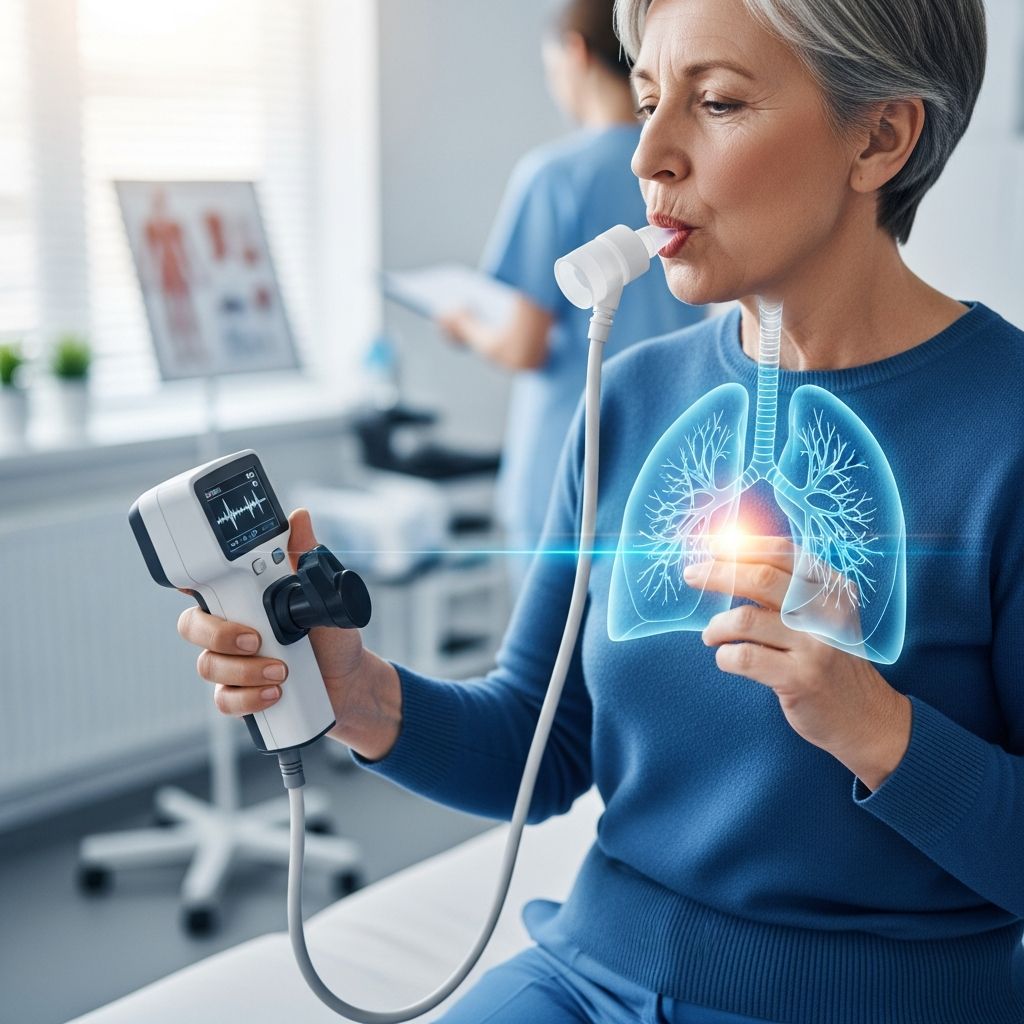
Spirometry is a breathing test that measures how well your lungs are working. The test uses a device called a spirometer, which is a diagnostic instrument that measures the amount of air you can breathe in and out and how quickly air moves through your airways. This simple, non-invasive test plays a crucial role in diagnosing chronic obstructive pulmonary disease (COPD) and monitoring disease progression.
During the test, you breathe into a tube connected to the spirometer machine after inhaling a medicine called a bronchodilator, which helps widen your airways. The machine records the volume of air and the speed at which you exhale, providing objective data about your lung function. For patients with COPD, spirometry is the gold standard test for diagnosis and assessment of disease severity.
Why Is Spirometry Important for COPD?
Assessment of airway obstruction plays a key role in the diagnosis and management of COPD. Spirometry provides objective measurements that help healthcare providers distinguish COPD from other respiratory conditions and determine the severity of airflow limitation. The test is essential for:
- Confirming a diagnosis of COPD in patients with respiratory symptoms
- Assessing the degree of airflow obstruction
- Monitoring disease progression over time
- Evaluating treatment effectiveness
- Guiding decisions about medication and lifestyle management
Without spirometry, diagnosis of COPD would rely solely on symptoms and clinical examination, which can be unreliable since symptoms vary widely between individuals.
How to Prepare for Spirometry
Proper preparation helps ensure accurate test results. Before your appointment:
- Inform your healthcare provider about your current medications, particularly bronchodilators or inhalers, as timing of medication use may affect results
- Avoid heavy meals 2–3 hours before testing, as a full stomach can restrict breathing
- Wear comfortable, loose-fitting clothing that allows full chest expansion
- Get adequate rest the night before to ensure you have energy for the test effort
- Note your last bronchodilator use, as this information is important for test interpretation
- Avoid caffeine and smoking for several hours before the test, as these can affect results
Your healthcare provider should explain the purpose of the test and describe the procedure clearly before beginning. It may help if the provider demonstrates or mimics the procedure to help you understand what is expected.
The Spirometry Procedure: Step-by-Step
Understanding what happens during spirometry can help reduce anxiety and ensure you perform the test correctly.
Preparation and Setup
The respiratory therapist or nurse will record your age, sex, height, and the time of your last bronchodilator use, as these factors influence normal lung function values. You’ll sit upright in a chair facing the spirometer machine. A clip will be placed on your nose to prevent air from escaping through your nostrils, and you’ll be given a mouthpiece to seal with your lips.
Related Stories



The Test Sequence
Spirometry involves a specific breathing sequence with four distinct parts:
- Part 1: A rapid, maximal inspiration to reach total lung capacity (TLC), filling your lungs completely
- Part 2: A very brief pause followed by a forceful “blast” to begin exhalation
- Part 3: Continued full expiration, lasting usually for at least 6 seconds and no more than 15 seconds, breathing out as hard and fast as possible
- Part 4: Rapid inspiration back to maximal lung volume (TLC)
The technician will emphasize the need to take a full breath and blow out as fast and hard as possible. You may be asked to repeat the test several times (typically 2–3 attempts) to get consistent, reliable readings. This repetition is normal and helps ensure accuracy.
Post-Bronchodilator Testing
For COPD diagnosis, spirometry is typically performed after inhalation of a bronchodilator medication, which temporarily relaxes airway muscles and widens the airways. This allows measurement of the airway’s maximum opening capacity and helps confirm that airflow obstruction is not fully reversible—a key characteristic of COPD.
Understanding Spirometry Results
The two main measurements spirometry records are FEV1 and FVC. Understanding these values is essential for interpreting your results.
Key Measurements Explained
FEV1 (Forced Expiratory Volume in 1 second) is the volume of air you can forcefully breathe out in the first second of the exhalation maneuver, starting from a maximal inspiration. This measurement directly indicates how obstructed your airways are. FEV1 is expressed both as an absolute volume (liters) and as a percentage of the predicted normal value for your age, sex, and height.
FVC (Forced Vital Capacity) is the maximum total volume of air you can exhale after maximal inspiration. This measures your lungs’ overall capacity and is also expressed as both absolute volume and percentage of predicted values.
The FEV1/FVC Ratio: The Diagnostic Criterion
The most important measurement for diagnosing COPD is the FEV1/FVC ratio. The spirometric criterion required for a diagnosis of COPD is an FEV1/FVC ratio below 0.70 (or 70%) after bronchodilator administration. This ratio indicates that the amount of air you can exhale in one second is abnormally low compared to your total exhaled volume, confirming airflow obstruction.
The readings obtained during spirometry are compared with normal predicted values for your age, sex, and height. This comparison shows whether your airways are obstructed and allows your healthcare provider to classify the severity of obstruction.
COPD Severity Classification
Once airflow obstruction is confirmed (FEV1/FVC < 70%), severity is classified based on FEV1 percentage of predicted values according to GOLD (Global Initiative for Chronic Obstructive Lung Disease) guidelines:
| COPD Stage | FEV1 % of Predicted | Classification |
|---|---|---|
| Stage I | >80% | Mild |
| Stage II | 50–79% | Moderate |
| Stage III | 30–49% | Moderately Severe |
| Stage IV | <30% | Very Severe |
Your healthcare provider uses this classification along with symptom severity and exacerbation history to guide treatment decisions.
Quality and Repeatability Standards
For spirometry results to be clinically useful, they must meet strict quality standards. The American Thoracic Society (ATS) provides grading criteria for result acceptability and repeatability:
| Grade | Number of Acceptable Measurements | Repeatability Criteria (Ages >6 years) |
|---|---|---|
| A | >3 acceptable | Results within 150 mL |
| B | 2 acceptable | Within 150 mL |
| C | >2 acceptable | Within 200 mL |
Results with grades A, B, or C are considered clinically useful. Your technician will coach you throughout the test to achieve the best possible effort and ensure valid results.
Common Challenges and Solutions
Spirometry is described as a challenging test for both the tester and the patient, with several particular activities that must be performed correctly and timely. Common problems include:
- Inadequate inspiration: Failing to take a full, maximal breath before exhalation. Solution: The technician will encourage deeper breathing and may demonstrate the maneuver.
- Premature termination of exhalation: Stopping the breath too soon before fully emptying the lungs. Solution: Continued verbal coaching to “keep blowing” and encouragement to maintain effort.
- Variable effort: Inconsistent effort across multiple attempts. Solution: Clear explanation of expectations, demonstration, and several practice runs if needed.
- Poor seal around the mouthpiece: Air leaking around the mouth. Solution: Proper positioning and positioning adjustments by the technician.
For patients who have difficulty performing the standard FVC maneuver, an alternative measurement called FEV6 (forced expiratory volume in 6 seconds) may be used. The FEV6 is more reproducible, less physically demanding, has less risk of causing syncope, and provides a more explicit “end of forced expiration.”
Safety Considerations
Spirometry is generally safe, but certain conditions contraindicate the test. Your healthcare provider will assess whether spirometry is appropriate for you. Contraindications include:
- Recent surgery (within several weeks)
- Recent myocardial infarction (within one month)
- Recent pneumothorax (collapsed lung)
- Inability to understand directions
- Inability to seal the mouthpiece properly
The technician performs spirometry safely by monitoring your condition throughout, ensuring you can sit comfortably, and watching for any signs of distress.
What Happens After the Test
After completing the spirometry test, the machine generates a report with your measurements and calculated values. Your healthcare provider will review these results along with your symptoms, physical examination findings, and medical history to make a diagnosis. If COPD is diagnosed, spirometry results help determine the stage of disease and guide treatment decisions.
Spirometry may be repeated at regular intervals (typically annually or as symptoms change) to monitor disease progression and evaluate whether current treatment is effective. For newly diagnosed COPD patients, follow-up testing helps establish a baseline for future comparisons.
Frequently Asked Questions
Q: Does spirometry hurt?
A: No, spirometry is painless. You may feel slightly uncomfortable from the nose clip or mouthpiece, and the forceful exhalation may cause mild chest discomfort, but these sensations are temporary and resolve immediately after the test.
Q: How long does a spirometry test take?
A: The actual testing usually takes 15–30 minutes, including preparation, the test itself, and post-test explanation. Plan for about 45 minutes total appointment time.
Q: Can I eat or drink before spirometry?
A: Avoid heavy meals 2–3 hours before the test, as a full stomach restricts breathing. Light meals are acceptable. Avoid caffeine, as it may affect results.
Q: What should I wear for spirometry?
A: Wear comfortable, loose-fitting clothing that doesn’t restrict chest expansion. Avoid tight belts, bras, or restrictive garments.
Q: Will my medications affect the test?
A: Yes, inform your healthcare provider about all medications you take, especially bronchodilators and inhalers. The timing of medication use may be adjusted before testing to ensure accurate results.
Q: How often do I need spirometry if I have COPD?
A: Your healthcare provider will determine the testing frequency based on disease severity and treatment changes, typically at least annually or when symptoms change significantly.
Q: Can spirometry distinguish between COPD and asthma?
A: Spirometry results showing a fixed FEV1/FVC ratio below 70% after bronchodilator are consistent with COPD. Asthma typically shows more reversible airflow obstruction. However, additional testing may be needed to differentiate between conditions definitively.
References
- Spirometry Quick Guide — Global Initiative for Chronic Obstructive Lung Disease (GOLD). Accessed January 2026. https://goldcopd.org/spirometry-quick-guide/
- Chronic Obstructive Pulmonary Disease (COPD) – Diagnosis — NHS. Updated 2024. https://www.nhs.uk/conditions/chronic-obstructive-pulmonary-disease-copd/diagnosis/
- Top 5 Spirometry Tips for COPD Diagnosis and Management — Bill Pruitt, MBA, RRT, CPFT, FAARC. Respiratory Therapy. https://respiratory-therapy.com/disorders-diseases/chronic-pulmonary-disorders/copd/top-5-spirometry-tips-copd-diagnosis/
- COPD – Diagnosis and Treatment — Mayo Clinic. Updated 2024. https://www.mayoclinic.org/diseases-conditions/copd/diagnosis-treatment/drc-20353685
- Spirometry Quick Glance Guide — American Lung Association. 2024. https://www.lung.org/getmedia/d53c0e59-f3ab-435a-bcaa-a6a195b6b565/Spirometry-quick-glance-guide.pdf
- Diagnosis and Early Detection of COPD Using Spirometry — National Center for Biotechnology Information (NIH). PubMed Central. https://pmc.ncbi.nlm.nih.gov/articles/PMC4255165/
- Chronic Obstructive Pulmonary Disease: Diagnosis and Management — American Academy of Family Physicians (AAFP). June 2023. https://www.aafp.org/pubs/afp/issues/2023/0600/chronic-obstructive-pulmonary-disease.html
Similar Articles








Read full bio of Sneha Tete