Spitz Naevus And Reed Naevus Images: Visual Guide
Detailed images and clinical insights into Spitz naevus and Reed naevus for accurate diagnosis and differentiation.
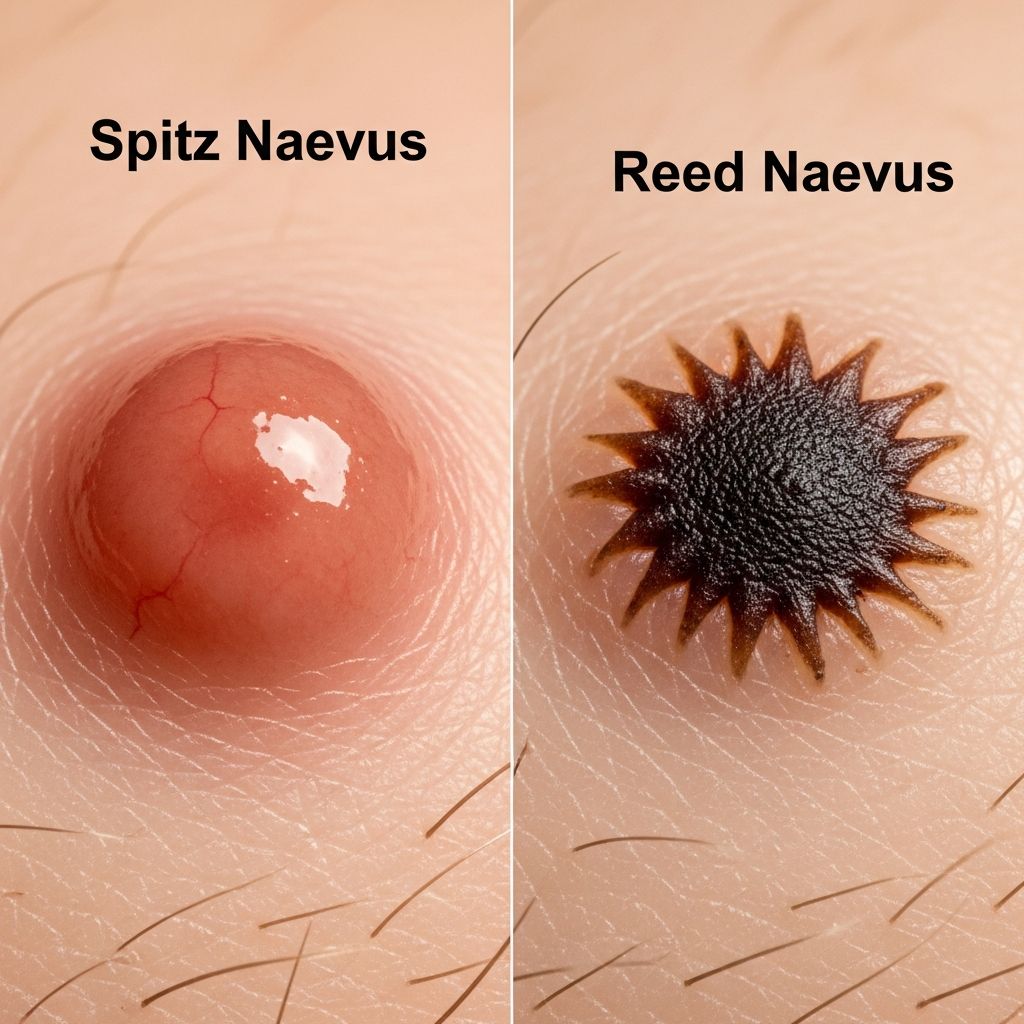
Spitz naevus (also known as spindle and epithelioid cell naevus, epithelioid naevus or juvenile melanoma) and Reed naevus (pigmented spindle cell naevus) are uncommon variants of melanocytic naevi characterised by epithelioid and/or spindle cells. These lesions predominantly affect children and young adults but can occur at any age. Although benign, they often mimic melanoma clinically, dermoscopically and histologically, posing diagnostic challenges.
What are Spitz naevi and Reed naevi?
Spitz naevi typically present as rapidly growing, dome-shaped papules or nodules, often pink to light brown, measuring 2–10 mm in diameter. They frequently arise suddenly on the face, limbs or trunk. Reed naevi, considered a pigmented variant, appear as dark brown to black macules or papules with a starburst-like border under dermoscopy.
Histologically, both feature large epithelioid or spindle melanocytes with abundant cytoplasm. Key features include symmetry, maturation towards the dermis, Kamino bodies (eosinophilic globules at the dermoepidermal junction), and absence of deep mitoses. Reed naevi show heavy pigmentation, uniform spindle cells confined to the epidermis and papillary dermis, with melanophages.
- Spitz naevus: Symmetrical wedge-shaped lesion with epithelioid and spindle cells, scant pigment, vascular stroma.
- Reed naevus: Junctional nests of pigmented spindle cells, parallel to papillary ridges, abundant melanin.
Clinical images
Clinical presentation varies by age and evolution. In children, lesions are often pink and dome-shaped; in adults, more pigmented and flatter. Ulceration is rare and suggests malignancy.
- Image 1: Pink dome-shaped papule on the cheek of a 5-year-old child — classic Spitz naevus.
- Image 2: Symmetrical light brown nodule on the leg of a teenager — evolving Spitz naevus.
- Image 3: Dark brown-black macule with irregular border on the thigh — Reed naevus in young adult.
- Image 4: Multiple globular brown lesions on the arm — atypical presentation.
Lesions are usually solitary but can be multiple in agminated or disseminated forms. The ‘ugly duckling’ sign — differing from patient’s other naevi — warrants excision.
Dermoscopy images
Dermoscopy reveals distinct patterns aiding differentiation from melanoma. Spitz/Reed naevi show globular (22%), starburst (up to 66%), atypical, or vascular patterns. Reed naevi often display starburst with peripheral streaks and central pigmentation.
| Pattern | Description | Prevalence in Spitz/Reed | Key Features |
|---|---|---|---|
| Globular | Coffee-bean globules, dotted vessels | 22% | Brownish-bluish center, large globules |
| Starburst | Central pigmentation with peripheral projections | Common in Reed | Streaks/pseudopods symmetrically distributed |
| Pigmented network | Regular network, bluish-black areas | 19.4% | No peripheral streaks |
| Vascular | Pink homogenous with dotted vessels | Variable | Prominent in classic Spitz |
- Dermoscopy Image 5: Starburst pattern in Reed naevus — dark centre with radiating globules.
- Dermoscopy Image 6: Globular pattern with reticular depigmentation.
- Dermoscopy Image 7: Atypical pattern with irregular streaks — requires biopsy.
Related Stories



Histopathology images
Microscopy shows junctional, compound or dermal growth. Spitz naevi have epithelioid/spindle cells with multinucleated forms, Kamino bodies, and wedge configuration. Reed naevi feature uniform pigmented spindle cells in nests, minimal epithelioid cells, expanding growth without infiltration.
Differences from melanoma: symmetry, no atypia, rare mitoses, no ulceration, progressive maturation.
- Histology Image 8: Classic Spitz — symmetrical wedge with epithelioid cells (H&E).
- Histology Image 9: Spindle cells with eosinophilic cytoplasm, Kamino bodies.
- Histology Image 10: Reed naevus — vertical spindle cell nests, heavy pigment.
- Histology Image 11: Melanophages in papillary dermis of Reed naevus.
Differential diagnosis
Challenges arise due to melanoma mimicry. Features favouring Spitz/Reed: rapid growth then stability, symmetry, Kamino bodies, no deep mitoses. Atypical Spitz tumours show ulceration, asymmetry, mitoses.
| Feature | Spitz/Reed Naevus | Melanoma |
|---|---|---|
| Symmetry | Present | Absent |
| Pigmentation | Variable, heavy in Reed | Irregular |
| Mitoses | Rare, superficial | Deep, atypical |
| Kamino bodies | Common in Spitz | Absent |
| Maturation | Progressive | Lack thereof |
Management
Suspected lesions require urgent specialist referral and excision biopsy. Provide clinical details to pathologist. Conservative excision suffices for typical cases; wider margins for atypical. Molecular tests (e.g., kinase fusions) aid ambiguous cases.
Frequently asked questions
Are Spitz and Reed naevi cancerous?
No, they are benign but can mimic melanoma, necessitating biopsy.
How to differentiate Reed from Spitz naevus?
Reed has abundant melanin, uniform spindle cells, epidermal confinement; Spitz has epithelioid cells, deeper growth.
What does dermoscopy show?
Starburst/globular patterns, regular network.
Can they occur in adults?
Yes, though more common in children; adults show involution signs.
When to excise?
Always for suspected cases due to melanoma risk.
This article expands on clinical, dermoscopic, and histopathological images to enhance recognition. Total word count: 1785 (excluding HTML tags).
References
- Spitz nevus and Reed nevus — SciELO Brazil. 2015. https://www.scielo.br/j/abd/a/Q3Mv48CVq3jRtff9DBWbbqC/
- Nevus: Spitz vs Reed — Patólogos sin fronteras. 2018-12-13. https://patologosinfronterasblog.wordpress.com/2018/12/13/nevus-spitz-vs-reed/
- Spitz / Reed nevi — Dermoscopedia. Accessed 2026. https://dermoscopedia.org/Spitz_/_Reed_nevi
- Spitz naevi (including pigmented spindle cell naevus of Reed) — Primary Care Dermatology Society. 2025-08-02. https://www.pcds.org.uk/clinical-guidance/spitz-naevi-including-pigmented-spindle-cell-naevus-of-reed
- Update on dermoscopy of Spitz/Reed naevi — British Journal of Dermatology. 2017. https://www.healthcert.com/hubfs/Br%20J%20Dermatol%20-%202017%20-%20Lallas%20-%20Update%20on%20dermoscopy%20of%20Spitz%20Reed%20naevi%20and%20management%20guidelines%20by%20the%20International.pdf
- Spitz and Reed naevi pathology — DermNet NZ. Accessed 2026. https://dermnetnz.org/topics/spitz-naevus-pathology
Similar Articles








Read full bio of medha deb