Squamous Cell Carcinoma Dermoscopy: Key Signs And Guide
Comprehensive guide to dermoscopic features, diagnosis, and differentiation of squamous cell carcinoma for dermatologists.
Author: Dr. Antonella Tosti, Professor of Dermatology, University of Miami
Synonyms: cutaneous SCC dermoscopy, keratinocyte cancer dermoscopy, nonmelanoma skin cancer dermoscopy
What is squamous cell carcinoma?
Cutaneous
squamous cell carcinoma (SCC)
represents the second most common form ofskin cancer
after basal cell carcinoma. It arises from malignant transformation of keratinocytes in the epidermis and can be locally invasive or metastatic. SCC typically develops onsun-exposed areas
such as the face, scalp, ears, neck, hands, and forearms. Risk factors include chronic ultraviolet (UV) exposure, fair skin types, immunosuppression, chronic wounds, and prior actinic damage. While most SCCs are curable with early excision, aggressive subtypes like poorly differentiated tumors carry higher risks of recurrence, perineural invasion, and metastasis.Clinically, SCC manifests as an enlarging, irregular nodule or plaque with a rough, hyperkeratotic surface that may ulcerate or crust. Early lesions often evolve from
actinic keratosis (AK)
orintraepidermal carcinoma (Bowen’s disease)
, highlighting the importance of dermoscopy in detecting progression. Dermoscopy enhances diagnostic accuracy by revealing subsurface structures invisible to the naked eye, aiding differentiation from benign lesions, basal cell carcinoma (BCC), melanoma, and seborrheic keratosis.Clinical features
SCC presents variably depending on differentiation grade and subtype:
- Well-differentiated SCC: Firm, hyperkeratotic papule or plaque with adherent scale; slow-growing; low metastasis risk (<2%).
- Moderately differentiated: Larger, irregular borders; may show central ulceration.
- Poorly differentiated: Flat, rapidly growing; exophytic or ulcerated; high-risk features like size >2 cm, perineural invasion.
- SCC in situ (Bowen’s disease): Scaly, erythematous plaque; glomerular vessels prominent.
- Pigmented SCC: Rare; brown-gray pigmentation obscures vessels.
High-risk sites include lips, ears, scalp, genitalia, and digits. Flat morphology correlates with poor differentiation (fourfold risk).
Dermoscopic features
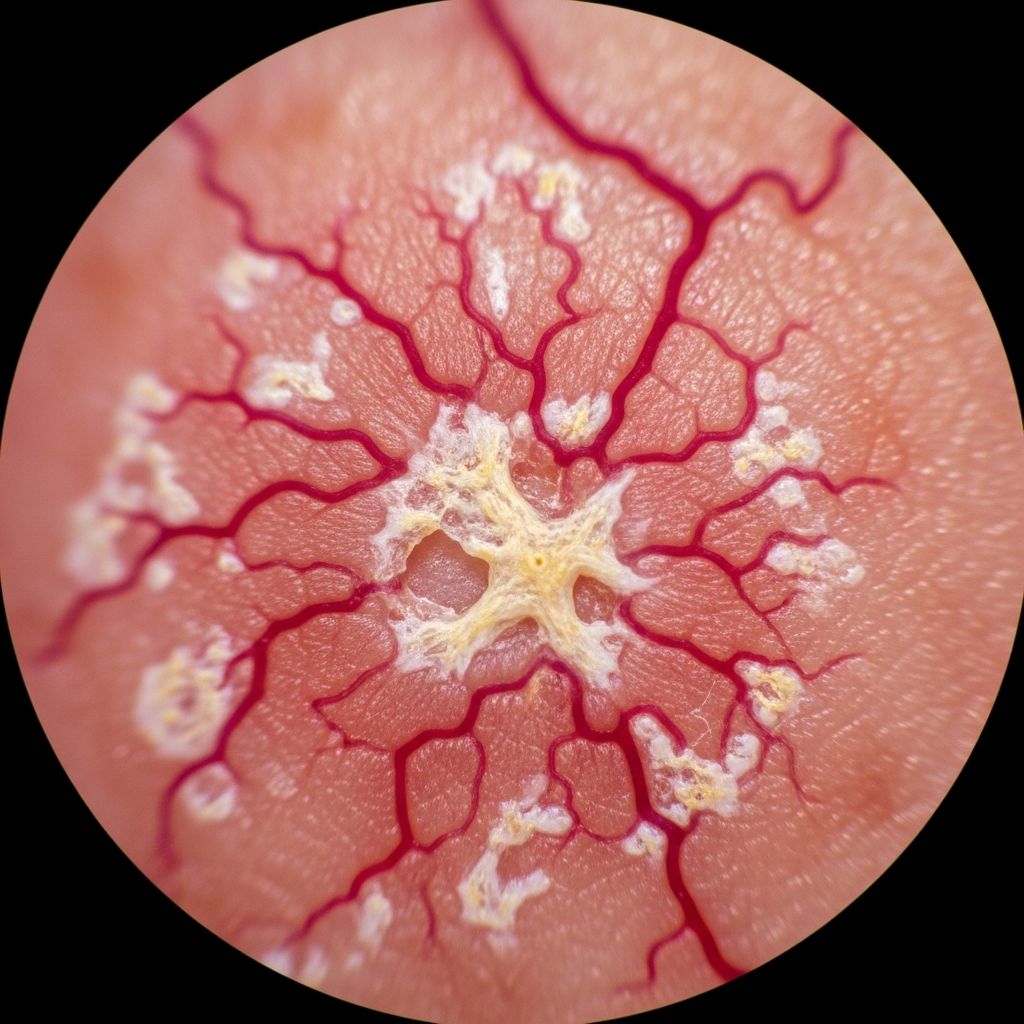
Dermoscopy of SCC reveals a spectrum of keratin, vascular, and pigmentary structures. Features vary by invasion depth, differentiation, and pigmentation.
Main dermoscopic criteria
- White circles: Highly specific; represent keratotic plugs in follicular openings or infundibula. Prevalent in keratoacanthoma-like SCC and well-differentiated tumors.
- White structureless areas: Homogeneous white zones from dense keratin or fibrosis; predict well/moderately differentiated SCC (97% odds reduction for poor differentiation).
- **Keratin masses/clods:** Central amorphous yellow-white to orange-brown accumulation; hallmark of invasive SCC.
- Ulceration/crusts: Red-brown spots or spontaneous bleeding; associated with poor differentiation.
- Polymorphous vessels: Combination of dotted, glomerular (coiled), hairpin, linear-irregular (serpentine), or looped vessels. Diffuse vascularity (>50% surface) indicates poor differentiation.
- Scale/keratin: Thick, yellow-white; potent predictor of lower-grade tumors.
- Red/pink background: Predominant red hue signals poor differentiation (13-fold risk); contrasts with white-yellow in well-differentiated.
SCC in situ (Bowen’s disease)
Non-pigmented: Irregular glomerular/globular vessels on scaly background; orange-pink hue vs. blue in BCC. Polarized dermoscopy shows rare crystalline rosettes on face. Pigmented: Brown globules, linear gray dots, homogeneous pigment; white circles in clusters.
Invasive SCC
Progresses from AK’s strawberry pattern (red pseudonetwork, white circles/rosettes) to neovascularization: clustered dotted/glomerular → hairpin/linear-irregular vessels, keratin mass, ulceration. Poorly differentiated: Red-dominant, bleeding, dense vessels.
Pigmented SCC
Rare; diffuse blue-gray homogeneous pigmentation with granular blue-gray structures; dark crusts if ulcerated. Vessels obscured. Peripheral linear brown dots noted.
| Feature | Well/Moderately Differentiated | Poorly Differentiated |
|---|---|---|
| Color | White/yellow-white | Predominantly red |
| Vessels | Focal | Diffuse (>50%), polymorphous |
| Keratin/scale | Prominent | Reduced |
| Bleeding | Rare | Frequent |
Related Stories



Differential diagnoses
SCC mimics include:
- Actinic keratosis: Strawberry pattern, thin scale, white rosettes/circles, dotted vessels; symmetric.
- Seborrheic keratosis: Comedo-like openings, milia-like cysts; stuck-on appearance.
- Keratoacanthoma: Symmetric white circles, central keratin crater.
- Basal cell carcinoma: Arborizing vessels, blue-gray ovoid nests; less scale.
- Amelanotic melanoma: Atypical polymorphous vessels without keratin.
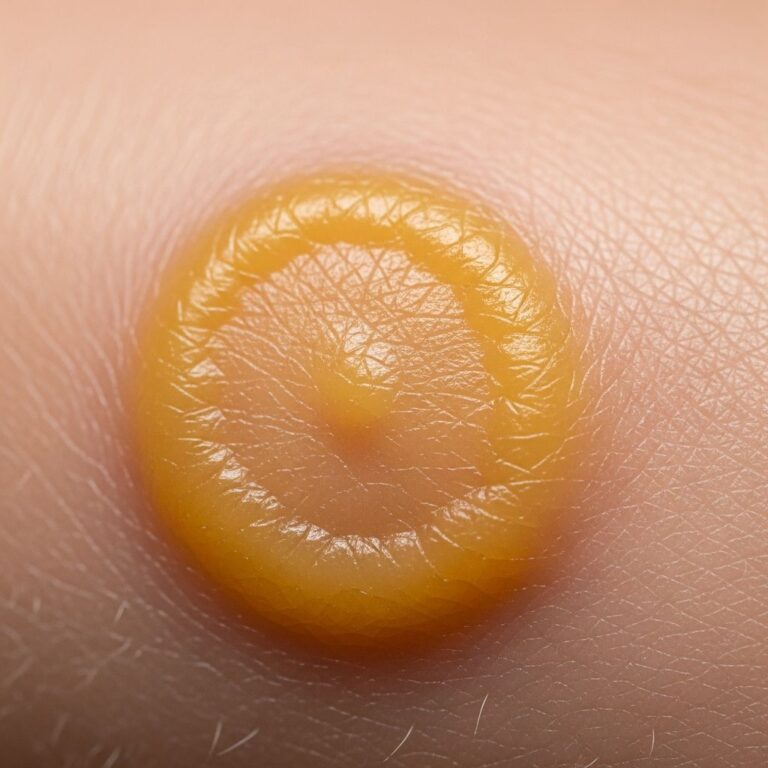
- Pyoderma/impetigo: Diffuse dotted vessels, golden crusts.
Histological explanation
SCC histology shows atypical keratinocytes invading dermis with varying differentiation. Well-differentiated: keratin pearls, intercellular bridges. Poorly: pleomorphic cells, high mitoses, necrosis. Dermoscopic correlates include keratin masses (hyperkeratosis/parakeratosis), white circles (follicular hyperkeratosis), vessels (neovascularization in stroma), ulceration (tumor erosion). Glomerular vessels reflect looped papillary dermal capillaries.
Frequently asked questions
What are the most specific dermoscopic signs of SCC?
White circles, central keratin masses, and polymorphous vessels surrounded by white halos.
How does dermoscopy distinguish poorly differentiated SCC?
Predominant red color, diffuse vessels >50% surface, bleeding; lacks white structureless areas.
Can dermoscopy diagnose SCC in situ?
Yes; glomerular vessels + scale differentiate from psoriasis (symmetric) and AK (strawberry).
Is pigmented SCC dermoscopically unique?
Diffuse blue-gray pigmentation with granular structures; vessels hidden.
What is the progression from AK to invasive SCC dermoscopically?
Red pseudonetwork → dotted/glomerular vessels → hairpin/linear vessels + keratin/ulceration.
References
- The clinical and dermoscopic features of invasive squamous cell carcinoma as predictors of tumour differentiation — Zalaudek I et al. British Journal of Dermatology. 2014-11-01. https://pubmed.ncbi.nlm.nih.gov/25363081/
- Dermoscopy of squamous cell carcinoma — DermNet NZ. Accessed 2026. https://dermnetnz.org/cme/dermoscopy-course/dermoscopy-of-squamous-cell-carcinoma
- Squamous cell carcinoma — Dermoscopedia. Accessed 2026. https://dermoscopedia.org/Squamous_cell_carcinoma
- Dermoscopy of squamous cell carcinoma | Prof Giuseppe Argenziano — YouTube (G. Argenziano). 2026. https://www.youtube.com/watch?v=tWTNXxU5BcQ
- Dermoscopic Features of Squamous Cell Carcinoma — YouTube (K. Buchanan). 2026. https://www.youtube.com/watch?v=PcLRe7f7QKw
- Squamous cell carcinoma dermoscopy — DermNet NZ. Accessed 2026. https://dermnetnz.org/topics/squamous-cell-carcinoma-dermoscopy
- Dermoscopy of Squamous Cell Carcinoma and Keratoacanthoma — JAMA Dermatology. 2011. https://jamanetwork.com/journals/jamadermatology/fullarticle/1358588
Similar Articles








Read full bio of Sneha Tete