Squamous Cell Carcinoma In Situ Pathology
Detailed pathology of squamous cell carcinoma in situ, including clinical features, histopathology, and management strategies for dermatologists.
Squamous cell carcinoma in situ (SCC in situ) is a form of skin cancer confined to the epidermis, also known as Bowen’s disease. This non-invasive malignancy arises from squamous cells and carries a risk of progression to invasive squamous cell carcinoma if untreated. Understanding its pathology is crucial for accurate diagnosis and management.
Definition
Squamous cell carcinoma in situ represents the earliest stage of squamous cell carcinoma, where atypical squamous cells are limited to the epidermis without dermal invasion. Clinically termed Bowen’s disease, it manifests as a persistent, scaly erythematous plaque primarily on sun-exposed areas. While not immediately life-threatening, approximately 3-5% of untreated cases may evolve into invasive carcinoma over time.
Clinical features
SCC in situ typically presents as a slowly enlarging, well-demarcated erythematous patch or plaque with variable scaling, crusting, or erosion. Lesions measure 1-3 cm in diameter but can grow larger over years. Common sites include the lower legs (especially in women), dorsal hands, and head/neck in men due to cumulative UV exposure. The skin surface may appear shiny or velvety, mimicking eczema, psoriasis, or actinic keratosis.
- Morphology: Solitary or multiple plaques; sharp borders; adherent scale
- Sites: Lower legs (60%), hands, trunk, anogenital region
- Duration: Months to years before diagnosis
- Progression signs: Ulceration, induration, or nodule formation indicates invasion
In the anogenital area, lesions may appear moist and verrucous, associated with HPV in some cases. Pigmented variants occur in darker skin types.
Histopathology
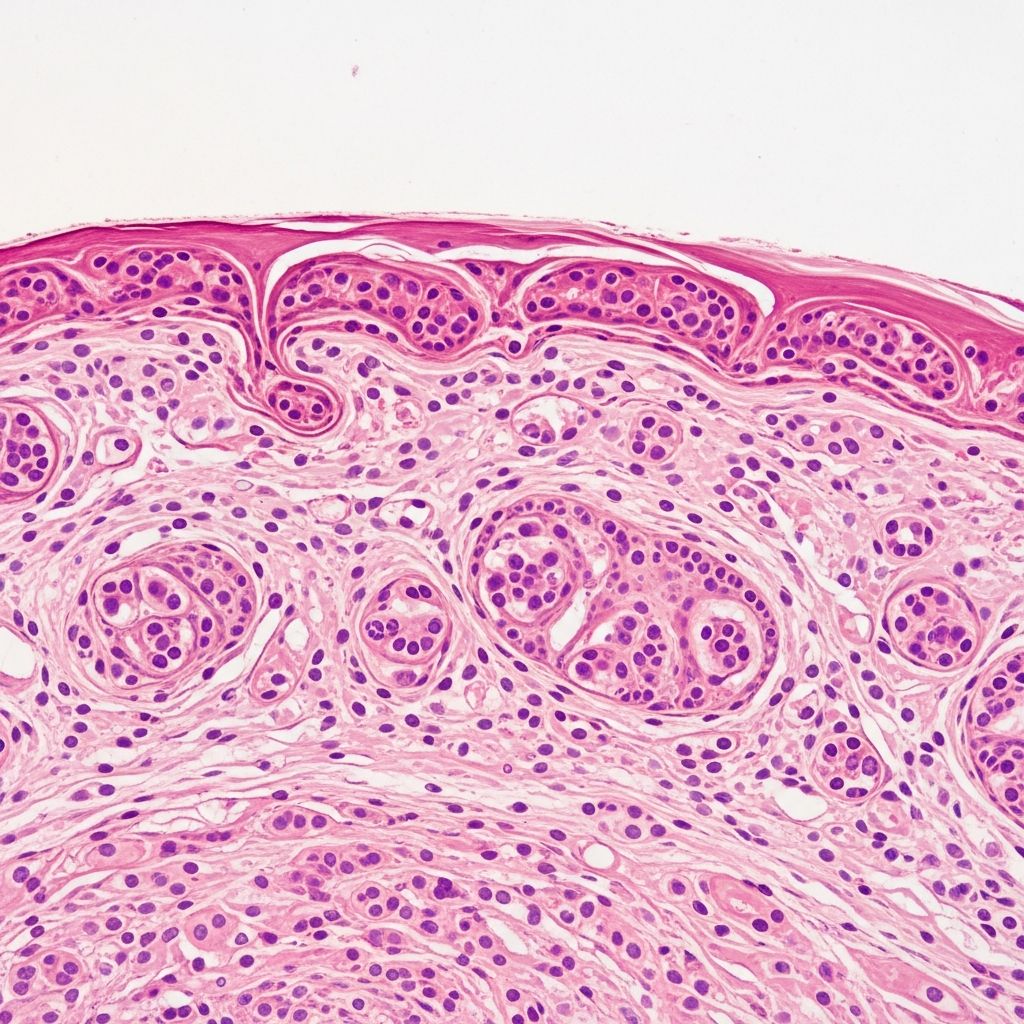
Microscopic examination reveals full-thickness epidermal atypia with disordered maturation, nuclear hyperchromasia, pleomorphism, and numerous mitoses. Characteristic features include:
- Budding of nuclei into paranuclear cytoplasm (Clouston’s phenomenon)
- Multiple dyskeratotic (apoptotic) keratinocytes
- Loss of polarity and crowding of basal keratinocytes
- Hypergranulosis or parakeratosis
- Absent dermal invasion
The epidermis shows acanthosis, spongiosis, and elongated rete ridges. Inflammatory infiltrate in the dermis is mild and lymphocytic. In sun-exposed sites, solar elastosis is prominent.
Cytological features
- Large, hyperchromatic nuclei with prominent nucleoli
- Increased nuclear:cytoplasmic ratio
- Abundant eosinophilic cytoplasm
- Frequent mitoses, including atypical forms
Architectural patterns
Several histological variants exist:
| Variant | Key Features |
|---|---|
| Classic Bowenoid | Full-thickness atypia, dyskeratosis, mitotic figures |
| Hypertrophic | Marked acanthosis, hyperkeratosis |
| Atrophic | Thin epidermis, subtle atypia |
| Pigmented | Dendritic melanocytes, melanin incontinence |
| Clear cell | Glycogen-rich clear cytoplasm |
| Signet-ring | Mucin vacuoles displacing nucleus |
These patterns do not affect prognosis but influence clinical appearance.
Diagnosis
Definitive diagnosis requires skin biopsy with histopathological confirmation. Punch or shave biopsy samples the full lesion thickness. Dermoscopy may show glomerular vessels, surface scale, and white structureless areas, aiding in vivo differentiation from mimics. Immunohistochemistry is rarely needed but can employ p53, Ki-67 (proliferation), or cytokeratins to highlight atypia.
Related Stories



Differential diagnosis
SCC in situ overlaps histologically with several entities:
- Actinic keratosis: Partial atypia confined to lower epidermis
- Intraepidermal carcinoma: Synonymous term
- Paget’s disease: Larger cells, ductal differentiation, mucin
- Melanoacanthoma: Prominent dendritic melanocytes
- Lichen simplex chronicus: Hypergranulosis, no atypia
- Psoriasiform eczema: Spongiosis predominant
Key discriminators include extent of atypia and cytological severity.
Management
Treatment aims to eradicate abnormal clones and prevent invasion. Options vary by lesion size, site, patient factors, and recurrence risk. Surgical excision offers lowest recurrence (0.8%) but is invasive.
| Treatment | Recurrence Rate | Advantages | Disadvantages |
|---|---|---|---|
| Excision | 0.8% | Histological margin control | Scar, not for large areas |
| Mohs surgery | <1% | Tissue-sparing | Specialized centers |
| Cryotherapy | 4.7% | Simple, office-based | Pigmentation changes |
| Photodynamic therapy | 18% | Cosmetic, field treatment | Painful, multiple sessions |
| 5-FU cream | 10-20% | Non-invasive | Irritation, compliance |
| Imiquimod | 10-15% | Immune modulation | Local reactions |
Lower leg lesions pose healing challenges due to poor vascularity. Monitoring is viable for small, low-risk lesions.
Prognosis
Excellent with treatment; cure rates exceed 95%. Recurrence relates to margins and immunosuppression. Progression to invasion is rare (3-5%) but mandates surveillance.
Images
Description of typical histopathology images: Low-power view shows full-thickness epidermal replacement by atypical keratinocytes with dermal sparing. High-power reveals nuclear atypia, mitoses, and dyskeratotic cells.
Frequently asked questions
What is squamous cell carcinoma in situ?
A non-invasive skin cancer limited to the epidermis, known as Bowen’s disease.
Does it spread?
No, by definition it does not invade dermis or metastasize.
How is it treated?
Excision is gold standard; alternatives include cryotherapy, PDT, topicals.
What is the recurrence risk?
Lowest with surgery (0.8%); higher with non-surgical (up to 18%).
Can it become invasive?
Yes, 3-5% risk if untreated; monitor for changes.
This comprehensive pathology review equips clinicians to recognize, diagnose, and manage SCC in situ effectively, preventing progression to invasive disease.
References
- Squamous Cell Carcinoma in Situ | Clinical Keywords — Yale Medicine. 2023. https://www.yalemedicine.org/clinical-keywords/squamous-cell-carcinoma-in-situ
- Squamous cell carcinoma in situ (Bowen disease) — BAD Patient Hub. 2024. https://www.skinhealthinfo.org.uk/condition/bowens-disease-squamous-cell-carcinoma-in-situ/
- Squamous Cell Carcinoma In Situ (SCCIS) — Florida Dermatology. 2023. https://www.flderms.com/path-results/squamous-cell-carcinoma-situ
- A Retrospective Study of Treatment of Squamous Cell Carcinoma In Situ — PubMed. 2015-06-01. https://pubmed.ncbi.nlm.nih.gov/26073523/
- What Are Basal and Squamous Cell Skin Cancers? — American Cancer Society. 2024. https://www.cancer.org/cancer/types/basal-and-squamous-cell-skin-cancer/about/what-is-basal-and-squamous-cell.html
- Squamous Cell Carcinoma: What it is, Causes & Treatment — Cleveland Clinic. 2024. https://my.clevelandclinic.org/health/diseases/17480-squamous-cell-carcinoma
Similar Articles








Read full bio of medha deb