Squamous Cell Carcinoma Of The Lip: What You Need To Know
Understanding lip cancer: Clinical presentation, risk factors, and treatment options.
Squamous Cell Carcinoma of the Lip: A Comprehensive Overview
Squamous cell carcinoma (SCC) of the lip is a significant form of cutaneous malignancy that presents particular clinical challenges due to the unique anatomical location and functional importance of the lips. As the second most common type of skin cancer, SCC represents a substantial public health concern, particularly among individuals with chronic sun exposure. Lip lesions warrant special attention because they carry a higher risk of recurrence and metastasis compared to SCC occurring on other body sites. Understanding the clinical presentation, pathogenesis, and management strategies for lip SCC is essential for dermatologists and primary care physicians responsible for early detection and treatment.
Epidemiology and Risk Factors
Squamous cell carcinoma of the lip predominantly affects the lower lip and occurs with particular frequency in males with chronic sun exposure. The condition is notably more prevalent in smokers, indicating that tobacco use represents an additional risk factor beyond ultraviolet radiation exposure. The vermilion border of the lip, which is consistently exposed to solar radiation, represents a high-risk anatomical location classified as such due to increased recurrence potential.
The development of SCC involves a complex interaction of genetic and environmental factors, primarily UV-induced DNA damage. Multiple genetic mutations have been identified in the pathogenesis of SCC, with the most frequently implicated genes including p53 (present in 66% of cases), NOTCH1/2 (40%), FAT1 (30%), and CDKN2A (35%). P53 mutations alone are involved in approximately 50% of all cancers, making this tumor suppressor gene central to SCC development.
Precursor Lesions
The solar or actinic keratosis represents the most common precursor lesion for squamous cell carcinoma, including lip SCC. On the lips, actinic keratoses are often referred to as actinic cheilitis. These lesions present as scaly, erythematous patches found on sun-exposed sites, predominantly affecting the face, ears, and hands. Histologically, actinic keratoses are characterized by atypical keratinocytes located in the basal layer of the epidermis, without dermal invasion.
Although actinic keratoses frequently remit spontaneously, they possess malignant potential and should be monitored or treated appropriately. The hard scaly surface typical of actinic keratosis may progress to true squamous cell carcinoma when induration develops, indicating dermal infiltration.
Clinical Presentation and Appearance
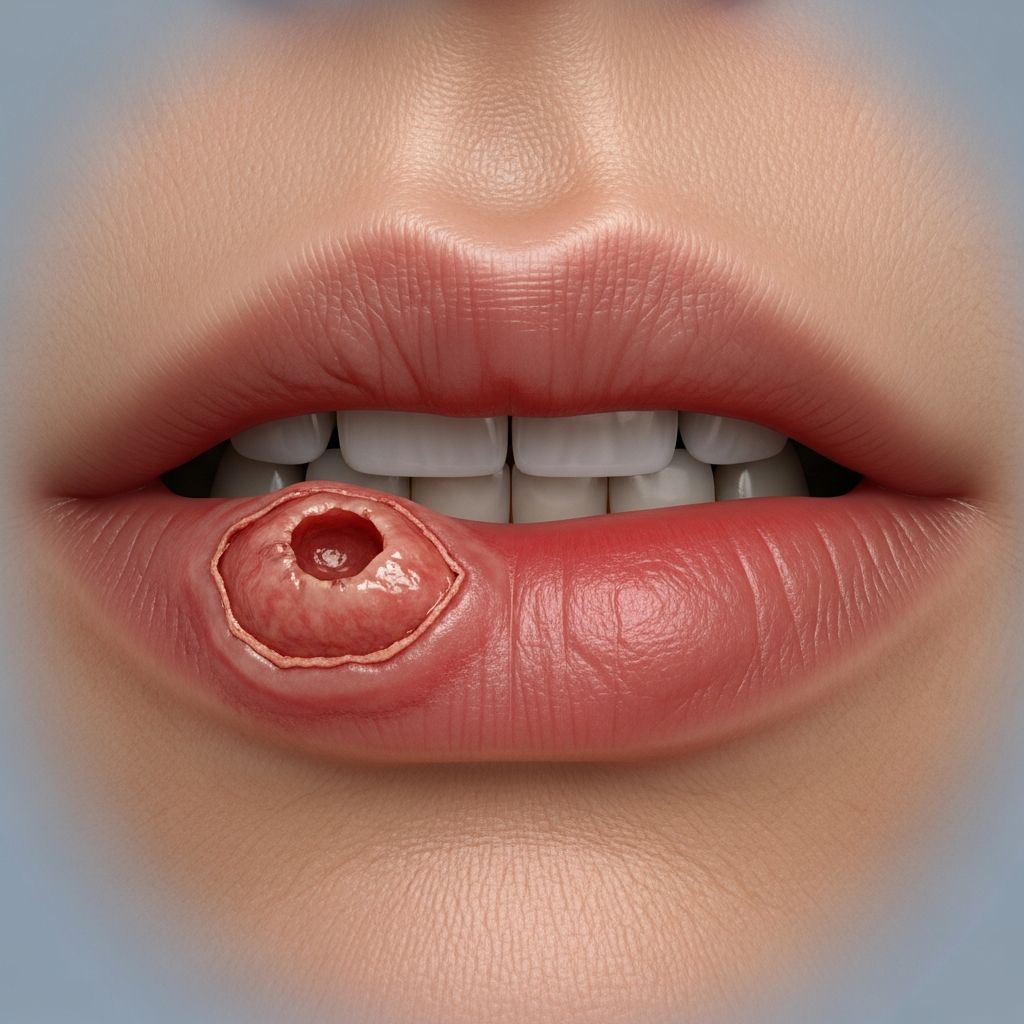
Squamous cell carcinoma of the lip typically presents as a firm nodule with distinctive clinical features. The lesion often appears as a pink or erythematous firm lump with a rough, hyperkeratotic, or keratinous surface. These lesions grow progressively over weeks to months and frequently develop central ulceration, a characteristic feature that distinguishes invasive SCC from its in situ counterpart.
Affected individuals commonly report that the lesion is tender or painful, adding to the symptomatic burden. The clinical morphology is often irregular rather than uniform, with less uniform keratin production compared to low-risk lesions located elsewhere on the body. This clinical appearance, combined with the anatomical location on the lip vermilion, places these lesions in the high-risk category requiring prompt evaluation and treatment.
Histopathological Features
Histologically, invasive squamous cell carcinoma of the lip is characterized by atypical keratinocytes proliferating within the dermis, distinguishing it from in situ disease where neoplastic cells remain confined to the epidermis. The depth of invasion, degree of differentiation, and presence of specific aggressive features determine tumor grade and inform prognosis. Well-differentiated tumors typically have a better prognosis than poorly differentiated variants.
Related Stories



Risk Stratification System
Cutaneous squamous cell carcinoma is classified into low-risk and high-risk categories based on the probability of recurrence and metastasis. This stratification system guides clinical decision-making regarding treatment intensity and follow-up protocols.
Low-Risk Tumors
Low-risk SCC exhibits the following characteristics:
- Diameter less than 2 centimeters
- Slow growth pattern with keratotic surface
- Regular, well-defined features
- Good histological differentiation
- Location on trunk or extremities (excluding high-risk sites)
High-Risk Tumors
High-risk squamous cell carcinomas possess one or more of the following features:
- Lesions greater than or equal to 2 centimeters in diameter, particularly those exceeding 4 centimeters
- Rapidly growing lesions with minimal keratin production
- Irregular, ill-defined borders
- Location on the ear or lip vermilion (including lip SCC)
- Poor histological differentiation (desmoplastic, spindle cell variants)
- Depth greater than 6 millimeters or invasion into subcutaneous fat or nerve sheaths
- Lymphatic or vascular invasion present on histology
- Lesions arising within scars or areas of chronic inflammation
- Evidence of immunosuppression in the patient
Patients who are immunosuppressed present particular challenges, as their tumors may behave more aggressively. Individuals with epidermolysis bullosa (EB) experience particularly aggressive SCC that represents the most common cause of death in this population.
Diagnosis and Staging
Diagnosis of squamous cell carcinoma of the lip is based on clinical features combined with pathological confirmation. While experienced clinicians may recognize characteristic lesions clinically, definitive diagnosis requires either diagnostic biopsy or pathological examination following surgical excision.
Diagnostic Procedures
For suspected lip SCC, the following diagnostic approaches may be employed:
- Clinical examination and documentation of lesion characteristics
- Diagnostic punch or shave biopsy for histopathological analysis
- Excisional biopsy when diagnostic and therapeutic goals can be achieved simultaneously
- Histological assessment of differentiation level and invasion depth
Staging Investigations
Patients with high-risk SCC, particularly those with lip lesions, may require staging investigations to determine whether metastatic disease is present. These investigations include:
- Ultrasound scanning of regional lymph nodes
- Computed tomography (CT) scans
- Magnetic resonance imaging (MRI) scans
- X-ray imaging when clinically indicated
Regional lymph node involvement represents a critical prognostic factor, with metastatic SCC most commonly found in regional lymph nodes (80%), followed by distant sites including lungs, liver, brain, bones, and skin.
Treatment Options
The management of squamous cell carcinoma of the lip depends on multiple factors including tumor size, depth, histological grade, patient age, immunological status, and patient preferences. Multiple effective treatment modalities are available, and the choice of therapy should be individualized.
Surgical Excision
Simple excision represents a primary treatment option for most lip SCC lesions. This approach involves surgical removal of the tumor with an appropriate margin of surrounding normal tissue, determined by tumor risk factors. The resected tissue is then examined histopathologically to confirm complete removal and assess for adverse prognostic features. Margins are typically assessed during the procedure using frozen section analysis, allowing real-time determination of whether complete excision has been achieved.
Laser Therapy
Laser therapy utilizes an intense beam of light to vaporize malignant growths with several advantages particularly relevant to lip lesions. Laser treatment typically results in minimal damage to surrounding tissue, reduced risk of bleeding and swelling compared to conventional surgical approaches, and decreased scarring—a significant consideration given the cosmetic and functional importance of the lip. Lasers are frequently used to treat superficial carcinomas on the lips where cosmetic outcomes are particularly important.
Mohs Micrographic Surgery
For high-risk lip SCC lesions, Mohs micrographic surgery may be considered. This specialized surgical technique allows complete histological examination of surgical margins during the procedure, maximizing the likelihood of complete tumor removal while minimizing healthy tissue loss. This approach is particularly valuable for lip lesions where functional and cosmetic preservation is paramount.
Management of Advanced Disease
For patients with very large, deeply invasive tumors or clinical evidence of lymph node involvement, additional interventions may be necessary:
- Lymph node dissection: Removal of regional lymph nodes is recommended when nodes are enlarged and/or firm on clinical examination, or when the primary tumor exhibits very high-risk features. Following removal, lymph nodes undergo microscopic examination to determine cancer involvement, which is critical for staging and prognosis.
- Radiation therapy: May be recommended after surgery in selected cases, particularly those with evidence of extensive nodal involvement or perineural invasion.
- Systemic chemotherapy: Represents an option for patients with squamous cell carcinoma that has metastasized to lymph nodes or distant organs. Chemotherapy may be combined with surgery or radiation therapy in comprehensive treatment regimens.
Prognosis and Outcomes
Most squamous cell carcinomas of the lip are cured when treated appropriately. The likelihood of cure is substantially improved when treatment is undertaken promptly, while the lesion remains small. The risk of recurrence or disease-associated death is greater for tumors exceeding 20 millimeters in diameter and/or exceeding 2 millimeters in thickness at the time of surgical excision.
When treated early, squamous cell carcinomas generally cause no long-term complications. However, untreated SCC can destroy healthy tissue surrounding the tumor, spread to lymph nodes or other organs, and rarely may be fatal. Metastatic disease is generally uncommon but carries significantly worse prognosis than localized disease.
Recurrence Risk
Approximately 50% of individuals at high risk for SCC develop a second malignancy within 5 years of their first diagnosis. These patients are also at increased risk for other skin cancers, particularly melanoma. This observation underscores the importance of ongoing surveillance and sun protective behaviors in susceptible individuals.
Prevention and Long-Term Management
Prevention of squamous cell carcinoma of the lip focuses on reducing UV exposure and identifying precursor lesions early. Regular self-skin examinations combined with annual skin checks by experienced health professionals are strongly recommended, particularly for individuals at high risk due to sun exposure history, fair skin type, or personal history of skin cancer.
Sun protection measures including broad-spectrum sunscreen with SPF 30 or higher, protective lip balms with UV filters, wide-brimmed hats, and avoidance of peak UV hours reduce the risk of developing actinic keratoses and their progression to invasive SCC. Smoking cessation represents an additional important preventive measure, as smoking increases lip SCC risk.
Frequently Asked Questions
Q: Why are lip lesions considered higher risk than SCC elsewhere?
A: Lip lesions, particularly on the vermilion border, are classified as high-risk sites due to their higher recurrence rates and greater metastatic potential compared to SCC on other body locations. The unique vascular and lymphatic drainage patterns of the lip, combined with chronic UV exposure to this site, may contribute to this increased risk.
Q: What is the difference between actinic cheilitis and invasive SCC of the lip?
A: Actinic cheilitis represents a precursor lesion with atypical keratinocytes confined to the epidermis, whereas invasive squamous cell carcinoma shows atypical keratinocyte proliferation extending into the dermis. Histological examination is required to make this distinction definitively.
Q: How often should patients with a history of lip SCC undergo skin examinations?
A: Patients with a history of lip SCC should undergo regular annual skin checks by an experienced dermatologist or primary care physician trained in skin cancer detection. More frequent surveillance may be warranted for high-risk individuals or those with multiple risk factors.
Q: Can lip SCC be treated without surgery?
A: While surgical excision remains the gold standard treatment, alternative options for superficial lesions include laser therapy and topical treatments. However, invasive lip SCC typically requires surgical intervention to ensure complete tumor removal and allow histological assessment.
Q: What is the recurrence rate for lip SCC?
A: Recurrence rates vary based on tumor characteristics and treatment approach. Approximately 50% of high-risk patients develop a second SCC within 5 years of their first diagnosis, highlighting the importance of ongoing surveillance and preventive measures.
References
- Understanding Squamous Cell Carcinoma — Skintel. 2026. https://skintel.co.nz/articles/squamous-cell-carcinoma/
- Common skin lesions. Squamous cell carcinoma — DermNet New Zealand. 2026. https://dermnetnz.org/cme/lesions/squamous-cell-carcinoma
- Fact-Sheet-Squamous-Cell-Carcinoma-of-Skin-NCR-2013 — Cancer Association of South Africa. December 2017. https://www.cansa.org.za/files/2018/01/Fact-Sheet-Squamous-Cell-Carcinoma-of-Skin-NCR-2013-web-December-2017.pdf
- Cutaneous squamous cell carcinoma — DermNet New Zealand. 2026. https://pdfs.semanticscholar.org/5607/fdcb6a92341e8e9326cb38024cddb743842b.pdf
- Squamous cell carcinoma — Right Decisions, NHS Scotland. 2026. https://rightdecisions.scot.nhs.uk/shared-content/cfsd/dermatology/squamous-cell-carcinoma/
- Cutaneous squamous cell carcinoma — DermNet New Zealand. 2026. https://dermnetnz.org/topics/cutaneous-squamous-cell-carcinoma
Similar Articles








Read full bio of medha deb