Stages Of Appendicitis: 4 Critical Phases Explained
Understand the progressive stages of appendicitis, from initial inflammation to potential rupture, and learn critical symptoms and treatments.
Appendicitis is a medical emergency characterized by inflammation of the appendix, a small tube-like organ attached to the large intestine. If untreated, it can progress through distinct stages, leading to severe complications like rupture and peritonitis. Recognizing the stages—simple, suppurative, gangrenous, and perforated—is crucial for timely diagnosis and treatment.
What Is Appendicitis?
The appendix is a finger-shaped pouch in the lower right abdomen. Appendicitis typically begins when it becomes blocked by fecal matter, a foreign body, or infection, causing bacterial overgrowth and inflammation. Early symptoms include abdominal pain starting near the navel and migrating to the lower right side. Without intervention, pressure builds, potentially leading to tissue death and rupture.
Acute appendicitis affects about 7% of people in Western countries over their lifetime. It most commonly occurs between ages 10 and 30 but can affect anyone. Prompt treatment prevents progression to complicated stages.
The 4 Stages of Appendicitis
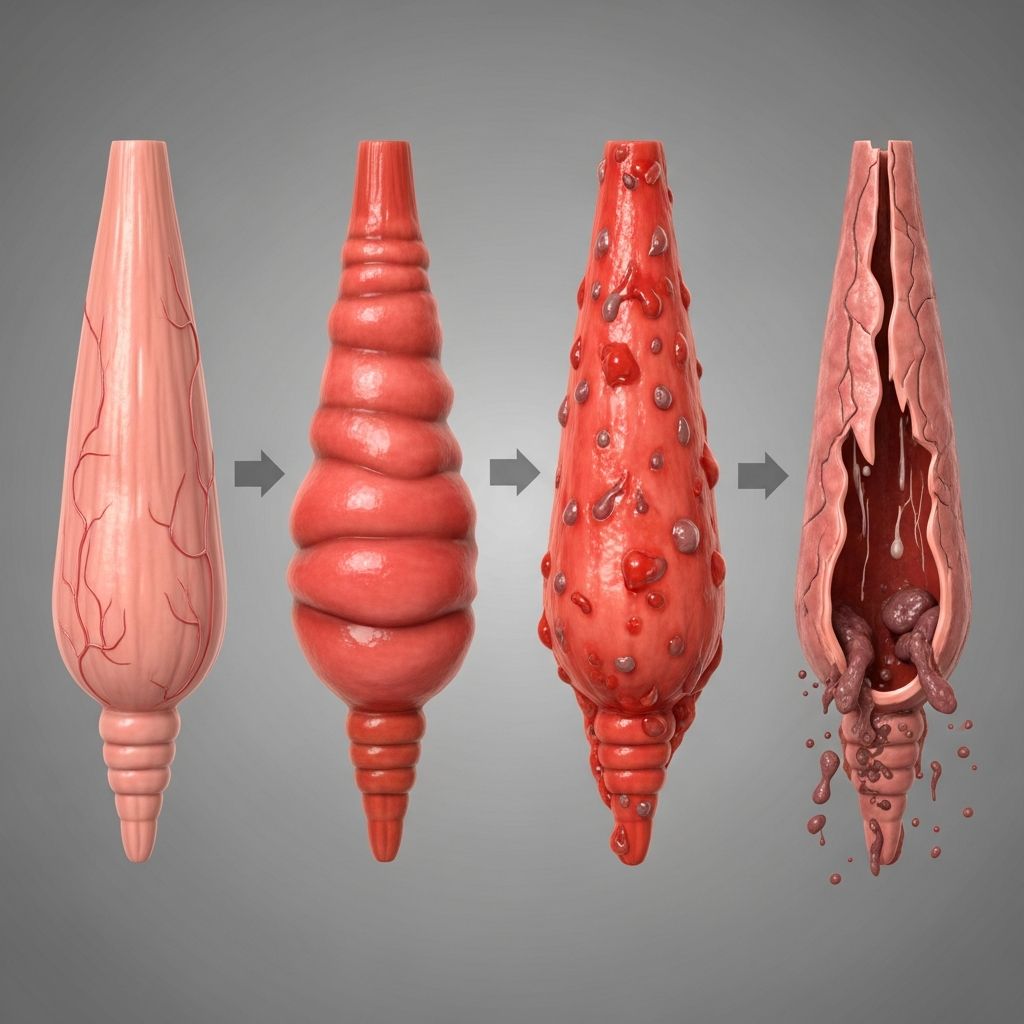
Medical professionals classify appendicitis into four progressive stages based on pathological changes: simple, suppurative, gangrenous, and perforated. These stages reflect increasing severity, from mild inflammation to life-threatening rupture.
Stage 1: Simple Appendicitis
Simple appendicitis is the earliest stage, involving inflammation without necrosis (cell death) or perforation. The appendix swells due to obstruction, but the wall remains intact. Neutrophils, a type of white blood cell, infiltrate the tissue as the body fights infection.
Symptoms are often vague: periumbilical pain that localizes to the right lower quadrant (RLQ), nausea, loss of appetite, and low-grade fever. This stage may resolve spontaneously in rare cases or with antibiotics alone, avoiding surgery.
Stage 2: Suppurative Appendicitis
Also called phlegmonous appendicitis, this stage features pus accumulation (suppuration) and ulcers in the appendix wall. Inflammation penetrates deeper layers, causing abscesses and possible blood clots in nearby vessels. Bacterial overgrowth shifts to include anaerobes like Bacteroides and Peptostreptococcus.
Pain intensifies, worsens with movement, coughing, or deep breaths. Abdominal swelling and higher fever may appear. Treatment often requires antibiotics, but surgery is considered if symptoms persist.
Stage 3: Gangrenous Appendicitis
Gangrenous appendicitis involves necrosis of the appendix wall due to prolonged inflammation and reduced blood supply. Tissue turns black and dies, increasing rupture risk. Histopathology shows transmural neutrophil infiltration, ulceration, and vascular thrombosis.
Symptoms escalate: severe RLQ pain, high fever, rapid heartbeat, and signs of systemic infection. This is a complicated stage requiring urgent surgical intervention to prevent perforation.
Stage 4: Perforated Appendicitis
The most dangerous stage occurs when the weakened appendix bursts, spilling pus and bacteria into the abdominal cavity, causing peritonitis or abscesses. Risk factors include delayed diagnosis, weakened immunity, extremes of age, male sex, pregnancy, or prior abdominal surgery.
Related Stories



Symptoms include explosive pain, rigid abdomen, high fever, vomiting, and shock in severe cases. Hospitalization, IV antibiotics, and emergency appendectomy (often laparoscopic) are standard. Recovery may take weeks with possible drains or additional procedures.
Uncomplicated vs. Complicated Appendicitis
Beyond the four stages, appendicitis is broadly classified as uncomplicated or complicated:
- Uncomplicated: Inflammation without necrosis, perforation, or abscess. Treatable with antibiotics; surgery optional.
- Complicated: Involves tissue damage, pus, or rupture. Requires surgery; higher risk of sepsis and longer recovery.
| Aspect | Uncomplicated | Complicated |
|---|---|---|
| Symptoms Duration | <24 hours | >48 hours |
| Treatment | Antibiotics ± surgery | Surgery + IV antibiotics |
| Complications Risk | Low | High (peritonitis, abscess) |
| Recovery Time | 1-2 days | Weeks |
Symptoms of Appendicitis
Classic presentation: sudden pain starting epigastrically or periumbilically, migrating to McBurney’s point (1.5-2 inches from the right anterior superior iliac spine toward umbilicus). Pain worsens with walking, coughing, or sneezing.
- Nausea/vomiting (80% of cases)
- Loss of appetite
- Low-grade fever (40% febrile)
- Rebound tenderness/RLQ guarding
- Bowel changes: constipation, diarrhea, urgency
- Urinary symptoms in some
Atypical symptoms in children, elderly, or pregnant individuals may delay diagnosis.
Diagnosis of Appendicitis
Diagnosis combines history, physical exam, labs, and imaging:
- Physical Exam: RLQ tenderness, rebound, guarding, psoas/rovsing signs.
- Labs: Leukocytosis (>10,000 WBCs), elevated CRP. Alvarado score (0-10): ≥7 suggests appendicitis (migratory pain, anorexia, nausea, RLQ tenderness, rebound, fever, leukocytosis).
- Imaging: Ultrasound (first-line, esp. kids/pregnant), CT scan (95% accurate), MRI if needed.
Treatment for Appendicitis
Standard: Appendectomy (open or laparoscopic). Early uncomplicated cases may use antibiotics (e.g., piperacillin-tazobactam).
- Laparoscopic: Minimally invasive, 1-2 small incisions, faster recovery.
- Open: For perforation/peritonitis.
- Post-op: Antibiotics if complicated; diet advancement; discharge in 1-3 days uncomplicated.
Non-operative management succeeds in 70-90% uncomplicated cases but risks recurrence (14% in 1 year).
Complications and Prognosis
Untreated perforation leads to peritonitis (30-50% mortality if diffuse), sepsis, abscesses. Early surgery mortality <1%. Complicated cases prolong hospital stay (5-7 days).
Prognosis excellent with prompt care: full recovery in 24-48 hours uncomplicated.
Prevention and When to Seek Help
No sure prevention, but high-fiber diet may reduce fecalith risk. Seek ER for severe abdominal pain, fever, vomiting lasting >12 hours.
Frequently Asked Questions (FAQs)
What are the first signs of appendicitis?
Sudden pain near the belly button moving to lower right abdomen, nausea, vomiting, fever.
Can appendicitis go away on its own?
Rarely in simple stage with antibiotics; most require surgery to prevent rupture.
How long before appendix bursts?
Typically 48-72 hours untreated, but varies.
Is appendicitis more common in men?
Slightly; also higher in young adults.
What tests confirm appendicitis?
CT/ultrasound, blood tests, Alvarado score.
References
- How might a doctor classify appendicitis? — Medical News Today. 2023. https://www.medicalnewstoday.com/articles/4-stages-of-appendicitis
- Appendicitis — StatPearls, NCBI Bookshelf, NIH. 2023-10-05. https://www.ncbi.nlm.nih.gov/books/NBK493193/
Similar Articles








Read full bio of Sneha Tete