Stasis Ulcer
Comprehensive guide to stasis ulcers: causes, symptoms, diagnosis, and effective treatment strategies for venous leg ulcers.
A
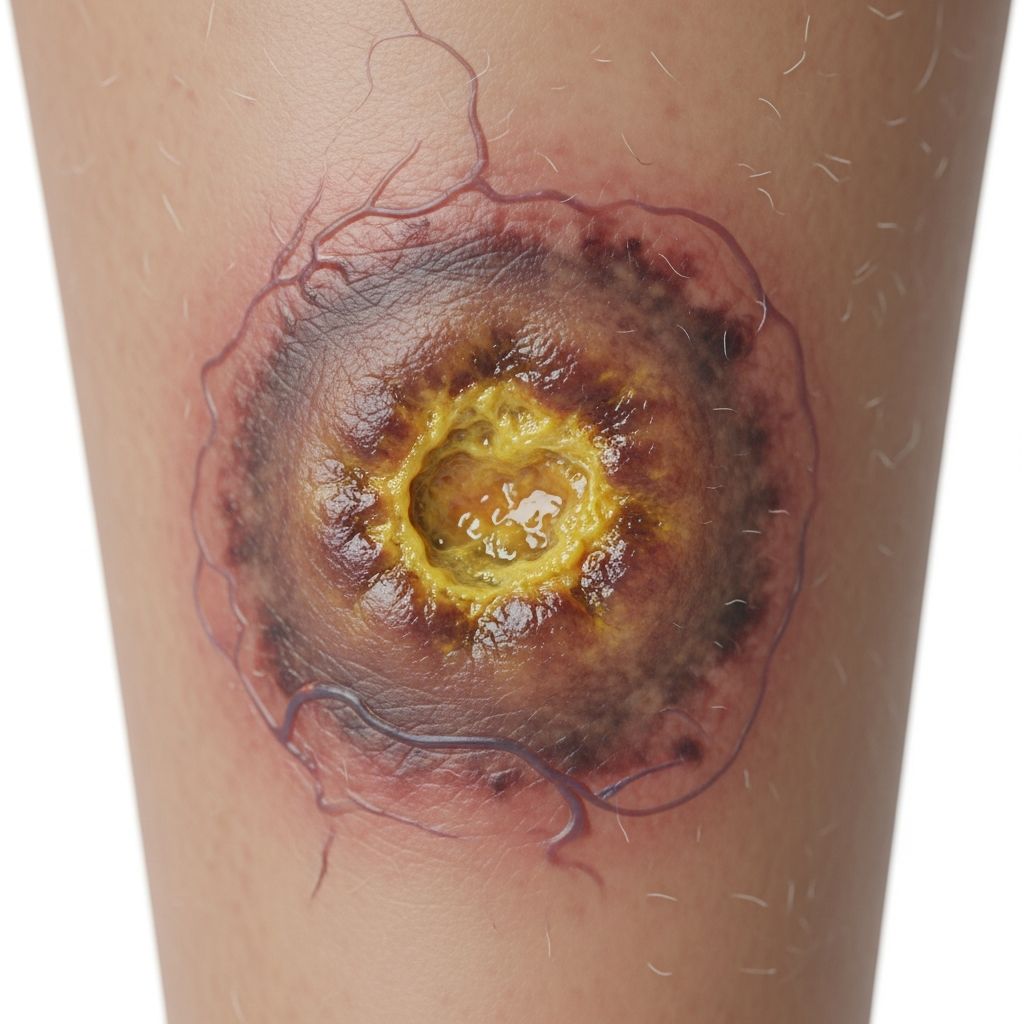
, also known as a venous leg ulcer, gravitational ulcer, or varicose ulcer, represents the most common cause of chronic full-thickness skin loss on the lower leg. It arises when venous blood flow from the leg back to the heart is impaired due to venous insufficiency.Introduction
Stasis ulcers account for 40–50% of all chronic lower limb ulcers and contribute to 20% of mixed arterial-venous ulcers. They affect approximately 1% of the adult population, with prevalence increasing to 4% in those over 65 years. These wounds typically develop on the medial aspect of the lower leg, particularly around the gaiter area (above the medial malleolus), due to chronic venous hypertension leading to skin breakdown.
Without proper intervention, stasis ulcers can persist for months or years, significantly impacting quality of life through pain, immobility, and risk of complications. Early recognition and management are crucial for healing and prevention of recurrence.
Demographics
Stasis ulcers predominantly affect older adults, with a higher incidence in individuals aged 60 and above. Women are at greater risk than men, with a female-to-male ratio of approximately 2:1, likely due to factors like pregnancy, obesity, and hormonal influences on venous walls.
Prevalence rises with age: about 0.1% in those under 50 years, increasing to 1–2% in the elderly population. In developed countries, the lifetime risk approaches 1% for the general population. Certain ethnic groups may show variations, but data is limited; higher rates are noted in populations with high obesity prevalence.
Causes
Stasis ulcers result from
chronic venous insufficiency (CVI)
, where veins fail to return blood efficiently to the heart. This leads to venous hypertension, blood pooling, capillary leakage, inflammation, and eventual skin ulceration.Primary causes include:
- Venous valve incompetence, allowing reflux of blood
- Venous obstruction from prior thrombosis or compression
- Impaired calf muscle pump due to immobility or weakness
Factors contributing to venous insufficiency:
- Deep vein thrombosis (DVT): Damages valves, leading to post-thrombotic syndrome
- Varicose veins: Superficial venous reflux
- Obesity: Increases venous pressure
- Pregnancy: Hormonal changes and venous compression
- Trauma or surgery: To leg veins or fractures
- Sedentary lifestyle or prolonged standing/sitting: Weakens muscle pump
Clinical Features
Stasis ulcers present with characteristic features confirming underlying venous disease:
- Location: Medial ankle (gaiter area), 70–90% of cases; rarely above knee
- Appearance: Shallow, irregular borders; ruddy base with granulation tissue; yellow/black slough if infected
- Size: Variable, often 2–10 cm diameter; may coalesce
- Exudate: Moderate to heavy, serous or seropurulent
- Pain: Mild aching; worsens with dependency
Accompanying venous disease signs:
- Haemosiderin pigmentation: Brown discoloration medial malleolus
- Venous eczema: Itchy, scaly red skin
- Lipodermatosclerosis: Inverted champagne bottle leg; woody fibrosis
- Varicose veins or atrophie blanche (white scars)
- Oedema: Pitting, worsens end-of-day
Complications
The primary complication is
wound infection
, occurring in 20–30% of cases. Bacteria colonize nearly all ulcers, but clinical infection requires treatment.Signs of infection:
- Increased pain, erythema, warmth
- Fever, malaise
- Purulent discharge, foul odour
- Fragile ‘black’ eschar or rapid deterioration
Other complications include:
- Cellulitis or lymphangitis
- Malignant transformation (rare, e.g., squamous cell carcinoma in chronic ulcers)
- Recurrence: 60–70% within 5 years without compression
- Chronic pain and disability
Topical antibiotics are discouraged as they delay healing.
Diagnosis
Diagnosis is primarily clinical, based on history (risk factors), examination (venous signs, ulcer characteristics), and ankle-brachial pressure index (ABPI) to exclude arterial disease.
ABPI: >0.9 normal; 0.6–0.9 mixed; <0.6 arterial (contraindicates compression).
Further investigations for venous insufficiency:
- Duplex ultrasound: Gold standard; assesses reflux/obstruction
- Venography: Rarely, for complex cases
- Photoplethysmography: Venous refill time
Bacterial swab if infection suspected; biopsy for atypical/suspected malignancy.
Treatment
Treatment focuses on compression therapy, wound care, and addressing CVI. Healing rates: 70% at 12 weeks, 80% at 24 weeks with multilayer compression.
Compression Therapy
First-line: Multi-layer high-compression bandaging (40 mmHg) or hosiery.
| Type | Pressure (mmHg) | Indications |
|---|---|---|
| Short stretch bandages | 40 | ABPI >0.8; gold standard |
| Four-layer (Profore) | 40 | Moderate-heavy exudate |
| Unna boot | 20–40 | Fixed compression |
| Compression stockings | 20–40 | Healed ulcer prevention |
Wound Care
- Cleanse with saline; debride non-viable tissue
- Moist healing: foams, alginates for exudate
- Avoid topical antibiotics
Surgical/Endovascular
- Endovenous ablation: For superficial reflux
- Skin grafting: Large non-healing ulcers
- Vein surgery: Stripping/ligation (less common now)
Pentoxifylline
400 mg TDS for 6 months improves healing with compression.
Outcome
With optimal compression, 60–80% heal within 6 months; recurrence high (25–50% in 1 year) without lifelong compression hosiery. Patient education on leg elevation, exercise, weight control essential. Multidisciplinary care improves outcomes.
Frequently Asked Questions (FAQs)
Q: What is a stasis ulcer?
A: A chronic wound on the lower leg caused by poor venous return, leading to skin breakdown.
Q: Who is at risk for stasis ulcers?
A: Older adults, women, obese individuals, those with DVT history or varicose veins.
Q: How are stasis ulcers treated?
A: Compression bandaging, wound care, and treating underlying venous insufficiency.
Q: Can stasis ulcers be prevented?
A: Yes, via weight management, exercise, compression stockings, and early varicose vein treatment.
Q: How long do stasis ulcers take to heal?
A: 6–12 weeks with proper therapy; chronic cases longer.
References
- Identifying Venous Stasis Dermatitis and Ulcers — WCEI Blog. 2023. https://blog.wcei.net/identifying-venous-stasis-dermatitis-and-ulcers
- Wound Care – Venous Stasis Ulcer — University Surgeons Associates. Accessed 2026. http://www.utsurgery.com/woundcare_venousstasisulcer.php
- Stasis ulcer — DermNet NZ. 2024. https://dermnetnz.org/topics/stasis-ulcer
- Stasis dermatitis and ulcers — MedlinePlus, NIH. 2025-01-15. https://medlineplus.gov/ency/article/000834.htm
- Venous Leg Ulcer — StatPearls, NCBI Bookshelf, NIH. 2024-07-20. https://www.ncbi.nlm.nih.gov/books/NBK567802/
- Diagnosis and Treatment of Venous Ulcers — American Academy of Family Physicians (AAFP). 2010-04-15. https://www.aafp.org/pubs/afp/issues/2010/0415/p989.html
Similar Articles





Read full bio of medha deb