Structure Of The Dermis And Subcutis: Key Anatomy Insights
Explore the intricate anatomy of the dermis and subcutis, essential skin layers providing support, nourishment, and protection.
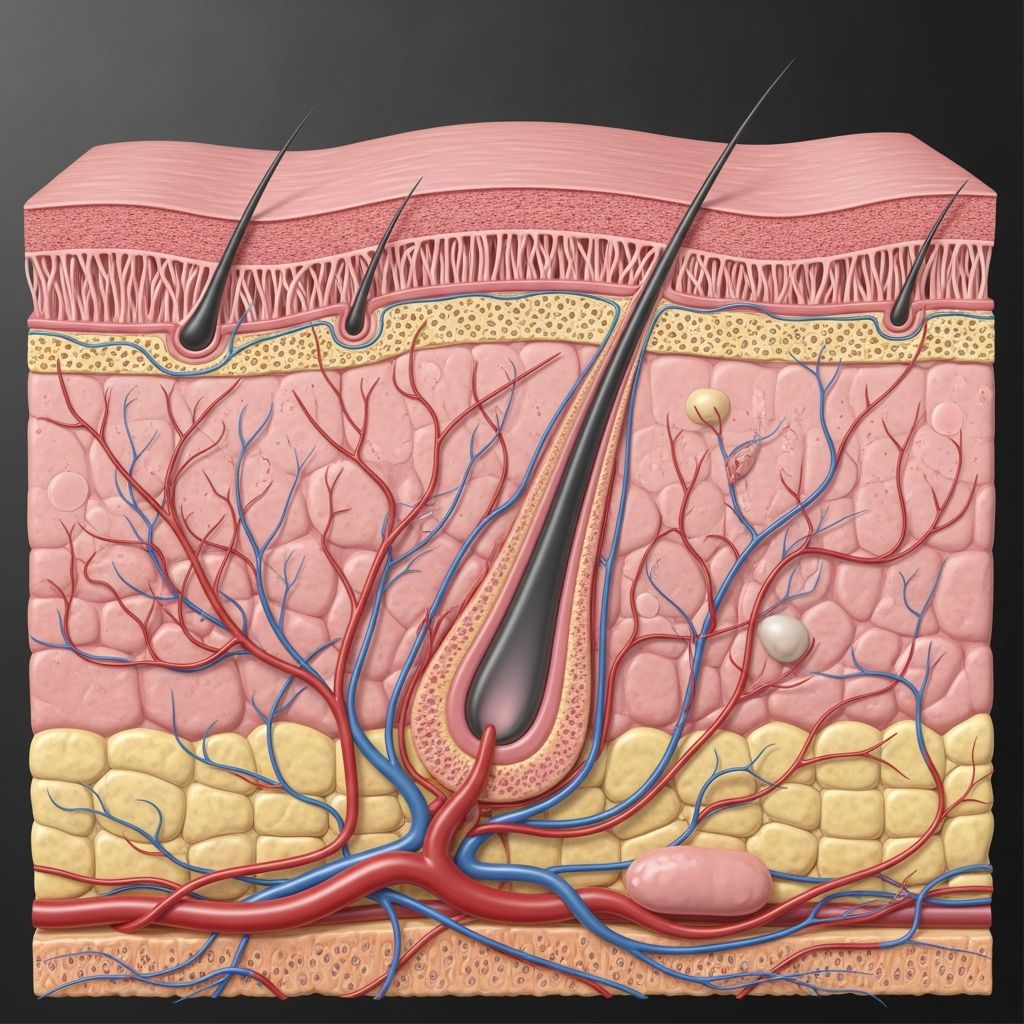
The dermis and subcutis form the foundational layers beneath the epidermis, providing structural integrity, nourishment, and protection to the skin. This article delves into their composition, organisation, and clinical relevance, drawing from authoritative anatomical descriptions.
Introduction to Skin Layers
The skin comprises three primary layers: the
epidermis
,dermis
, andsubcutis
(also termed hypodermis). The epidermis serves as a protective barrier, while the dermis supports it with nutrients, strength, and resilience. The subcutis lies deepest, anchoring the skin to underlying tissues and aiding in thermoregulation and energy storage.The
dermis
is a dense connective tissue layer rich in collagen, elastin, and ground substance. It houses blood vessels, nerves, lymphatics, and adnexal structures like hair follicles and glands. Full ofpapillae
—peg-like projections under the basement membrane—the dermis interlocks with the epidermis, enhancing adhesion and nutrient exchange.The Dermis
The dermis supports the epidermis by supplying nutrients and mechanical toughness. Composed of fibres (collagen and elastic), ground substance, nerves, blood vessels, and cells like fibroblasts, it divides into two main regions: the papillary and reticular dermis.
Papillary Dermis
The
papillary dermis
is the superficial portion directly beneath the epidermis. Characterised by thin, haphazardly arrangedcollagen fibres
, fineelastic fibres
, and abundantground substance
, it forms a loose network facilitating diffusion of nutrients and waste.Key features include:
- Collagen type III: Predominant, forming fine, loosely woven bundles.
- Elastic fibres: Thin oxytalan fibres perpendicular to the surface, providing initial elasticity.
- Ground substance: Rich in glycosaminoglycans (GAGs) like hyaluronic acid, maintaining hydration and turgor.
- Cells: Abundant fibroblasts, mast cells, and macrophages; fewer lymphocytes.
- Vascular plexus: Superficial network of post-capillary venules, crucial for inflammation responses.
Papillary ridges (double rows of papillae) underlie epidermal ridges, visible as fingerprints. This interdigitation minimises shear forces and maximises surface area for exchange.
Reticular Dermis
The
reticular dermis
forms the thicker, deeper portion, extending from the papillary dermis to the subcutis. It consists of coarseelastic fibres
and thickcollagen bundles
(primarily type I) oriented parallel to the skin surface, conferring tensile strength.Composition details:
- Collagen bundles: Dense, wavy, and intertwined, arranged in a basketweave pattern.
- Elastic fibres: Thicker elaunin and mature fibres, running parallel and perpendicular for recoil.
- Ground substance: Less abundant than in papillary dermis, but supports matrix stability.
- Cells and structures: Fibroblasts, eccrine glands, hair follicles, and deeper vascular networks.
This layer’s robustness resists tearing, while its elasticity allows deformation. Thickness varies: thinnest on eyelids (~0.6 mm), thickest on back (~4 mm).
The Basement Membrane Zone
Situated between epidermis and dermis, the
basement membrane zone (BMZ)
anchors the epidermis. It comprises four zones visible on electron microscopy:| Structure | Description |
|---|---|
| Basal cell membrane | Plasma membrane of basal keratinocytes, with hemidesmosomes. |
| Lamina lucida | Electron-lucent layer containing laminin-332 and integrins. |
| Lamina densa | Dense layer rich in type IV collagen, forming the basal lamina. |
| Sublamina densa | Anchoring fibrils (type VII collagen) linking to dermal collagen. |
This structure ensures epidermal-dermal cohesion; defects cause blistering disorders like bullous pemphigoid.
Related Stories



Components of the Dermis
The dermis’s extracellular matrix (ECM) dominates, synthesised by fibroblasts.
| Component | Description | Function |
|---|---|---|
| Collagen | Types I (80-90%), III (papillary), V, VI; triple helix fibres. | Tensile strength, structural scaffold. |
| Elastic fibres | Oxytalan (papillary), elaunin, elastin core with microfibrils. | Elasticity and recoil. |
| Ground substance | GAGs (hyaluronan, proteoglycans), glycoproteins. | Hydration, diffusion medium, resilience. |
| Fibroblasts | Stellate cells producing ECM. | Synthesis, remodelling. |
| Blood vessels | Two plexuses: papillary (nutrient), reticular (deep). | Nutrition, thermoregulation. |
These elements interplay for skin homeostasis.
The Subcutis
The
subcutis
(hypodermis, superficial fascia) underlies the dermis, comprising adipose lobules separated by fibrous septa. It connects skin to muscle/bone, varying greatly in thickness (e.g., thin on shins, thick on abdomen).- Composition: Adipocytes (90%), collagen fibres, vessels, nerves.
- Functions: Insulation (fat traps heat), shock absorption (cushions organs), energy reserve, hormone production (leptin).
- Thermoregulation: Vasodilation/constriction modulates heat loss.
- Variations: Thicker in females, infants; site-dependent.
Adipose lobules increase with age/obesity; septa contain larger vessels.
Clinical Relevance
Dermal/subcutis alterations underpin many conditions:
- Ageing: Collagen loss, elastosis cause wrinkles.
- Scarring: Fibroblast hyperactivity in keloids.
- Inflammation: Papillary vessels mediate oedema.
- Malignancy: Melanoma invades dermis; lipomas arise in subcutis.
- Lipodystrophy: Subcutis fat loss.
Frequently Asked Questions (FAQs)
What is the main difference between papillary and reticular dermis?
The papillary dermis is loose with fine fibres for nutrient exchange; reticular is dense with thick collagen for strength.
How does the subcutis protect the body?
It insulates against cold, absorbs shocks, stores energy, and cushions organs via fat lobules.
What role do fibroblasts play in the dermis?
Fibroblasts synthesise collagen, elastin, and ground substance, maintaining ECM integrity.
Why are dermal papillae important?
Papillae interlock with epidermis, enhancing adhesion and forming fingerprints.
Can subcutis thickness vary?
Yes, thicker in women and certain body sites like abdomen; thins with age.
References
- Layers of the Skin – SEER Training Modules — National Cancer Institute. 2023. https://training.seer.cancer.gov/melanoma/anatomy/layers.html
- The subcutaneous layer: Anatomy, composition, and functions — Medical News Today. 2023-10-10. https://www.medicalnewstoday.com/articles/subcutaneous-layer
- Structure of the dermis and subcutis — DermNet NZ. 2024. https://dermnetnz.org/cme/principles/structure-of-the-dermis-and-subcutis
- Layers of the Skin | Anatomy and Physiology I — Lumen Learning. 2023. https://courses.lumenlearning.com/suny-ap1/chapter/layers-of-the-skin/
- Skin: Layers, Structure and Function — Cleveland Clinic. 2024-01-25. https://my.clevelandclinic.org/health/body/10978-skin
Similar Articles








Read full bio of Sneha Tete