Sturge-Weber Syndrome: What You Need To Know
Comprehensive guide to Sturge-Weber syndrome: symptoms, diagnosis, management, and living with this neurocutaneous disorder.
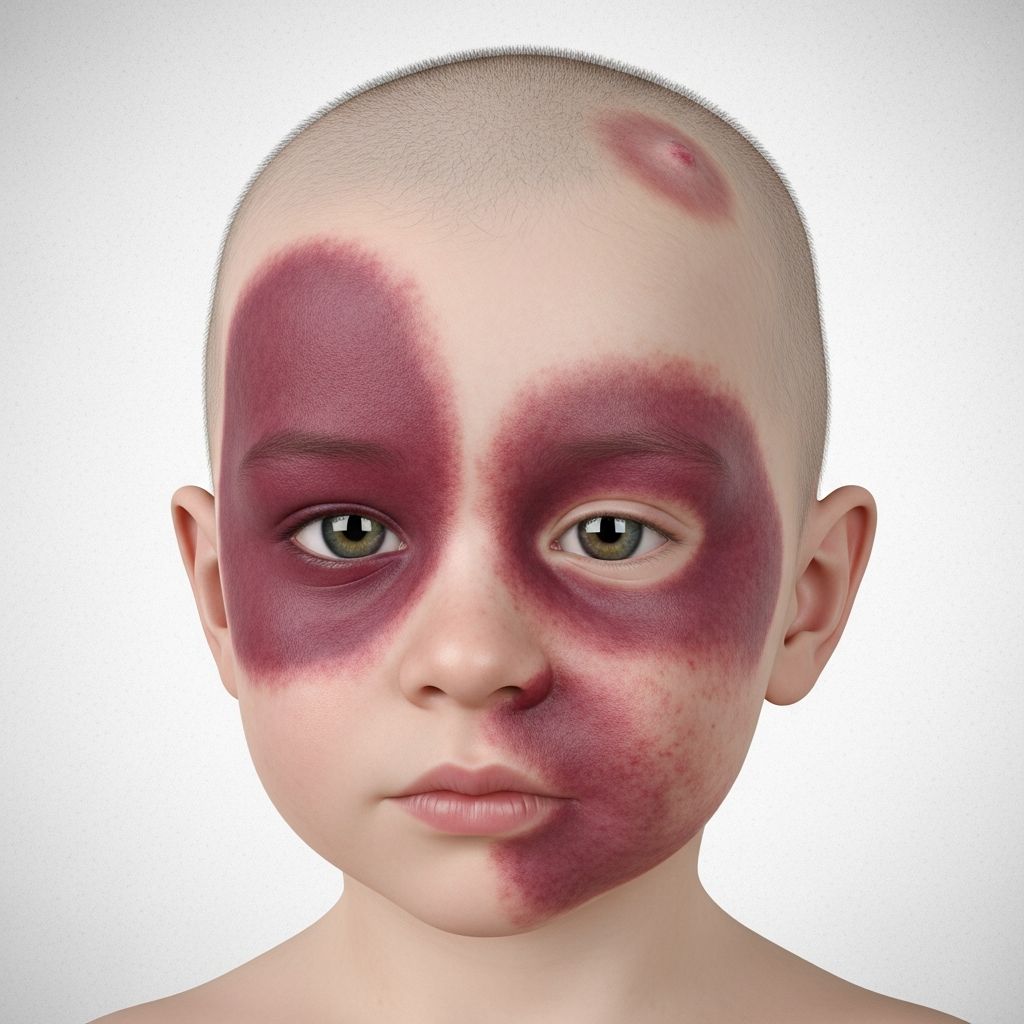
Sturge-Weber syndrome (SWS), also known as encephalotrigeminal angiomatosis, is a rare sporadic neurocutaneous disorder characterized by congenital vascular malformations affecting the skin, brain, and eyes. It manifests primarily as a facial port-wine stain (nevus flammeus), leptomeningeal angiomas, and associated neurological and ocular complications.12 This condition arises due to somatic mosaicism in the GNAQ gene, leading to abnormal blood vessel development during embryogenesis. SWS affects approximately 1 in 20,000 to 50,000 live births, with no sex or ethnic predisposition, and is typically unilateral but can be bilateral in rare cases.1
What is Sturge-Weber Syndrome?
Sturge-Weber syndrome involves abnormal capillary growth in the meninges (leptomeningeal angioma) and facial skin (port-wine stain in the trigeminal nerve distribution, usually V1 ophthalmic division). These vascular anomalies cause a ‘vascular steal’ phenomenon, where blood is diverted from normal brain tissue, leading to hypoxia, ischemia, calcification, and atrophy of the underlying cortex.12 The Roach classification divides SWS into three types:
- Type I: Both facial and leptomeningeal angiomas present, often with ipsilateral glaucoma (most common, ~75% of cases).
- Type II: Facial angioma only, with possible eye involvement but no leptomeningeal disease.
- Type III: Isolated leptomeningeal angioma without facial stain (often asymptomatic, diagnosed radiologically).
Neurological progression results from chronic hypoperfusion, gliosis, and calcifications, manifesting as seizures (75-90% of cases), hemiparesis, developmental delays, and cognitive impairments.13
Who Gets Sturge-Weber Syndrome (Epidemiology)?
SWS is a sporadic condition, not inherited, occurring due to postzygotic somatic mutations in GNAQ on chromosome 9q21, present in affected tissues but not germline.1 Incidence is estimated at 1:20,000-50,000 newborns. Port-wine stains occur in ~0.3% of the population, but only 8-15% progress to SWS when involving V1 trigeminal distribution (forehead/upper eyelid); risk rises to 30% if both eyelids affected.14 No familial cases reported; equal male-female ratio. Bilateral involvement in 15-30%; leptomeningeal angiomas ipsilateral to stain in 90% when both eyelids involved, 10-20% if unilateral eyelid.1
Clinical Features
Skin Lesions
The hallmark is a pink-to-purple port-wine stain (capillary malformation) on the face, sharply demarcated at midline, following trigeminal nerve branches (V1 > V2; V3 rare). It darkens/thickens with age, may hypertrophy, bleed, or ulcerate. Size varies; forehead/upper eyelid involvement flags SWS risk.15
Neurological Manifestations
Seizures onset by age 1 in 75-90%, focal (contralateral to angioma) progressing to generalization; drug-resistant in 50%.17 Hemiparesis/hemiplegia (25-50%), headaches (migraine-like), stroke-like episodes (transient weakness lasting minutes to months), developmental delay (50% intellectual disability), learning disorders, ADHD.235
Ocular Involvement
Glaucoma (30-70% if eyelid stain), choroidal hemangiomas, episcleral hemangiomas, leading to buphthalmos, refractive errors, strabismus, amblyopia.14
Other Features
Cerebral atrophy, macrocephaly (early), intracranial calcifications (‘tram-track’ on imaging). Over time: hemianopia, cognitive decline.12
Diagnosis
Clinical: Port-wine stain in V1 + neurological/ocular signs. Confirmed by MRI (leptomeningeal enhancement, atrophy, calcifications) or CT (cortical calcifications post-infancy).12 SPECT/PET show hypoperfusion; genetic testing (GNAQ mutation) supportive but not routine. Eye exam mandatory for glaucoma screening. Differential: Klippel-Trenaunay, PHACE syndrome, isolated port-wine stain, TORCH infections.13
| Imaging Modality | Findings in SWS |
|---|---|
| MRI | Leptomeningeal enhancement, cortical atrophy, white matter changes, enlarged choroid plexus |
| CT | ‘Tram-track’ calcifications, atrophy (after 1-2 years) |
| SPECT | Hypoperfusion in affected hemisphere |
| PET | Metabolic hypometabolism |
Treatment and Management
Symptomatic and multidisciplinary: neurology, ophthalmology, dermatology, neurosurgery.
- Seizures: ASD/oxcarbazepine first-line; vigabatrin/low-dose steroids early; hemispherectomy if refractory.17
- Skin: Pulsed dye laser for cosmesis/hypertrophy.1
- Glaucoma: Topical meds, surgery (trabeculectomy/goniotomy).14
- Stroke-like/Headaches: Aspirin prophylaxis, migraine therapy.3
- Developmental: Early intervention, physiotherapy, speech therapy.25
Related Stories



Monitor with annual MRI/eye exams. Ketogenic diet for seizures; avoid triggers like fever.7
Prognosis and Complications
Variable: Seizure control by age 2 predicts better outcome; early/intractable seizures worsen cognition/motor function (50% ID if uncontrolled).1 Glaucoma may cause blindness; stroke-like episodes resolve but recur. Life expectancy normal without severe complications; quality of life impacted by disabilities.45
Frequently Asked Questions (FAQs)
What causes Sturge-Weber syndrome?
SWS results from somatic GNAQ mutations causing mosaic vascular overgrowth in skin, brain, eyes. Not inherited.1
Is Sturge-Weber syndrome curable?
No cure; management controls symptoms. Early seizure control improves prognosis.17
Does every port-wine stain mean SWS?
No; only V1-involved stains (forehead/upper eyelid) risk SWS (8-30%). Screen with MRI if suspected.1
What is the first sign of SWS?
Facial port-wine stain at birth; seizures often by age 1.15
Can SWS be bilateral?
Yes, 15-30%; worse prognosis with bilateral brain involvement.1
Patient and Family Resources
Sturge-Weber Foundation (sturge-weber.org) offers support, ER guides, research updates.78 Multidisciplinary clinics recommended.
References
- Sturge-Weber Syndrome — Merck Manuals Professional Edition. 2023. https://www.merckmanuals.com/professional/pediatrics/neurocutaneous-syndromes/sturge-weber-syndrome
- Sturge-Weber Syndrome — Physiopedia. 2024. https://www.physio-pedia.com/Sturge-Weber_Syndrome
- Sturge-Weber syndrome (SWS) — Stroke Manual. 2023. https://www.stroke-manual.com/sturge-weber-syndrome/
- Sturge-Weber Syndrome: What It Is, Symptoms & Treatment — Cleveland Clinic. 2024. https://my.clevelandclinic.org/health/diseases/6074-sturge-weber-syndrome
- Sturge-Weber Syndrome — Child Neurology Foundation. 2023. https://www.childneurologyfoundation.org/disorder/sturge-weber-syndrome/
- STURGE-WEBER SYNDROME — Kennedy Krieger Institute. 2022. https://www.kennedykrieger.org/sites/default/files/library/documents/community/specialized-health-needs-interagency-collaboration-shnic/factsheets-medical-conditions/Sturge%20weber_1.pdf
- EMERGENCY ROOM GUIDE — Sturge-Weber Foundation. 2023. https://sturge-weber.org/file_download/b8b16312-24af-4609-b516-e46bc7678750
Similar Articles








Read full bio of Sneha Tete