Subcision: Complete Guide To Results, Risks, Aftercare
Effective minor surgical procedure for treating depressed acne scars and wrinkles by breaking fibrotic strands.
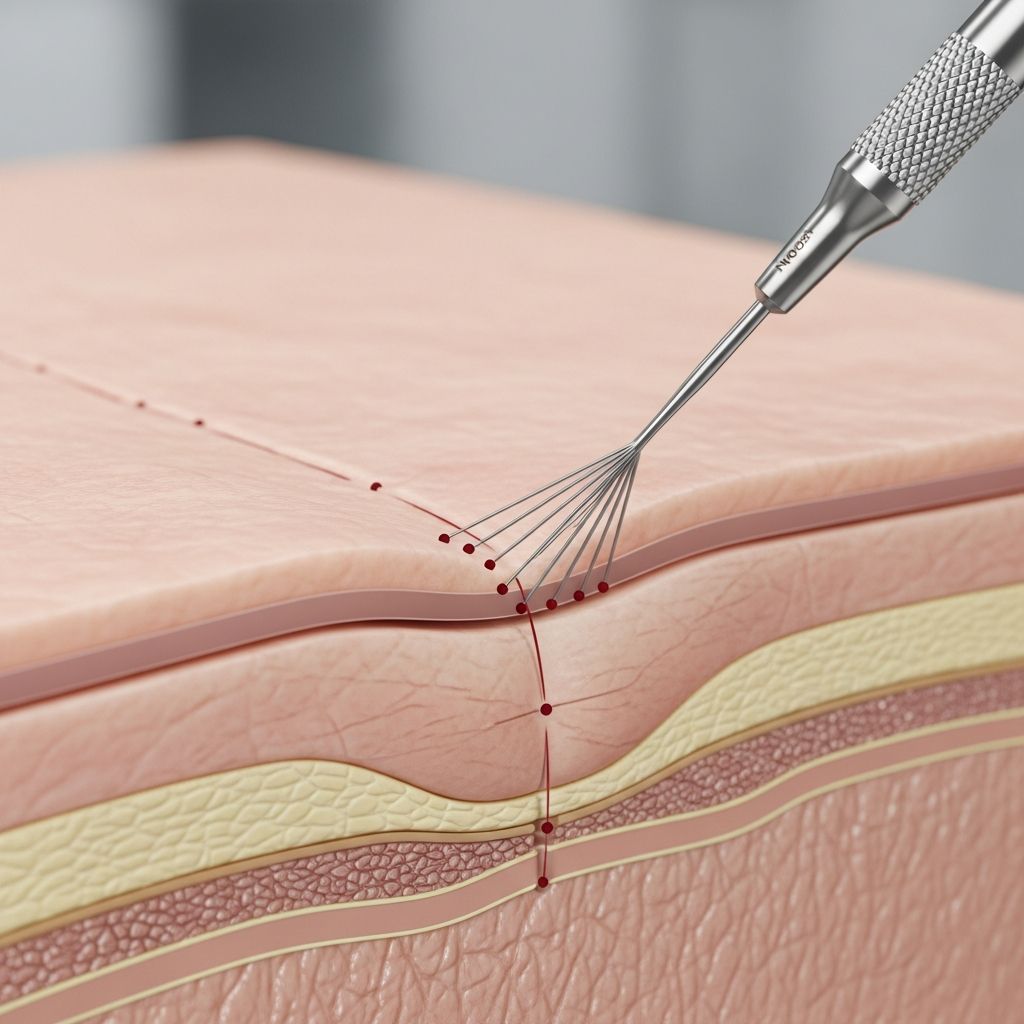
Subcision, also known as subcutaneous incisional surgery, is a minor surgical procedure designed to treat depressed cutaneous scars and wrinkles. It involves inserting a special hypodermic needle through a small puncture in the skin to break fibrotic strands tethering the scar to underlying tissue, allowing the skin surface to elevate.
Introduction
Subcision works by mechanically disrupting the fibrous attachments between the dermis and subcutaneous tissue that cause skin depressions. This release promotes scar elevation through subsequent clot formation, inflammation, and neocollagenesis, where new collagen fills the created space. Originally developed for atrophic acne scars, it has proven particularly effective for rolling scars, which exhibit a slopy, undulating appearance due to fibrotic tethering, and to a lesser extent for boxcar scars. Deeper, wider rolling scars respond more dramatically than shallow ones.
The procedure is minimally invasive, performed in an outpatient setting, and can be combined with other treatments like microneedling, fillers, or laser therapy to enhance results. Studies confirm its safety and efficacy, with modifications such as cannulas reducing side effects compared to traditional needles.
Indications
Subcision is primarily indicated for atrophic acne scars, excluding deep ice-pick scars which require different approaches like punch excision. Key indications include:
- Rolling scars: Fibrotic bands tether dermis to subcutaneous fat, creating undulating depressions. Subcision excels here by shredding these attachments.
- Boxcar scars: Shallow to medium-depth with defined edges; improves less dramatically than rolling scars but still beneficial.
- Depressed cutaneous scars from other causes, such as trauma or surgery.
- Wrinkles and folds, including nasolabial folds and marionette lines, where fibrous tethers pull skin downward.
It is less suitable for macular scars (flat, discolored marks without contour issues) or hypertrophic/keloid scars.
Contraindications
Subcision may not be suitable in certain cases to minimize risks:
- Active acne or skin infections in the treatment area.
- Coagulation disorders or patients on anticoagulants like warfarin, increasing bruising risk.
- Pregnancy or lactation.
- Recent scar treatments (within 3 months) or history of keloidal scarring.
- Unrealistic expectations or poor compliance with post-care.
Patients with a predisposition to hypertrophic reactions should undergo limited initial treatment.
Assessment
Pre-procedure evaluation is crucial. Use Goodman and Baron’s qualitative acne scar grading system for objective assessment:
| Grade | Description |
|---|---|
| Macular | Erythematous, hyperpigmented, or hypopigmented flat marks; no contour issue. |
| Mild Atrophic | Shallow scars visible at oblique light; minor relief issues. |
| Moderate Atrophic | Moderately deep boxcar/rolling scars; evident under normal lighting. |
| Severe Atrophic | Deep extensive boxcar/ice-pick scars; shadows visible normally. |
Assess scar type, depth, location, and skin type (e.g., higher risk in Fitzpatrick IV-VI for hyperpigmentation). Discuss goals, number of sessions (typically 1-4, monthly), and combinations like microneedling.
Subcision
The procedure is performed under local anesthesia. Key steps include:
- Anesthesia: Topical eutectic mixture (lidocaine-prilocaine) under occlusion for 45-60 minutes, or tumescent anesthesia for deeper work to separate planes and reduce risks.
- Technique: Insert an 18-gauge tribeveled hypodermic needle horizontally adjacent to the scar at a 30-degree angle. Advance parallel to the skin, using the sharp edge to break fibrotic strands via back-and-forth motion (fanning).
- Tools: Four main categories:
- Needles: Standard (e.g., Nokor); L-shaped modifications for precision.
- Cannulas: Blunt-tipped for fewer side effects, higher satisfaction; comparable efficacy to needles.
- Wires: Subdermal sawing (e.g., scalpel wires) for broad release.
- Blunt-blades: With tumescent for wide/deep scars; small incision near hairline.
- Session Limits: Limit intensity on first session to gauge collagen response. Deeper fanning risks vascular injury; avoid going below dermis.
Related Stories



For combination: Follow with microneedling (2mm dermaroller for PCI) in same session, monthly for 4 sittings.
Post-procedure
Immediate effects include pinpoint bleeding, edema, and erythema. Care instructions:
- Apply ice packs 10-15 min hourly day 1.
- Gentle cleansing; broad-spectrum sunscreen 3x daily.
- Avoid makeup 24-48h; no rubbing/scratching.
- Platelet-rich plasma (PRP) or fillers immediately post-subcision to prevent re-tethering and enhance fill.
Swelling/bruising peaks at 48h, resolves 7-10 days. Limit initial sessions for hypertrophic-prone skin.
Complications
Common, transient: Erythema, edema, bruising, postinflammatory hyperpigmentation (PIH). Rare: Infection, hypertrophic scars, nerve damage if too deep.
Cannula-based shows fewer adverse events vs. needle (e.g., less swelling). Tumescent reduces neurovascular risks. Incidence low in studies (e.g., 45-patient trial: mild erythema/PIH, no interference with daily life).
Treatment outcome
Outcomes vary by scar severity, type, sessions (1-6), and combos. Collagen induction elevates scars over 4-12 weeks.
- Rolling scars: Dramatic improvement, especially deep/wide.
- Boxcar: Moderate gains.
- Overall: Prospective studies show significant pre/post improvements (Z-test p<0.05); combos with microneedling/PRP superior.
Patient satisfaction high; e.g., cannula users report better at 1-3 months. Maintenance may need repeat every 6-12 months. Individual collagen response dictates sessions.
Frequently Asked Questions (FAQs)
What is subcision?
A minimally invasive procedure breaking fibrotic scar bands to lift depressed skin.
Is subcision painful?
Local anesthesia minimizes discomfort; post-procedure soreness like bruising for days.
How many sessions for acne scars?
Typically 3-4 monthly; deeper scars need more.
Can subcision treat ice-pick scars?
No, better for rolling/boxcar; ice-pick needs excision/punch.
What are risks of subcision?
Bruising, swelling, PIH; rare infection/hypertrophy. Cannulas safer.
Combine subcision with other treatments?
Yes, microneedling, PRP, fillers enhance results, prevent re-depression.
References
- Subcision and Microneedling as an Inexpensive and Safe Combination Therapy — J Clin Aesthet Dermatol. 2019-08. https://jcadonline.com/acne-scars-august-2019/
- Subcision for Atrophic Acne Scarring: A Comprehensive Review — Clin Cosmet Investig Dermatol. 2023-01-18. https://pmc.ncbi.nlm.nih.gov/articles/PMC9868281/
- Subcision – DermNet — DermNet NZ. https://dermnetnz.org/topics/subcision
- Subcision in acne scarring: A review of clinical trials — J Cosmet Dermatol. 2022. https://onlinelibrary.wiley.com/doi/10.1111/jocd.15480
- Acne Scarring – DermNet — DermNet NZ. https://dermnetnz.org/topics/acne-scarring
Similar Articles








Read full bio of Sneha Tete