Subepidermal Calcified Nodule: Definition, Diagnosis & Treatment
Comprehensive guide to understanding subepidermal calcified nodules, their diagnosis, and treatment options.
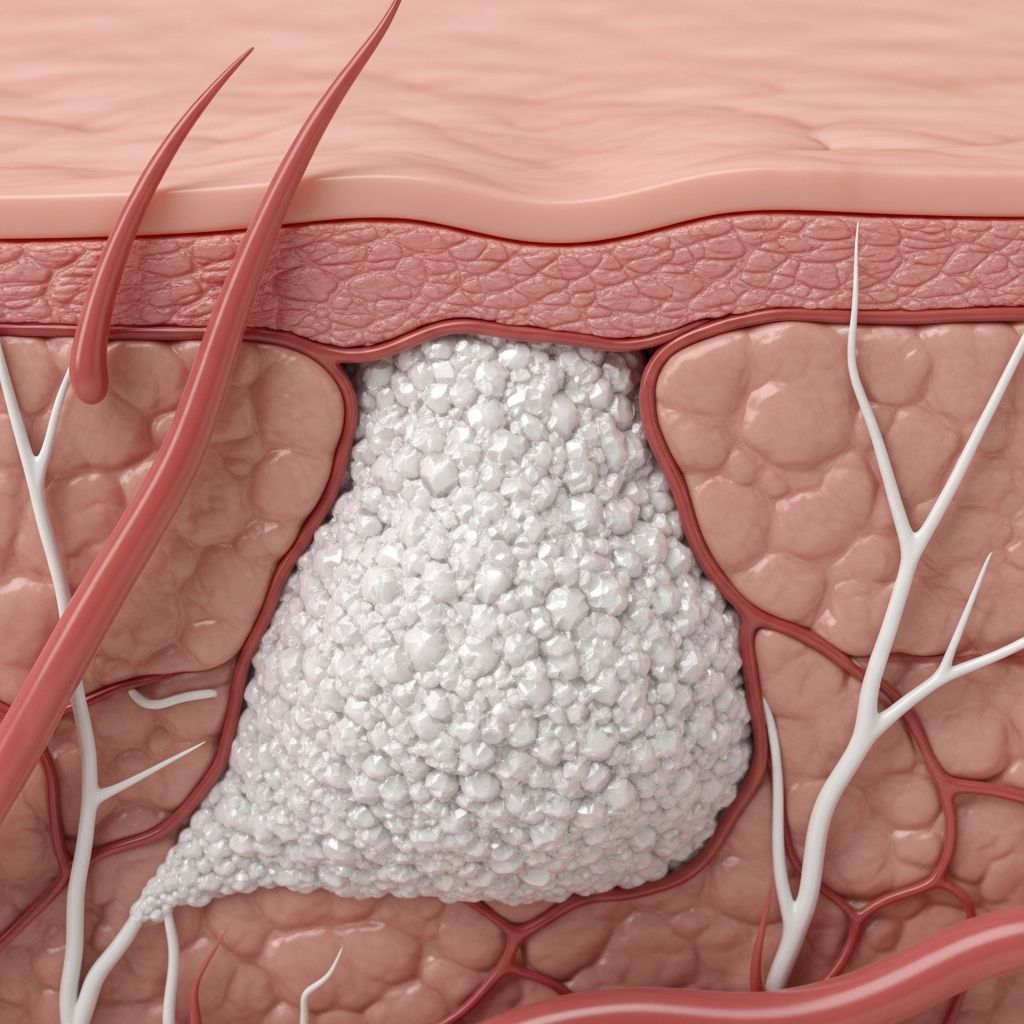
Subepidermal Calcified Nodule: A Comprehensive Guide
Subepidermal calcified nodules are deposits of insoluble calcium or phosphorus that accumulate within the skin. Also referred to as Winer’s nodular calcinosis or solitary congenital nodular calcification, these lesions represent a distinct subtype of calcinosis cutis, a condition characterized by abnormal calcium deposition in dermal and subcutaneous tissues. While typically considered benign, these nodules can present diagnostic challenges and may require professional medical evaluation to confirm their nature and rule out associated systemic conditions.
Epidemiology and Demographics
Subepidermal calcified nodules are relatively rare dermatological conditions, with only a few hundred cases reported in the medical literature. However, they are more commonly encountered than initially recognized, particularly in pediatric populations. These lesions predominantly affect children, though approximately 30% of documented cases occur in adults, demonstrating that this condition extends beyond childhood presentations.
A notable gender difference exists in the prevalence of subepidermal calcified nodules, with these lesions occurring twice as frequently in males compared to females. This gender predisposition remains unexplained in current literature, representing one of several unanswered questions about the condition’s etiology and pathogenesis.
Clinical Presentation and Characteristics
Subepidermal calcified nodules typically present as firm, mobile, and asymptomatic nodules, regardless of the patient’s skin type. The consistent clinical presentation across diverse populations suggests a unified pathophysiological mechanism underlying these lesions. They characteristically appear as yellowish-white lesions that are commonly found on the face and extremities. The nodules generally measure up to 1 centimeter in diameter and may be solitary or, less commonly, present as multiple lesions.
In many cases, these lesions are identified as incidental findings during examination or imaging studies. When symptomatic, patients may experience cosmetic concerns or local irritation and pain, which often prompts medical consultation and intervention. The asymptomatic nature of many cases means they may go undiagnosed for extended periods, occasionally being mistaken for benign skin growths such as warts or molluscum contagiosum.
Key Clinical Features
- Firm, mobile texture without fixation to surrounding tissue
- Yellowish-white coloration visible upon close inspection
- Typically asymptomatic in the majority of cases
- Preference for facial and extremity locations
- Size generally limited to 1 centimeter or less in diameter
- May appear as solitary lesions or in small groups
Etiology and Pathophysiology
The exact etiology of subepidermal calcified nodules remains unclear, and controversy persists regarding the precise mechanisms underlying their formation. As a type of idiopathic calcinosis cutis, these lesions develop without identifiable systemic causes or metabolic derangements. Affected individuals consistently demonstrate normal serum calcium, phosphate, and parathyroid hormone levels, effectively ruling out metabolic calcification as a contributing factor.
While subepidermal calcified nodules have been suggested to represent a form of dystrophic calcification—wherein calcium deposits occur in previously damaged or compromised tissue—this hypothesis remains contentious. The lesions characteristically develop in ostensibly undamaged skin, though some researchers propose that unappreciated or minor trauma may contribute to their pathogenesis. The apparent spontaneous nature of their development in structurally normal skin continues to perplex dermatologists and dermatopathologists.
Related Stories



Diagnostic Approaches
Clinical examination alone frequently proves insufficient for definitive diagnosis of subepidermal calcified nodules, often leading to misidentification as other cutaneous conditions. This diagnostic challenge necessitates additional investigative modalities to confirm the clinical suspicion and establish a definitive diagnosis.
Dermoscopy Findings
Dermoscopic examination provides valuable diagnostic clues that assist in differentiation from other cutaneous nodules. Characteristic dermoscopic findings include yellow-white clods surrounded by linear vessels, a pattern that, while suggestive, is not pathognomonic for subepidermal calcified nodules. Despite these helpful features, dermoscopy cannot definitively establish diagnosis without histopathological confirmation.
Histopathological Examination
Histological analysis remains the gold standard for confirming subepidermal calcified nodule diagnosis. The definitive nature of histopathology often makes it the only reliable method of confirming diagnosis when clinical presentation is ambiguous. Histological findings characteristically demonstrate dense, acellular deposits of calcium salts within the dermis, frequently accompanied by epidermal hyperkeratosis and acanthosis. Special staining techniques, particularly Von Kossa staining, effectively identify and confirm the presence of calcium deposits.
Reflectance Confocal Microscopy
Recently, reflectance confocal microscopy (RCM) has emerged as a potential non-invasive diagnostic tool for identifying subepidermal calcified nodules. While still under investigation, RCM may offer advantages as a complementary diagnostic modality, though it has not yet achieved widespread clinical adoption.
Systemic Evaluation
Comprehensive biochemical and endocrinological evaluation is essential to exclude systemic metabolic disorders and rule out other forms of calcinosis cutis. Standard investigations should include assessment of serum calcium, phosphorus, alkaline phosphatase, vitamin D, parathyroid hormone, and kidney function tests. Additional screening may include anti-nuclear antibody testing to exclude autoimmune connective tissue disorders associated with calcification.
Differential Diagnosis Considerations
The clinical presentation of subepidermal calcified nodules can mimic several other dermatological conditions, contributing to frequent misdiagnosis. Common conditions in the differential diagnosis include:
- Warts (verruca vulgaris)
- Molluscum contagiosum
- Appendageal tumors
- Pilomatricoma
- Other forms of calcinosis cutis
Pilomatricoma deserves particular attention in the differential diagnosis, as it similarly presents with dermal calcification on histology. However, pilomatricoma can be distinguished by the presence of characteristic basaloid cells and ghost (shadow) cells, which are absent in subepidermal calcified nodules.
Relationship to Other Forms of Calcinosis Cutis
Subepidermal calcified nodules represent one of three clinical forms of idiopathic calcinosis cutis, alongside tumorous calcinosis and scrotal calcinosis. Tumorous calcinosis presents as large calcific masses around major joints in otherwise healthy adolescents, with deposits being subcutaneous or intramuscular. Scrotal calcinosis manifests as nodules and masses on the scrotum, typically asymptomatic but occasionally associated with itching and white chalky discharge.
Management and Treatment Options
The benign nature of subepidermal calcified nodules permits conservative management approaches, with treatment decisions primarily driven by patient preference and the presence of symptoms. The excellent prognosis associated with treatment ensures favorable outcomes regardless of the selected management approach.
Expectant Management
Asymptomatic lesions may be managed conservatively with periodic observation and monitoring. This approach is appropriate for patients without cosmetic concerns or functional impairment, avoiding unnecessary intervention on benign lesions.
Surgical Excision
Surgical excision represents the most effective and commonly employed treatment modality, particularly for symptomatic or cosmetically concerning lesions. Excision typically results in complete removal without recurrence, providing definitive resolution. Beyond therapeutic benefit, excisional biopsy offers the diagnostic advantage of permitting histopathological examination, which may be particularly valuable when diagnosis remains uncertain.
Alternative Treatment Modalities
Several alternative treatment approaches have been described in the medical literature, though their efficacy varies and evidence supporting their use remains limited. These alternatives include curettage, laser therapy, salicylic acid application, and intralesional triamcinolone injection. However, destructive methods that do not allow histopathological examination of the specimen are generally not recommended, particularly in cases where diagnosis has not been definitively established.
Prognosis and Long-term Outcomes
Subepidermal calcified nodules carry an excellent prognosis, as they are entirely benign lesions without malignant potential or association with systemic disease. When elective excision is chosen—most often for cosmetic reasons or pain management—outcomes are consistently excellent, and recurrence has not been documented in the medical literature.
The absence of recurrence following appropriate treatment and the lack of systemic associations make this condition among the most favorable of dermatological diagnoses. Patients can be assured that appropriate management will result in definitive resolution without long-term complications.
Frequently Asked Questions
Q: Are subepidermal calcified nodules contagious?
A: No, subepidermal calcified nodules are entirely benign, non-infectious lesions. They cannot be transmitted to other individuals and are not caused by infectious agents.
Q: Can subepidermal calcified nodules develop into more serious conditions?
A: No, these nodules are benign with no malignant potential. They do not progress to cancer or other serious skin conditions.
Q: Will a subepidermal calcified nodule go away on its own?
A: Spontaneous resolution is not typically observed. If treatment is desired for cosmetic or symptomatic reasons, surgical excision is the most effective approach.
Q: Can subepidermal calcified nodules indicate underlying systemic disease?
A: No, these are idiopathic lesions that occur in individuals with normal calcium and phosphate metabolism. No underlying systemic disease is associated with this condition.
Q: What is the difference between subepidermal calcified nodules and other forms of calcinosis cutis?
A: Subepidermal calcified nodules are a specific form of idiopathic calcinosis cutis characterized by their location, presentation, and lack of systemic metabolic abnormalities. Other forms may result from metabolic disturbances, trauma, or systemic diseases.
Q: Is a biopsy always necessary to diagnose subepidermal calcified nodules?
A: While clinical and dermoscopic findings may be suggestive, histopathological examination is often required for definitive diagnosis, particularly when clinical presentation is ambiguous or when other conditions are in the differential diagnosis.
Summary
Subepidermal calcified nodules represent a benign but often diagnostically challenging dermatological condition characterized by idiopathic calcium deposition in the dermis. Most commonly affecting children, though occurring in adults, these lesions present as small, firm, yellowish-white nodules that are typically asymptomatic. The unclear etiology and frequent misdiagnosis as other conditions underscore the importance of histopathological examination for definitive diagnosis. Management is straightforward, with surgical excision offering excellent outcomes and definitive cure when treatment is desired. The benign nature of these lesions and absence of systemic associations provide reassurance to affected patients, and appropriate management ensures complete resolution without recurrence or long-term complications.
References
- Subepidermal Calcified Nodule — DermNet New Zealand. Accessed January 2026. https://dermnetnz.org/topics/subepidermal-calcified-nodule
- Subepidermal calcified nodule (nodular calcinosis of Winer) — PubMed Central, National Center for Biotechnology Information. PMC10357789. https://pmc.ncbi.nlm.nih.gov/articles/PMC10357789/
- Calcification of the skin and subcutaneous tissues — Primary Care Dermatology Society. June 8, 2021. https://www.pcds.org.uk/clinical-guidance/calcification-of-the-skin-and-subcutaneous-tissues
- Subepidermal Calcified Nodule: Report of Two Cases and Review of Literature — Pediatric Dermatology, Wiley Online Library. DOI: 10.1046/j.1525-1470.2001.018003227.x. https://onlinelibrary.wiley.com/doi/10.1046/j.1525-1470.2001.018003227.x
- Subepidermal Calcified Nodule in an Octogenarian — JAMA Network, Journal of the American Medical Association. https://jamanetwork.com/journals/jamadermatology/fullarticle/551037
Similar Articles








Read full bio of Sneha Tete