Substantia Nigra: Function, Anatomy & Brain Health
Understanding the substantia nigra: Key brain structure for movement, mood, and cognitive control.
What Is the Substantia Nigra?
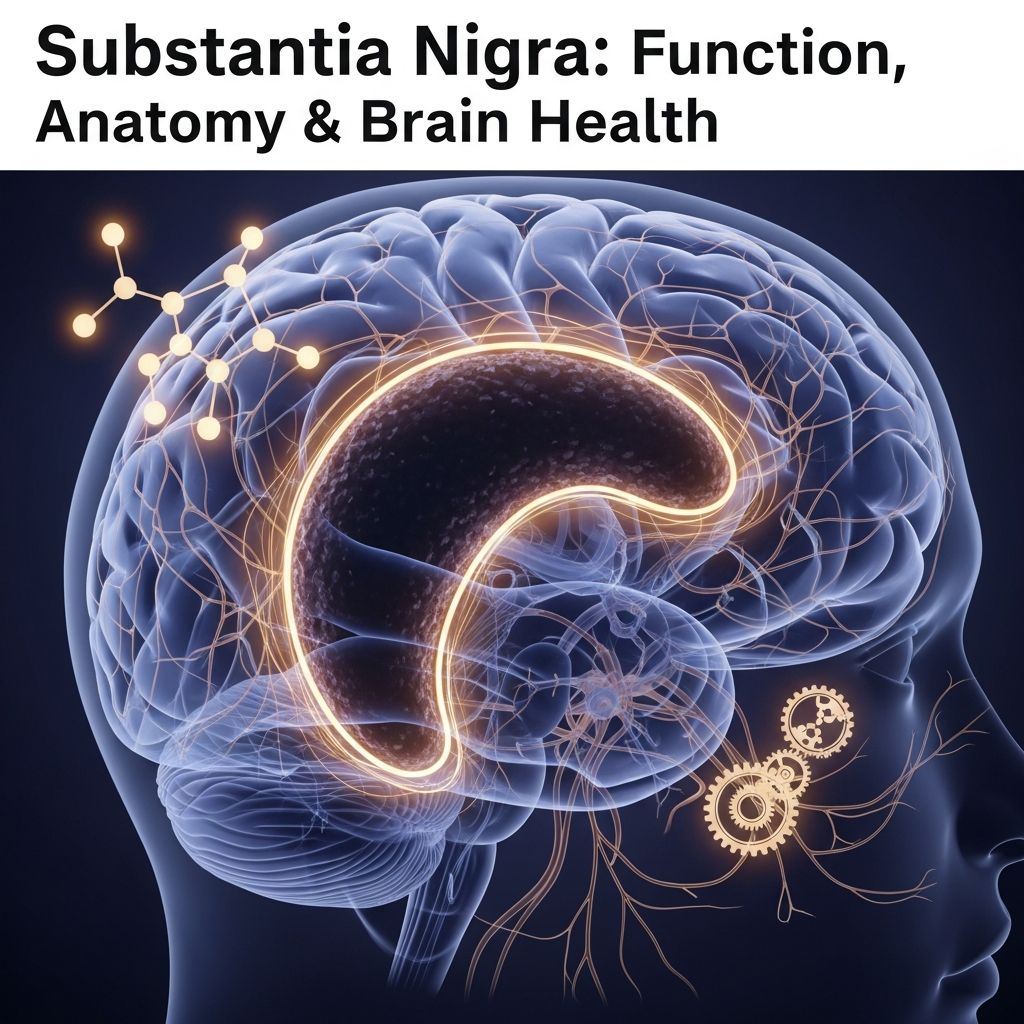
The substantia nigra is a small but extraordinarily important brain structure located in the midbrain, a region also known as the mesencephalon. Despite its diminutive size, this structure plays a vital role in your brain’s ability to control movement, regulate mood, and execute complex cognitive functions. The name “substantia nigra” comes from Latin, literally meaning “black substance,” which reflects its distinctive dark appearance when viewed in cross-sections of the brain. This dark coloration arises from the presence of neuromelanin, a pigment found in high concentrations within the dopaminergic neurons that populate this region.
The substantia nigra forms part of the basal ganglia, a collection of interconnected brain structures that work together to coordinate various functions essential to daily life. While most people have never heard of the substantia nigra, damage to this structure can have profound effects on movement, emotion, and cognition. Understanding what this brain structure does and how it functions provides insight into conditions like Parkinson’s disease and other movement disorders.
Anatomy of the Substantia Nigra
The substantia nigra is a paired structure, meaning humans have two of them, one on each side of the brainstem. Located in the anterior midbrain, it sits posterior to the crus cerebri and marks the transition point between the tegmentum and the cerebral peduncles. The substantia nigra is the largest nucleus in the midbrain and is distinguished by its prominent position within the basal ganglia network.
Two Distinct Subdivisions
Although the substantia nigra appears as a continuous structure in brain imaging, anatomical and functional studies have revealed that it actually consists of two distinct parts, each with different connections and functions:
Pars Compacta (SNpc): This is the larger, dorsomedial portion of the substantia nigra. The pars compacta appears particularly dark due to its exceptionally high intracellular neuromelanin content, which serves as a precursor in dopamine synthesis. This region is densely packed with dopaminergic neurons—cells specialized in producing and releasing dopamine. The pars compacta receives afferent projections (incoming signals) mainly from the pedunculopontine nucleus and the ascending reticular activating system. In turn, it sends dopaminergic projections to the striatum through the nigrostriatal pathway, specifically to the putamen and caudate nuclei. Due to these strategic connections, the pars compacta is considered a critical component of the basal ganglia pathways.
Pars Reticulata (SNpr): The pars reticulata is the ventrolateral portion of the substantia nigra, located along its outer edge. This region has a reddish appearance compared to the pars compacta, due to increased iron content rather than neuromelanin. Unlike the dopamine-producing pars compacta, the pars reticulata is composed primarily of GABAergic neurons, which produce gamma-aminobutyric acid (GABA), an inhibitory neurotransmitter. The pars reticulata receives afferent fibers from the striatum and subthalamic nucleus and sends efferent projections mainly to the motor thalamus. This structure serves as an important processing center within the basal ganglia, helping filter and modulate motor signals.
Some anatomists identify a third region called the pars lateralis, though it is typically classified as part of the pars reticulata.
Related Stories



Functions of the Substantia Nigra
The substantia nigra performs multiple critical functions that affect nearly every aspect of daily functioning. Its primary role centers on movement control, but its influence extends to mood regulation, learning, decision-making, and reward processing.
Motor Control and Movement
The most prominent and well-understood function of the substantia nigra, particularly the pars compacta, is motor control. The pars compacta produces dopamine and releases it to the striatum via the nigrostriatal pathway. This dopaminergic input to the striatum is intimately linked with the striatum’s function in executing voluntary movements. Motor movement is controlled through the basal ganglia via two pathways: a direct pathway and an indirect inhibitory pathway. Both pathways are significantly influenced by dopamine released from the pars compacta.
When the pars compacta sends excitatory input to the striatum via the D1 pathway, it activates the striatum and causes the release of GABA onto the globus pallidus, which inhibits the globus pallidus’s normal inhibitory effects on the thalamic nucleus. This complex cascade of neural signaling ultimately enables smooth, coordinated voluntary movement. Interestingly, direct electrical stimulation of the substantia nigra does not produce movement on its own; the striatum must mediate the influence of the substantia nigra on movement, demonstrating the interconnected nature of brain circuitry.
Cognitive Executive Functions
Beyond motor control, the substantia nigra plays an important role in cognitive executive functions. These include planning, decision-making, working memory, and attention. Dopamine released by the substantia nigra influences prefrontal cortex activity, areas critical for executive functioning. This connection explains why damage to the substantia nigra often results in cognitive deficits alongside movement problems.
Emotional and Mood Regulation
The substantia nigra contributes to emotional processing and mood regulation through its dopaminergic projections to various brain structures involved in emotional control. Dopamine affects limbic system activity, which governs emotional responses. Dysfunction of the substantia nigra has been implicated in mood disorders, and many antidepressant and antipsychotic medications target dopaminergic pathways involving the substantia nigra.
Reward Processing and Learning
The substantia nigra participates in the brain’s reward system circuitry. Dopamine released by substantia nigra neurons is crucial for reward-seeking behavior, learning, and motivation. The substantia nigra receives signals about rewarding stimuli and helps reinforce behaviors associated with positive outcomes. This function is essential for learning from experience and maintaining motivation for adaptive behaviors.
Vision and Eye Movement
The substantia nigra also plays a role in eye movement control and visual processing. Through its connections with the superior colliculus and other visual motor centers, the substantia nigra helps coordinate eye movements necessary for tracking objects and visual exploration of the environment.
Connection to the Basal Ganglia
The substantia nigra functions as a central hub within the basal ganglia, a system of interconnected brain structures that regulate motor control, habit formation, motivation, and various cognitive functions. The basal ganglia include the striatum (composed of the caudate nucleus and putamen), the globus pallidus, the subthalamic nucleus, and the substantia nigra itself.
The substantia nigra is unique among basal ganglia structures because it is the primary source of dopamine within this system. Dopamine serves as the chemical messenger that modulates basal ganglia circuitry, essentially adjusting the volume and quality of signals passing through the basal ganglia. When dopamine levels are sufficient, the basal ganglia operate smoothly, facilitating coordinated movement and appropriate behavioral responses. When dopamine production decreases, the basal ganglia become less efficient, leading to movement difficulties and other problems.
What Happens When the Substantia Nigra Is Damaged?
Damage to or degeneration of the substantia nigra can result in significant neurological consequences. The most prominent condition associated with substantia nigra dysfunction is Parkinson’s disease, a progressive neurological disorder characterized by the loss of dopaminergic neurons in the pars compacta.
Parkinson’s Disease
Parkinson’s disease develops when dopamine-producing neurons in the substantia nigra pars compacta progressively degenerate and die. This neurodegeneration leads to a deficiency of dopamine in the striatum and throughout the basal ganglia circuitry. The loss of dopaminergic signaling results in the cardinal symptoms of Parkinson’s disease, including tremor at rest, rigidity (stiffness), bradykinesia (slowness of movement), and postural instability. Beyond motor symptoms, Parkinson’s disease often includes cognitive changes, mood disturbances, and autonomic nervous system dysfunction, reflecting the widespread influence of the substantia nigra throughout the brain.
Other Conditions
While Parkinson’s disease is the most well-known condition associated with substantia nigra dysfunction, other neurological and psychiatric conditions may involve abnormalities in this structure. These include addiction disorders, schizophrenia, depression, and attention-deficit/hyperactivity disorder (ADHD), all of which involve disruptions in dopaminergic signaling.
Frequently Asked Questions
Q: Where exactly is the substantia nigra located in the brain?
A: The substantia nigra is located in the midbrain, a region of the brainstem. It sits in the anterior midbrain, posterior to the crus cerebri fibers of the cerebral peduncle. Humans have two substantiae nigrae, one on each side of the midline.
Q: Why is the substantia nigra called the “black substance”?
A: The substantia nigra appears dark when viewed in cross-sections of brain tissue because the pars compacta contains exceptionally high levels of neuromelanin, a dark pigment found in dopamine-producing neurons. This distinctive dark appearance is where the name “substantia nigra” (Latin for “black substance”) originates.
Q: What is the relationship between the substantia nigra and dopamine?
A: The substantia nigra, particularly the pars compacta, is one of the major sources of dopamine in the brain. Dopamine-producing neurons in this region synthesize and release dopamine into the striatum and other brain areas. Dopamine plays crucial roles in movement, motivation, reward, and mood regulation.
Q: How does the substantia nigra control movement?
A: The substantia nigra controls movement indirectly through the basal ganglia circuitry. The pars compacta releases dopamine to the striatum, which processes motor signals and determines whether movements should be initiated or inhibited. Dopamine modulates the direct and indirect pathways through the basal ganglia to enable coordinated voluntary movement.
Q: What is the difference between the pars compacta and pars reticulata?
A: The pars compacta is the dorsomedial portion containing dopamine-producing neurons, and it projects to the striatum to facilitate movement. The pars reticulata is the ventrolateral portion containing GABAergic (inhibitory) neurons, and it projects to the thalamus to modulate motor output. They have distinct anatomical connections and functional roles within the basal ganglia.
Q: Can the substantia nigra be affected by conditions other than Parkinson’s disease?
A: Yes, the substantia nigra can be affected in various neurological and psychiatric conditions beyond Parkinson’s disease, including addiction, depression, schizophrenia, and ADHD. Any condition affecting dopaminergic function or the structure of the basal ganglia can potentially involve the substantia nigra.
Q: How do researchers study the substantia nigra?
A: Researchers use multiple techniques to study the substantia nigra, including brain imaging (MRI, fMRI, PET scans), histological examination of brain tissue, electrophysiology to record neuronal activity, neurochemical analysis to measure dopamine levels, and animal models of neurological disease. These approaches help researchers understand normal substantia nigra function and how it becomes disrupted in disease.
The Future of Substantia Nigra Research
As technology and medical research continue to advance, our understanding of the substantia nigra becomes increasingly sophisticated. Researchers are developing new imaging techniques to visualize dopamine production and neuronal health, exploring genetic factors that influence substantia nigra vulnerability to disease, and investigating novel therapeutic approaches to slow or halt neurodegeneration. These efforts may eventually lead to breakthrough treatments for Parkinson’s disease and other conditions involving substantia nigra dysfunction, potentially restoring quality of life for millions of people affected by these disorders.
References
- Substantia nigra: Anatomy, structure and function — Kenhub. 2024. https://www.kenhub.com/en/library/anatomy/substantia-nigra-en
- Substantia nigra — Wikipedia. 2024. https://en.wikipedia.org/wiki/Substantia_nigra
- Substantia Nigra: What to Know — WebMD. 2024. https://www.webmd.com/brain/substantia-nigra-what-to-know
- Substantia Nigra — Physiopedia. 2024. https://www.physio-pedia.com/Substantia_Nigra
- Basal Ganglia (Section 3, Chapter 4) Neuroscience Online — University of Texas Health Science Center. 2024. https://nba.uth.tmc.edu/neuroscience/m/s3/chapter04.html
Similar Articles








Read full bio of Sneha Tete