Subungual Haemorrhage: Expert Guide To Diagnosis & Treatment
Explore causes, symptoms, diagnosis, and management of subungual haemorrhage, a common nail bed injury from trauma.
Author: Reviewed by Dr. Amanda Oakley, Dermatologist, Hamilton, New Zealand. Revised: 15 January 2026.
Subungual haemorrhage, also known as subungual hematoma, is a common condition where blood collects beneath the fingernail or toenail following trauma to the nail unit. This accumulation creates pressure on the sensitive nail bed, often resulting in significant pain and visible discoloration. While most cases resolve spontaneously without intervention, prompt recognition and appropriate management are crucial to prevent complications such as infection or permanent nail deformity.
The nail unit comprises the nail plate, nail matrix, nail bed, and surrounding soft tissues including the nail folds and hyponychium. Trauma disrupts the rich vascular supply beneath the nail, leading to bleeding that is confined by the rigid nail plate. This article provides a comprehensive overview of subungual haemorrhage, drawing from clinical guidelines and evidence-based practices.
What is subungual haemorrhage?
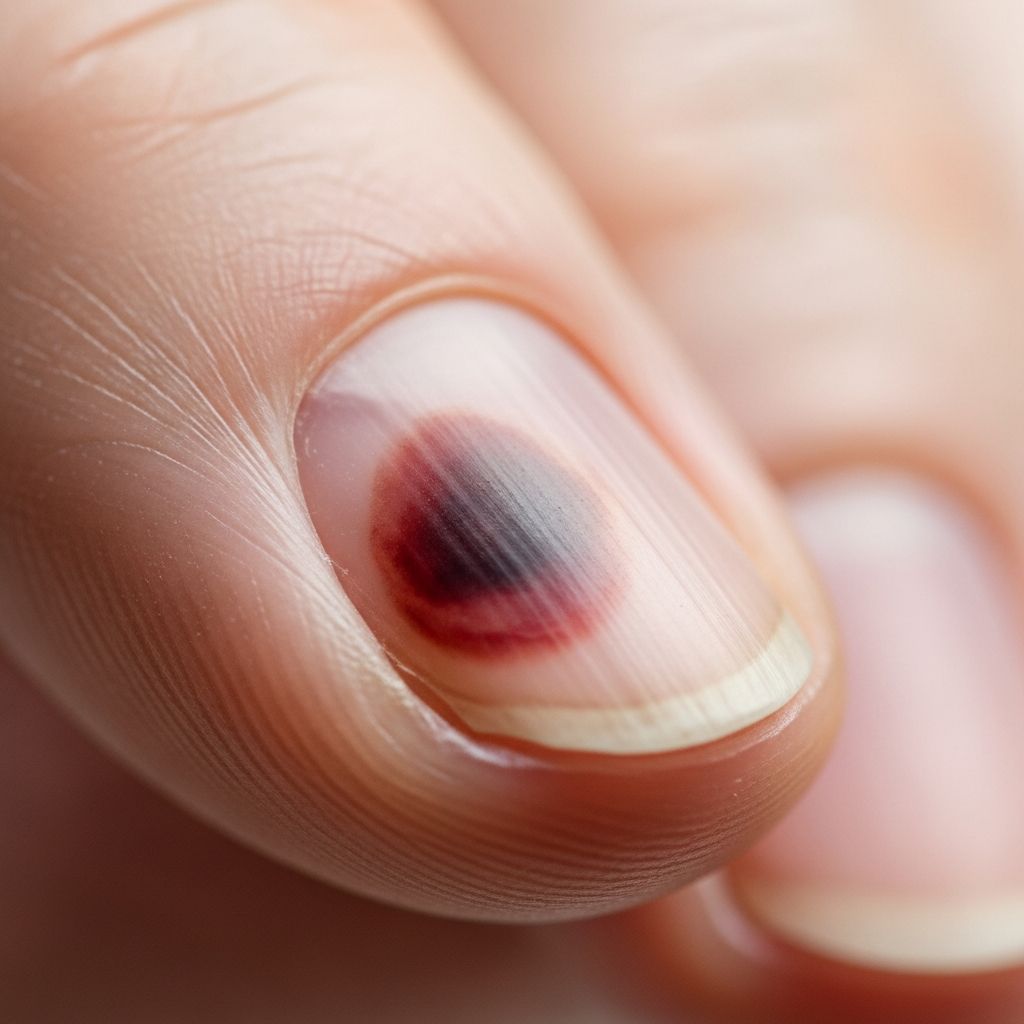
Subungual haemorrhage refers to bleeding beneath the nail plate due to rupture of blood vessels in the nail bed or matrix. It typically presents as a longitudinal or irregular red to black streak or patch under the nail, which may expand over time as blood spreads. The condition is analogous to a bruise but confined to the enclosed space of the nail unit, amplifying pain due to pressure buildup.
In acute cases, the haemorrhage follows blunt trauma such as crushing the digit in a door or dropping a heavy object on the toe. The blood pools rapidly, causing the nail to appear dark red, maroon, purple, or black. Surrounding tissues may show swelling, erythema, and tenderness shortly after injury.
Who gets subungual haemorrhage?
Subungual haemorrhage affects individuals of all ages but is more common in active children, manual workers, and athletes involved in contact sports like soccer, rugby, or martial arts. Repetitive minor trauma, such as from running or tight footwear, can also precipitate recurrent episodes, particularly in toenails.
Those with occupations involving hand tools, machinery, or frequent hammering are at higher risk for fingernail involvement. Podiatric trauma is prevalent in runners or those with ill-fitting shoes. Rarely, underlying conditions like coagulopathies or anticoagulant use may exacerbate bleeding.
What causes subungual haemorrhage?
The primary cause is acute trauma to the nail unit, including:
- Crushing injuries (e.g., slamming finger in door, hammer strike).
- Blunt force from sports or accidents (e.g., stubbing toe).
- Repetitive microtrauma (e.g., jogging, cycling with clipless pedals).
- Nail avulsion or fracture where the plate detaches partially.
Rare causes include spontaneous bleeding from nail matrix tumours such as squamous cell carcinoma, melanoma, or glomus tumours. These malignant lesions may mimic trauma with recurrent, non-resolving pigmentation. Vascular anomalies or infections can occasionally present similarly.
What are the clinical features of subungual haemorrhage?
Patients typically report an inciting injury followed by immediate, intense throbbing pain due to pressure from trapped blood. The pain is disproportionate to visible external injury and may persist until pressure is relieved.
Related Stories



Nail appearance:
- Longitudinal or blotchy red-black discoloration under the nail plate.
- May involve partial or entire nail surface.
- Proximal extension suggests matrix involvement, risking permanent deformity.
Associated signs:
- Tenderness and swelling of the digit tip.
- Erythema around nail folds.
- Onycholysis (nail plate detachment) or nail plate fracture in severe cases.
- Thickened hyponychium with dried blood.
Pain usually subsides within days as blood reabsorbs, but the discoloration migrates distally with nail growth over 4 6 months.
How is subungual haemorrhage diagnosed?
Diagnosis is primarily clinical, based on history of trauma and characteristic appearance. Key differentials include:
| Condition | Key Features | Differentiating Test |
|---|---|---|
| Longitudinal melanonychia | Uniform brown-black stripe; Hutchinson sign (periungual spread) | Dermoscopy; biopsy if persistent |
| Subungual exostosis | Painful bony growth; no trauma history | X-ray |
| Onychomycosis | Diffuse yellowing, crumbling; hyperkeratosis | KOH microscopy, culture |
| Glomus tumour | Intense localized pain; red-blue nodule | MRI; biopsy |
| Melanoma | Asymmetric, irregular borders; rapid growth | Biopsy essential |
Investigations include:
- X-ray: To exclude distal phalanx fracture (common in 20 650% of cases).
- Dermoscopy: Reveals homogenous clotting vs. irregular pigmentation of melanoma.
- Point-of-care ultrasound: Assesses hematoma size and nail bed integrity.
When to refer: Deformity, >50% nail involvement, fracture, infection signs, or no trauma history.
What is the treatment for subungual haemorrhage?
Most subungual haemorrhages (>80%) require no specific treatment and resolve as blood reabsorbs with nail growth.
Conservative management:
- Rest, ice, elevation (RICE protocol).
- Analgesics (paracetamol, ibuprofen).
- Protect nail with bandage; avoid pressure.
Indications for drainage (trephination): Pulsatile pain, >25 650% nail involvement, within 48 hours of injury.
Trephination involves creating a hole in the nail plate to drain blood, relieving pressure. Methods include:
- Electrocautery/paperclip: Heated tip sterilizes and coagulates.
- 18 621G needle: Twist to bore hole.
- Laser or punch biopsy tool: Precise for larger hematomas.
Post-procedure: Bandage, elevate 12 624 hours; antibiotics if open wound. Splinting for fractures.
Surgical nail avulsion reserved for associated lacerations or matrix damage.
What is the outcome for subungual haemorrhage?
Excellent prognosis with full resolution in 4 6 months as new nail grows (fingernails faster than toenails). Complications rare but include:
- Nail dystrophy or splitting (10 620% if matrix involved).
- Infection (paronychia, osteomyelitis if untreated).
- Chronic pain or deformity.
Trephination yields outcomes comparable to observation, with lower infection risk than nail removal. Recurrent cases warrant footwear/shoe assessment or tumour evaluation.
Frequently Asked Questions
Q: Does subungual haemorrhage always need draining?
A: No, only if painful and large (>25% nail). Small ones resolve naturally.
Q: Can I drain it myself?
A: Strongly discouraged; risks infection and nail damage. Seek professional care.
Q: How long until the nail looks normal?
A: 4 66 months for fingernails, 12 618 months for toenails.
Q: When should I see a doctor?
A: Severe pain, deformity, infection signs, or no trauma history.
Q: Is it a sign of cancer?
A: Rarely; single traumatic episode unlikely, but persistent/recurrent needs biopsy.
References
- Subungual Hematoma (Bleeding Under Nail): Causes and Treatments — WebMD. 2024-01-01. https://www.webmd.com/skin-problems-and-treatments/bleeding-under-nail
- Subungual Hematoma – Treatment — Emergency Care BC. 2023-05-15. https://emergencycarebc.ca/clinical_resource/clinical-summary/subungual-hematoma-treatment/
- Subungual Hematoma Drainage – StatPearls — NCBI Bookshelf, NIH. 2024-10-20. https://www.ncbi.nlm.nih.gov/books/NBK482508/
- Subungual haemorrhage – DermNet — DermNet NZ. 2024-01-15. https://dermnetnz.org/topics/subungual-haemorrhage
- Subungual Hematoma (Blood Under Nail): Causes, Treatment — GoodRx. 2024-08-10. https://www.goodrx.com/conditions/musculoskeletal/subungual-hematoma
Similar Articles








Read full bio of Sneha Tete