Subungual Melanoma Pathology: Comprehensive Guide For 2025
Detailed histopathological analysis of subungual melanoma, including clinical features, diagnostic challenges, and management strategies for optimal patient outcomes.
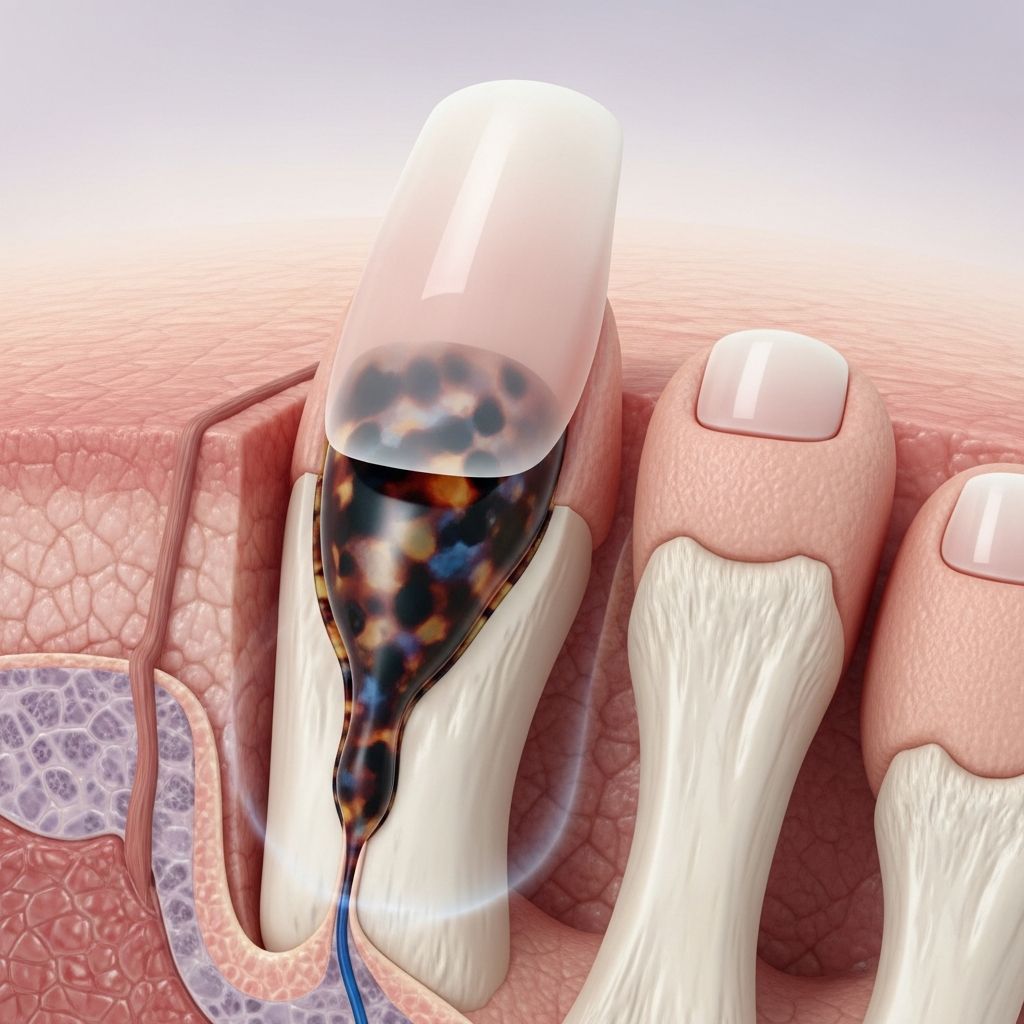
Subungual melanoma is a rare and aggressive subtype of melanoma originating from melanocytes in the nail matrix, nail bed, or nail fold, classified primarily as acral lentiginous melanoma (ALM). It accounts for 1 3% of melanomas in lighter-skinned populations but is more prevalent in darker skin types, often leading to delayed diagnosis due to misattribution of pigmentation to benign causes. Early detection is critical as it significantly impacts prognosis, with advanced lesions showing poor outcomes comparable to other invasive melanomas.
Introduction
Subungual melanoma arises in the nail unit, encompassing the nail plate, matrix, bed, and periungual skin. It predominantly manifests as
longitudinal melanonychia
, a pigmented streak on the nail plate, which can progress to nail dystrophy, ulceration, andHutchinson’s sign
(periungual pigmentation). Unlike sun-exposed melanomas, subungual variants are unrelated to UV exposure and occur equally across skin types, with higher incidence on thumbs and great toes. Pathologically, it features atypical melanocytes proliferating along the dermoepidermal junction, often with spindled or epithelioid morphology.Clinical features
Clinically, subungual melanoma presents with a broad, irregular pigmented band (>3 mm wide) in longitudinal melanonychia, blurred borders, and color variegation (brown, black, gray hues). Advanced cases show nail plate destruction, fissuring, ulceration, and elevation by a subungual nodule. Hutchinson’s sign indicates invasion into the proximal nail fold, raising malignancy suspicion. In darker skin, it may mimic benign trauma or hematoma. Dermoscopy reveals irregular pigmentation patterns, peripheral notches, and leukonychia, aiding early identification. Serial photography tracks changes, as benign hematomas migrate distally with nail growth.
- **Early stage**: Narrow, uniform melanonychia with regular borders and parallel tracks.
- **Suspicious features**: Widening band, irregular pigmentation, Hutchinson’s sign, nail dystrophy.
- **Advanced**: Ulceration, nodularity, bleeding, pain.
Epidemiology
Subungual melanoma represents 15 20% of melanomas in people of African, Asian, or Indigenous descent, versus 1 2% in Caucasians. Peak incidence is in individuals over 60, with no gender predilection, though males may present at later stages. The thumb (15 29%) and hallux (great toe, 48 75%) are most affected, linked to higher trauma exposure. Prognosis correlates with Breslow thickness; lesions >2 mm have 5-year survival rates of 20 50%, emphasizing early biopsy.
Pathology
Microscopic (histologic) description
Histologically, subungual melanoma displays poorly circumscribed proliferation of atypical melanocytes along the basal layer of the epithelium in the nail matrix and bed. Early lesions show single-cell or nested pagetoid spread with minimal dermal invasion. Characteristic features include:
- Elongated rete ridges with acanthosis and hyperpigmentation.
- Atypical melanocytes: enlarged nuclei, prominent nucleoli, spindled/epithelioid cytology.
- Invasive growth: vertical extension into dermis, lymphatic invasion, ulceration.
- Advanced: dermal nodules, mitotic figures (>1/mm B2), necrosis.
In the nail bed, epithelium is thin, accentuating subtle changes; matrix shows prominent keratinization. ALM subtype predominates (70 90%), with nodular (10%) or desmoplastic variants rarer. Breslow depth measurement is crucial, often requiring immunohistochemistry for accurate invasion assessment.
Subtypes
- **Acral lentiginous melanoma (ALM)**: Most common; lentiginous proliferation with spindle cells, minimal junctional nesting.
- **Nodular melanoma**: Vertical growth from onset, aggressive.
- **Desmoplastic**: S100+ spindled cells in fibrotic stroma, neurotropism.
- **Superficial spreading**: Less common, pagetoid spread.
Related Stories



Histopathology images
Typical low-power view reveals irregular melanocytic hyperplasia confined to epithelium in early in situ disease, transitioning to invasive dermal nests. High-power shows pleomorphic melanocytes with abundant cytoplasm, invading collagen. Nail plate fragments may artifactually distort sections. (Descriptions based on standard histologic atlases; images depict irregular basal melanocytosis, dermal invasion, and mitotic activity.)
Differential diagnosis
Differentiating subungual melanoma from benign mimics is challenging. Key differentials include:
| Lesion | Features | Dermoscopy | Histology |
|---|---|---|---|
| Longitudinal melanonychia (benign) | Narrow (<3mm), uniform, stable | Regular parallel tracks | Increased dendritic melanocytes, no atypia |
| Subungual hematoma | Homogeneous, distal migration | Red-black, follows nail growth | Hemorrhage, no melanocytes |
| Nevi | Stable, symmetric | Regular globules | Nested melanocytes, symmetry |
| Onychomycosis | Proximal white/yellow | Dermatophytes | Fungal elements |
| Lichen planus | Nail dystrophy, no pigment | Irregular | Band-like infiltrate |
Melanoma shows irregularity, atypia, and invasion absent in benign lesions.
Immunohistochemistry
Immunostains confirm melanocytic origin and assess invasion:
- S100: Diffusely positive in ALM, highlights spindled cells.
- HMB-45 (gp100): Positive in subungual melanoma, stronger in superficial components; gradient loss in deeper invasion.
- Melan-A (MART-1): Sensitive for nested and spindled melanocytes, delineates margins.
- Ki-67: Proliferation index >5 10% indicates malignancy.
- PRAME: Often positive in melanoma, negative in nevi.
Desmoplastic variants: S100+/SOX10+, HMB-45-/Melan-A- . Negative stains rule out non-melanocytic lesions.
Management
Diagnosis mandates biopsy: punch, shave, or excisional of pigmented matrix/bed by specialists to avoid dystrophy. Formal open biopsy preferred for adequacy. Treatment: wide local excision (1 cm margins) or digit amputation for invasive disease (>1mm or ulceration). Sentinel lymph node biopsy for staging if Breslow >0.8mm. Adjuvant immunotherapy (PD-1 inhibitors) for high-risk features. Mohs surgery for in situ lesions preserves digit. Prognosis: 5-year survival 80 90% for in situ, drops to 20 50% for thick tumors.
Frequently asked questions
What causes longitudinal melanonychia?
Commonly benign (nevi, drugs, ethnicity); suspicious if irregular, widening, or with dystrophy.
Is Hutchinson’s sign always melanoma?
No, but highly suggestive (90% specificity); biopsy essential.
How is subungual melanoma biopsied?
By experienced clinicians via open nail avulsion and bed biopsy to ensure adequacy.
What is the prognosis?
Depends on depth; early detection yields >90% survival.
Can it be treated without amputation?
Yes, for thin/in situ lesions via excision; amputation for advanced.
References
- Pigmented lesions of the nail bed 6 Clinical assessment and biopsy 6 Royal Australian College of General Practitioners. 2016-11-01. https://www.racgp.org.au/afp/2016/november/pigmented-lesions-of-the-nail-bed-clinical-assessm
- Melanoma pathology 6 DermNet NZ. 2023-05-15. https://dermnetnz.org/topics/melanoma-pathology
- Malignant Melanoma 6 StatPearls, NCBI Bookshelf. 2024-07-20. https://www.ncbi.nlm.nih.gov/books/NBK470409/
- Melanoma of the nail unit 6 DermNet NZ. 2024-02-10. https://dermnetnz.org/topics/melanoma-of-the-nail-unit
- Melanoma Comprehensive Guide 6 Skintel. 2023-11-05. https://skintel.co.nz/articles/melanoma/
Similar Articles








Read full bio of Sneha Tete